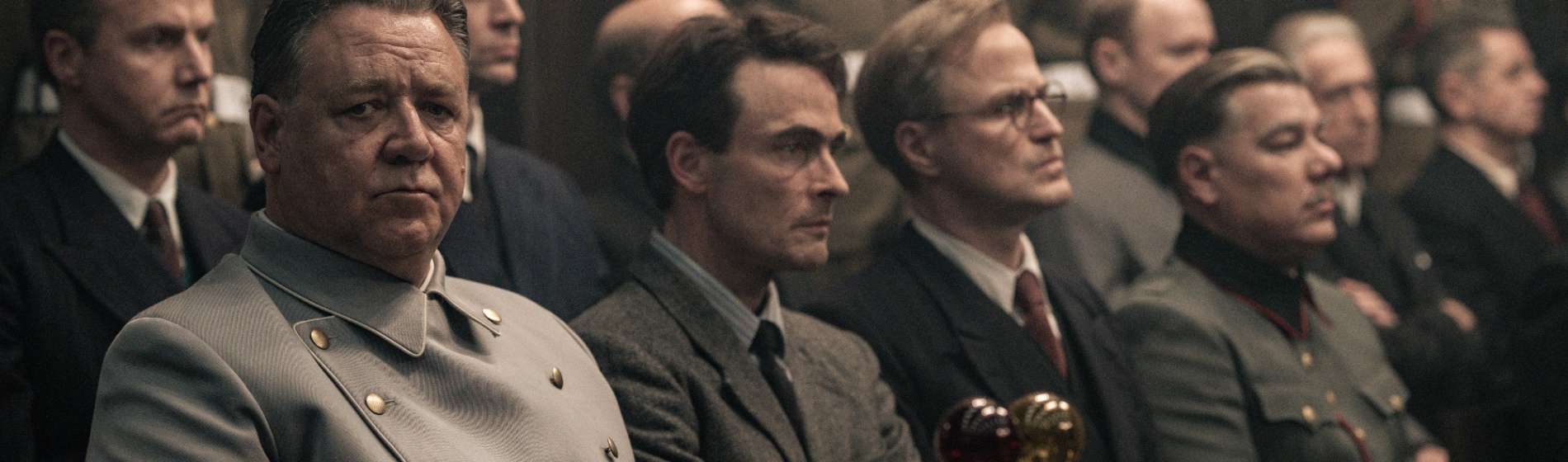



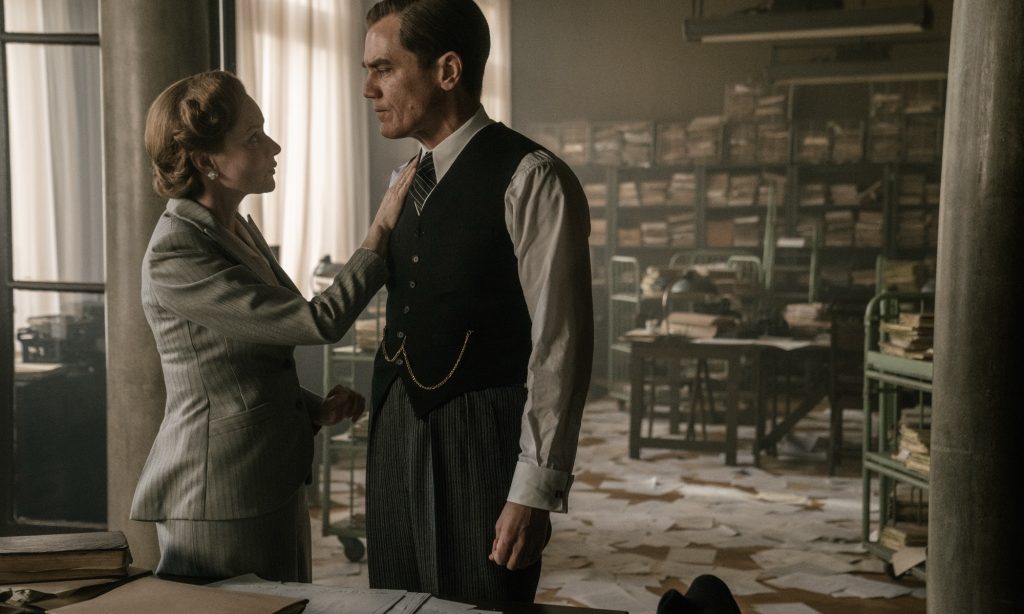
“We are able to do away with domestic tyranny only when we make all men answerable to the law, so that it can never happen again.” A noble quote from a noble man, Justice Robert H Jackson, as played by Michael Shannon in James Vanderbilt’s new World War II legal drama, Nuremberg. The trials, held in the aftermath of the war, put the leaders of the Third Reich on trial for all to see. While it’s a historical moment now, it was a dangerous gamble then. On the one hand, it gave the world an opportunity to see these Nazis for who and what they were, and on the other, it potentially gave them a platform from which to espouse their views.
Those men involved in the prosecution were walking a knife’s edge, and they knew it. Nuremberg attempts to dramatize how easily one can fall in with charismatic, evil men. The core relationship in the film is between Dr. Douglas Kelley (Rami Malek), the psychiatrist charged with assessing the competency of these men for trial, and Hermann Göring (Russell Crowe), the charismatic, narcissistic, and utterly manipulative second in command of the Nazi regime.
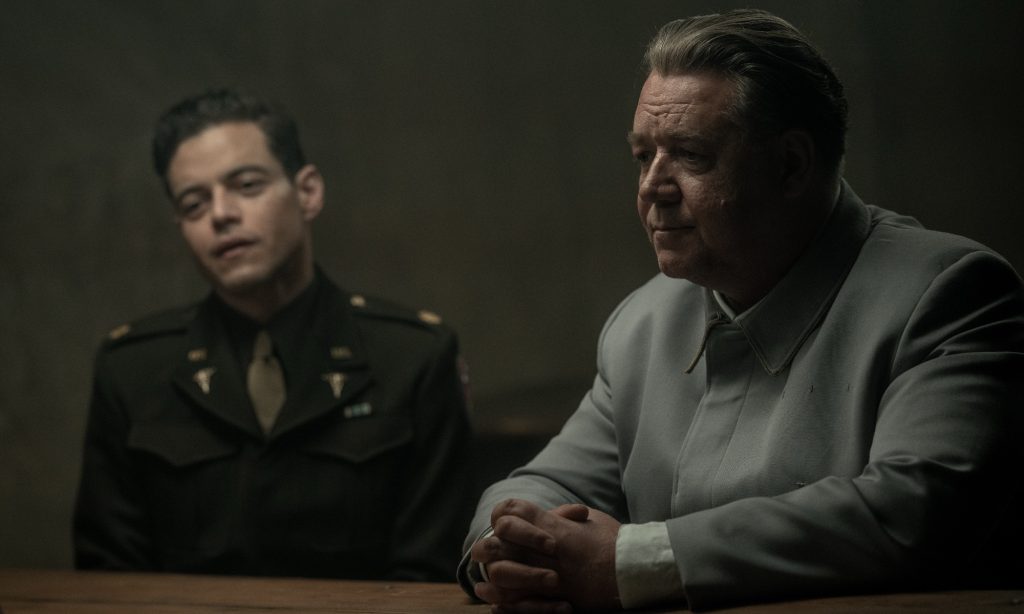
The film unfolds primarily in two parts: the first half is dedicated to conversations between Kelley and Göring, and the second to the actual trial. The film works best in the first half, with Malek nearly perfectly cast as the naive yet confident Kelley, and Crowe reminding us that he is the man for the job when you need a charismatic yet unlikable character. Their exchanges are electric, laced with layers of meaning and depth as each man tries to outwit the other.
The film suffers in the back half, though, where the focus is divided between this relationship and the trial. Crowe continues to shine—his appearance on the stand is a real highlight—but the film starts jumping around too much to cohere and devolves into a series of courtroom greatest hits. You will spend much of the trial waiting for the A Few Good Men moment that Vanderbilt’s script and direction very obviously telegraph, for example. The most recognizable trope is that of Kelley being extremely confident but ultimately falling under Göring’s spell, an internal conflict that is apparent before you even sit down in the cinema, playing out exactly as you expect it will. None of this is necessarily bad—it just hews a little too close to the established formula to be great.
There are more bright spots here, though, with Leo Woodall really giving his all to the role of Howie Triest, the translator on hand at the prison who assists Kelley, and Richard E. Grant as Sir David Maxwell-Fyfe, a British lawyer on the prosecution’s team. The former gets a moment to shine early as a young man who is perhaps more aware than Kelley, and Grant has one of the most satisfying exchanges with Crowe in the film as Maxwell-Fyfe draws the truth from an overconfident Göring.
To put it more succinctly, Nuremberg is a totally fine drama. It’s the kind of movie made by adults and for adults that some might lament no longer exists. It’s not a home run, but it’s the kind of film that would have been an absolute powerhouse in the mid-1990s. It has a cast of thousands, and everyone is at least good in their role. It covers a major historical event with enough truthfulness to avoid sensationalism and enough drama to be engaging. It perhaps doesn’t offer much that is new, but once again, with a story that is now 80 years old and one of the most famous in modern history, that familiarity is likely excusable for most of the audience.
The film concludes with Kelley attempting to warn America that men like Göring exist everywhere, in all walks of life, and are, in fact, a danger. This sequence is played as a warning, but in a better film, it would play like an indictment. That is perhaps where the film misses the mark by the widest margin. It celebrates the wins of the past, but says very little about the world we live in today, about the legacy of the trials and whether we lived up to them or not. Fine though it is, the result is that it feels like a missed opportunity.