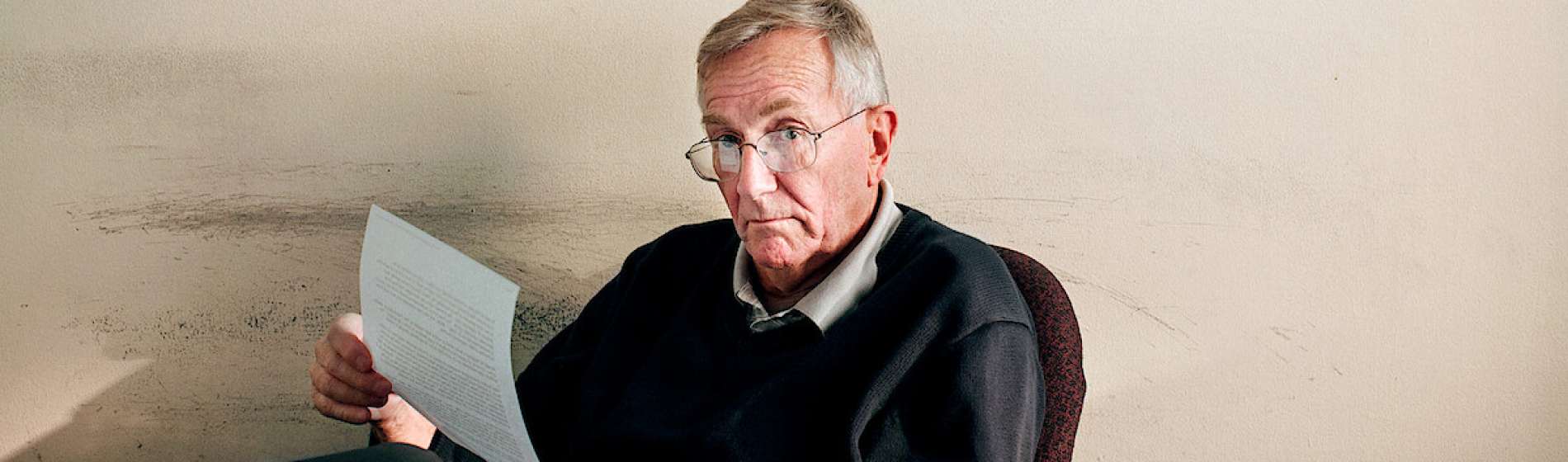



Seymour Hersh is regarded as one of the most prominent investigative journalists of the latter half of the 20th and the beginning of the 21st centuries. He has reported on everything from the Vietnam War and Watergate to the Gulf War, the Syrian Civil War, and political crises shaping the contemporary world. Despite his notoriety, fame, and many controversies, he has never been the subject of a documentary until now. He has repeatedly turned down the offer due to what some have termed ‘paranoia.’ In fact, directors Laura Poitras and Mark Obenhaus first approached the writer about making a biographical documentary of his life twenty years ago. He turned them down and, to top it off, told them never to ask again. Flash-forward two decades, and Hersh finally agreed to move forward with the project. The resulting documentary, Cover-Up, is an enthralling yet frustrating account of a singularly fascinating man.
The film opens with Hersh’s investigation into the My Lai massacre—an investigation that brought him to worldwide fame at the height of the Vietnam War. Using archival footage, photography, documents, and narration from the man himself, Cover-Up follows Hersh as he builds his story—from the initial phone call informing him of a soldier being court-martialled for the alleged killing of 75 civilians to the public fallout once the massacre gains international notoriety. This is when Cover-Up is at its strongest. When it showcases Hersh’s investigative process via his personal commentary, notes, and substantive documents, archival footage, and photography, the documentary is riveting.
After it delves into the breakthrough on the My Lai massacre, the film goes further back into Hersh’s childhood and early career, beginning what feels like a continuous loop. Cover-Up then jumps to whatever topic the writer is currently working on, then swings back to a significant story he covered decades ago, and then the cycle repeats. Each time it loops, the cinematic exploration of Hersh’s investigations feels thinner and less grounded. It feels like Hersh’s patience with the film and its crew begins to wear thin at that point, too. When the directing pair presses Hersh on why he trusts specific sources and dismisses others, he becomes wholly hostile. Then, when they ask him to confront some of his missteps, including the false information he published in his book, The Dark Side of Camelot, he threatens to walk away from the documentary altogether. His hostility may make him a fascinating subject, but it is clear that he was both challenging and exhausting to work with.
In its first 30 minutes, Cover-Up makes a deft attempt to explore Hersh’s enigmatic psyche (moods and all) and to parse his investigative process. How he handles anonymous tips, how he hunts down and confirms evidence, and how he corners the right people for interviews. But the hostility and obfuscation from the film’s subject may have meant that the documentary had to shift into a more conventional look at the man—albeit still in a non-linear fashion. And though the latter part of the film is serviceable and provides interesting insights, it never quite returns to the promise of its opening act.
While it’s easy to mourn the potential that was wasted here, Cover-Up still manages to enthral. The amount of restored archival footage, photography, and historical documents that the documentary pieces together, along with Hersh’s commentary, is incredibly impressive. And even though Hersh is not the most cooperative of subjects, when he does choose to engage with the filmmakers, he becomes a truly interesting subject—still sharp as hell at nearly ninety years old. So, while Cover-Up doesn’t paint a complete portrait of Seymour Hersh’s psyche and investigative process, it is still a fascinating look into the life of one of the most famous investigative journalists of our time.
Cover-Up begins streaming on Netflix on December 26.