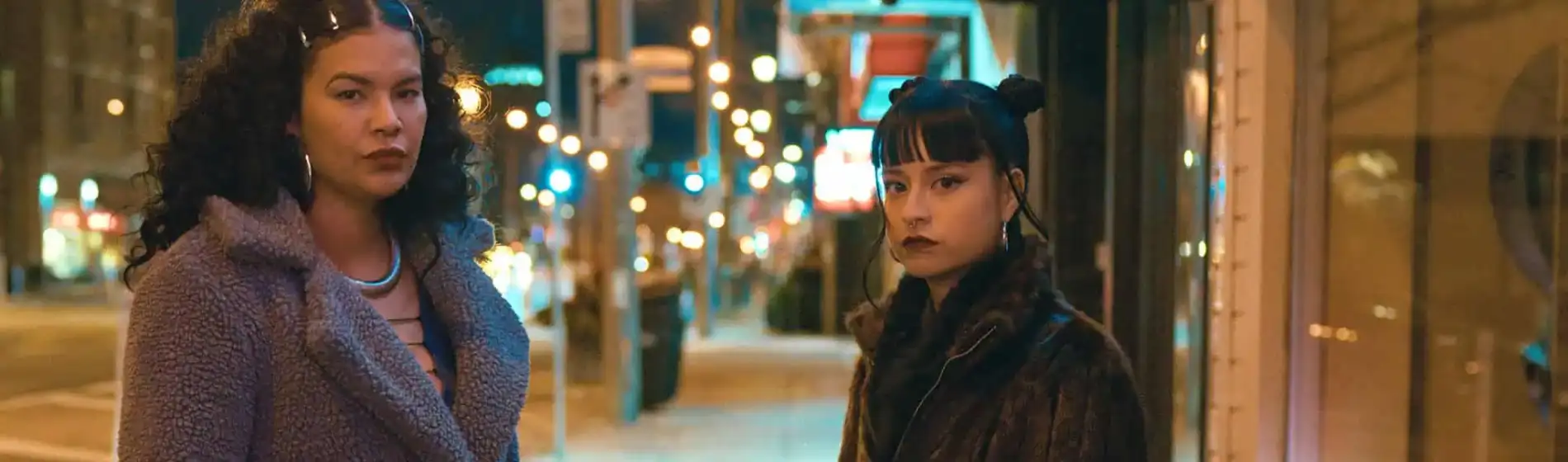



From short to feature, the journey behind director Eva Thomas’s debut solo feature Nika and Madison began with a practical plan: make a compelling proof-of-concept and use it to unlock an expanded, enhanced, big-screen vision. The filmmaker had long pictured a road-movie-inspired story, echoing the spirit of Thelma & Louise while telling something distinctly contemporary and rooted in the community. Knowing a first-time feature wouldn’t be funded on ambition alone, the short Red Lights was created to demonstrate both tone and directorial voice. That strategy worked. It opened doors, built credibility, and set the foundation for a debut solo feature that expands the world and deepens the emotional stakes.
Nika and Madison premiered to rave reviews at TIFF this past September, as part of a record number of Indigenous-led big-screen stories. Since then, it has won numerous awards and been featured at film festivals in Hawaii, New Mexico, Los Angeles, Minnesota, and beyond, resonating with both Indigenous and non-Indigenous audiences. Ahead of the film’s theatrical release this past Friday, That Shelf Managing Editor Emma Badame spoke with Thomas about Nika and Madison and how mentorship and representation played a central role in bringing the film to life.
Here’s their conversation:
Emma Badame (That Shelf – EB): Nika and Madison is based on your short film Red Lights, and I wanted to ask you about the experience of transitioning and expanding the story to a feature. What was most challenging about that process?
Eva Thomas (ET): You know, a lot of people think I made this short film and was like, “wow, this would be a great idea for a feature”. When in fact I always wanted to make it a feature. But I was very aware that I would not get millions of dollars to shoot a feature film having not really directed very much at all.
I had this idea for a feature–two Indigenous women who get in trouble with the law and go on the run–inspired by the great film Thelma and Louise. But how do people get their films made? So I looked up a few directors and saw how they got it done.
I was blessed to be associate producer on Night Raiders, directed by Danis Goulet, and she had first filmed a couple of short films and then went on to direct a feature. And I had seen that as a pattern enough times that I was like, “okay, well, I’ll just do that.” So it was always a short-to-feature project, with the idea that I would make a great short film and that would serve as a proof-of-concept of both the story and my ability to direct.
EB: You mentioned Danis Goulet there. Who did you look to as influences, or even as mentors, as you were pulling all of this all together?
ET: Great question. When I was on Night Raiders, it was the first time that I was able to be on set. All day long for multiple days. I was there for the duration of production and was really able to see Danis’s work. I remember feeling an internal something when I saw her direct, and I was like, “Oh, yeah, that. Whatever she’s doing, that’s what I want to do.” She certainly lit this fire in me, and then I had the really blessed opportunity to shadow as the assistant to director Darlene Naponse on Stellar. I was able to be in her community for the duration of the shoot watching her work. She’s a real artist. And she also had a production company and a studio on her reserve. So seeing this Indigenous woman doing it was very inspirational. And of course, shout out to Gail Maurice, because I was able to shadow her on Rosie, too. And so I was able to see 3 very talented Indigenous female directors working, and it just allowed me to see myself. If they can do it, I can do it.
EB: You mentioned multi-talented Gail Maurice. She has a fantastic role in your film here, too. What was it like actually working with her on the film, given that you’d shadowed and watched her before?
ET: I met Gail when I ran the ImagiNative Features Lab, which is a 9- or 10-month lab working with writers through from “I have an idea,” to first draft, second draft, and third draft. She was also focussing on bringing Rosie from its short version to a feature. So we expanded and worked with her on her script for the lab. Two years later, she came up to me and said, “I got the money to make my movie and I want you to be on set. What do you want to do?” So I suggested shadowing her as she directed. She’s so great. I also ran the mentorship program on Rosie, so I got to work with her in that capacity, as well. And of course on Aberdeen, which I co-directed, I got to work with her as an actor there. For Nika and Madison, when we first wrote the character of the chief, it was a man. And right before we went to casting, my sister was elected as chief for my own community.
EB: That’s amazing!
ET: Right? So I thought to myself, “I want my chief to be a female, too”. So then I decided I was going to reach out to the brilliant Gail Maurice and ask her if she would bless me and work with me again. And I’m happy to say she did.
EB: She did. And she brings so much to that character.
Speaking of casting: for a film like this, getting the two leads just right is so crucial. Not only does each actor have to carry a lot individually, but their chemistry makes or breaks the storytelling. What did Ellyn and Star bring to the table that made them click so well and made you kind of think, “yes, they are my Nika and Madison”?
ET: it’s a great little backstory. Ellyn Jade was in the short film version, Red Lights, and her co-star was Kaniehtiio Horn, who’s a really good friend of mine. And they had worked together on Letterkenny, so they were already friends. And I could really feel their friendship bleeding through the frame, which really lent an authenticity to that dynamic. And the dream was always to make both the short film and the feature with these two actresses.
But then Kaniehtiio got pregnant and had the most beautiful baby. The most beautiful baby! I had to recast her part and so we did a nationwide call for an Indigenous actress to play Madison. And then we watched all the tapes and I had my little list from that. Then I decided to call up Ellyn Jade and I said, “who are you like really good friends with? Like legit friends with who’s also an actress?” And she said, “I’m really good friends with Star Slade.” That was great, because she was at the top of my list. So they were already friends. I think Nika and Madison is the third project they’ve worked on together. And so again, I was really trying to recreate an authentic relationship that already existed, much like what I was able to be blessed with in Red Lights. It just made my job easier because they really cared about each other.
EB: Well, I was going to ask about the process of building that exceptional dynamic, but that came ready-made, in a way.
ET: Yeah, exactly.
EB: Can we talk about the music in the film? I believe they’re all Indigenous artists featured. Did you have a lot of those tracks already in mind or did you have to search to find what you wanted in the film?
ET: That’s another great story! Thank you for asking that. All the songs in the film, with the exception of one song, the song playing in the sushi restaurant, they’re all by Indigenous artists. I also had an Indigenous composer, Nigel Irwin, who helped to create both the original music and really helped look over all of the music on the film. I kind of knew music would be important because I wanted it to feel modern. I wanted it to feel like this was of our time, and the music was going to be important part of telling that story.
My executive producer Jennifer (Podemski) agreed even when we were way back in prep: “You got to start working on it now.” And I’m like, “What? Now? I was thinking I would think about that in post.” And she’s like, “No, you got to start thinking about it now.”
And so it was really Jennifer who recommended Nagamo, which is the Indigenous music publishing company that I worked with. Our Indigenous composer Nigel works for them, as well. So they recommended songs, and helped secure the licenses for them. Then Nigel created the original music, and then created folders for my editor, Jane McRae, and I to consider. It was mostly Jane, because she would pull stuff because she was editing, and I’d be like, “That sounds great.” So it is really a collective effort for the music of it all. I’m just so proud of how many Indigenous artists are featured in the film. And what was great, because at TIFF, was that many of them were able to come to the premiere!
EB: That’s amazing. What a great opportunity.
Speaking of screenings…You’ve actually taken this film all over North American, to so many different festivals. And you’ve been winning awards along the way. What’s it like going to all those different places and watching people connect with the film?
ET: It’s so nice to see the film connect with audiences in Hawaii or in New Mexico or in Vancouver or Edmonton or Sudbury. To sort of know the film works in multiple places with different kinds of audiences. We just had a screening in northern Minnesota over the weekend and it was predominantly a non-Indigenous audience and they still loved it. Loved the film. And I think that’s what I really appreciate. I always knew my community would get it. My community always sort of gets my work. But to see the non-Indigenous audiences connect to it is…it’s really nice because they’re being invited into my world. And my hope is that the film will create empathy and a bit of understanding. I just want audiences to care about these women and to root for them, so It’s been really nice to have that kind of reception.
EB: It’s great to hear that people are connecting to these two young women. But what are your favorite things about Nika and about Madison?
ET: You know, in some ways I’m a little bit Nika, and I’m a little bit Madison. I’m a little bit from the rez and I’m a little bit from the city. So I really like seeing that representation of Indigenous people in both spaces. I think that they both have a sense of humour. That I really like. They know each other so deeply, too. And I like how brave they are and how they come into their own power. Particularly Madison, as she ventures bravely into the world. That takes a certain amount of guts, and I appreciate that because I did that, too.
And I appreciate how Nika has stayed connected to her community, and is so protective of Madison, even though–at the beginning of the film–there is a bit of a rift in their relationship. Through the process and journey of the film, we see them reconnect in such a nice way.
EB: The women–and the film itself– deal with some pretty serious issues, too. Racism, police brutality, and the disproportionate incarceration of people in Indigenous communities. But you’ve managed to inject hope in the movie, too, especially with Nika and Madison’s relationship. How did you work on that, balancing that kind of light with the dark?
ET: Certainly a shout out to my co-writer Michael McGowan, who graciously agreed to work with me in crafting the narrative of the film and really helped me shape the structure of the film. When I first met with him, I sort of pitched him the story–the kind of film I wanted to make. He watched Red Lights and really mentored me both as a writer and as a director on this. I learned so much from him. Then I worked very closely with Jennifer Podemski, who’s been a mentor to me. She just kept noting and pushing me.
Even when we started production, I was still rewriting and still rewriting, because the actors had great ideas. So the story came together certainly through mentorship and guidance from people who could help me take the story to the next level. I didn’t want audiences to sit through a sad story and then leave being like, “oh man, that sucks for them.” I wanted to have an ending that felt hopeful. And I think that’s what audiences are responding to, because this story could go in a very different direction.
But I guess in a lot of ways, as a director and as an artist, you’re trying to say something about the world. And having these two women in this story with that ending was sort of my statement about the murdered and missing Indigenous women. Then there’s the red dress and the colour red throughout, with so many strong women in the story. It’s just such a great experience to be able to work with this cast and with this crew to tell this story, which I’m so happy is resonating with audiences.
EB: We already talked a little bit about the fact that it’s your first feature, but in terms of directing it solo, what did you learn in writing and directing it that maybe surprised you? I’m sure there are challenges, but there’s also probably positive lessons and learnings that come out of the experience.
ET: Certainly. I’m proud of myself for being able to have a vision, like, “I’m gonna make a short, and then I’m gonna make a feature,” I set that out as a goal, and that I was able to find the team that would allow me to take my work to the next level. When I was doing Red Lights, I knew nothing. Then I had the experience of co-directing in a safe environment where I wasn’t doing it by myself. But then to launch into, “okay, here you are, you’re leading the ship alone, you’re the one, you know, keeping the momentum going on the film.” I just really had to trust my own voice and trust my instincts and exercise that muscle as a director. I had to learn to be more comfortable in the role of leadership. Because I think the more you do it, I think you get better.
And certainly people saying that they liked my film or that they really connected to the characters helped build my confidence. So much of the role is really having that confidence to step into that role and to guide 100 people to a shared vision of something. To really recognize everyone’s talents and skills and to be able to make people feel included in the work. It is a muscle that only gets stronger by doing.
EB: Well, now that you’ve done it, you can turn around and mentor others. In fact, what kind of advice would you give to people who are starting out in filmmaking and looking to make a short film or feature? It’s such a daunting task, like you say, taking that leap and helming the ship.
ET: I think it’s important to recognize that this is not a solo sport. Filmmaking is a team effort. Find people who are coming up with you, look around you. Do you know an editor? Do you know a cinematographer? Do you know a costume designer? Do you know a writer? Build your team, build your community, because I think if you’re in this business long enough or you’re blessed enough to have more than one opportunity, you want to work with people who are talented, who are passionate. So finding people who are like-minded and have a similar commitment to the work, I think goes a long way. Learning to get along with those people and to collaborate is such an important part of the process. And hopefully that gets better as you do more of it.
EB: As we talked about, you’ve been taking the film around North America, but have you screened it internationally yet? I know you’re headed to New Zealand with it tomorrow.
ET: We had our international premiere in Hawaii at the Honolulu International Film Festival. And then we went on to Santa Fe, where we won Best Feature Film, Best Narrative Film. We hit Los Angeles with the Red Nation Film Festival. I mentioned Minnesota. We’ll be going to Tulsa and, and Lincoln next month. So it’s getting out there. But yeah, the Māoriland Film Festival in New Zealand is the farthest one away, so I’m really excited about that.
EB: I can’t imagine how good it feels to see it connect with so many people because, as you said, you thought your community would get it. But getting to people outside of that is another thing. There are unfortunately many viewers who may not be as aware of the issues like the missing and murdered Indigenous women and girls (MMIWG) and other issues affecting communities. Or it might be on their radar but it’s not something, fortunately for them, they’ve had to learn about or deal with. How do you get across the important, foundational exposition without taking away from the emotional, authentic story you’re trying to tell?
ET: My Indigenous community, like I mentioned, will get it. But it’s really my hope that my work will extend outside of that. So part of what we did in the film was introduce a character new to the area, Detective Sergeant Timmons, played by the brilliant Amanda Brugel. So you can get away with explaining it to the character and the audience at the same time. It’s a device that we use as writers and as creatives to introduce you the world you’re in. Then, with the situation that the girls find themselves in, there’s a lawyer, too. So the lawyer is going to explain some other things. And again, you can get away with telling and teaching at the same time because it feels organic to the situation at hand in the film. So in some ways it’s design, in some ways making sure that the dialog doesn’t feel too didactic or kind of exposition-y.
EB: Now that you’ve had this experience, what’s next for you?
ET: The film is released technically today, so I’m deep in the pushing or the promoting or the touring of the film. Like you mentioned, I’m going to New Zealand tomorrow, and I have a handful of festivals in April that I’ll attend. So I have a few more months with lifting the film and launching the film. Then the video-on-demand comes out promoting the film, then it broadcasts on CBC and APTN. Once i’ve finished carrying this baby across the finish line, I think I would like some time to detach, to let it go, to recoup and rejuvenate my creative energies.
So here I am, go see my film.
But I am in the process of adapting a novel, which I’m hoping will be my next project.
EB: I can only imagine, especially after doing something for this long, how difficult it also is to kind of let it go because it’s been such a huge part of your life for the last year.
ET: Exactly. It’s been absolutely amazing.
EB: I hope your trip to New Zealand is a huge success. It sounds very exciting. And thank you so much for finding time in your chaotic schedule to talk to That Shelf today.
ET: I really appreciate it. I’m so thankful for you asking great questions and for having you share and spread the word about the films. Thank you.
The above has been edited for length and clarity.
Nika and Madison hit theatres in Canada this past Friday, March 20, courtesy of Game Theory Films.