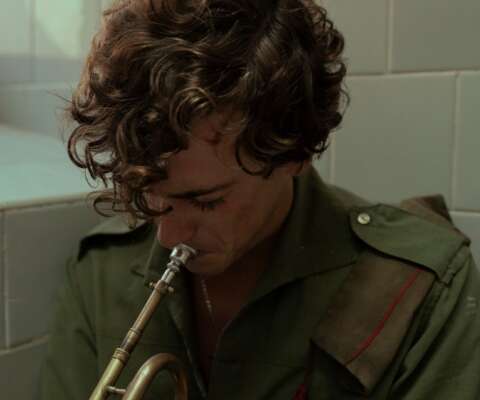
Irish writer-director John Carney has made a name for himself by delivering a slew of feel-good music-based dramedies. From musical sensation Once to the glorious 1980s-set Sing Street, Carney returns to his familiar musical ways with his latest, Power Ballad. An infectious story with an earworm of a tune running throughout, the Paul Rudd and Nick Jonas tale hits all the right notes.
What happens to former boybanders and one-hit wonders once the spotlight fades? For Rick (Paul Rudd), it means fronting a wedding band in Dublin. Once the lead singer of an American rock band, Rick fell for an Irish woman while touring and chose to settle on the Emerald Isle to build a family life. But as the music industry moved on without him, he’s spent years chasing the elusive next hit.
While performing at a wedding, Rick meets former boyband breakaway Danny (Nick Jonas). Bonding over their shared love of music, the pair launch into a whisky-soaked jam session that sparks fresh creative energy in both of them.
What begins as a friendly meeting between two faded stars soon takes a bitter turn when Danny transforms one of Rick’s songs into a global smash, reviving his solo career in the process. As Danny takes full credit for “How to Write A Song (Without You),” Rick becomes determined to track him down and reclaim what he believes is rightfully his – whether he can prove it or not.
Like most Carney films, the story leans into sentimentality. Co-written by Peter McDonald (co-writer and star of the excellent Irish comedy The Stag), who stars as Rick’s best friend and bandmate Sandy, the film’s strongest moments come from the shared scenes between Rudd and Jonas. Though the two characters are at vastly different stages of their lives and careers, they forge a believable connection, capturing the kind of fleeting but meaningful friendship that music can uniquely inspire. As Rick dreams of returning to sold-out crowds, Danny’s betrayal – and the stadium tour that follows – steals what Rick sees as his long-awaited comeback. Their relationship needs to feel genuine and emotionally charged for Rick’s devastation and ensuing trauma to fully land, and the film succeeds in establishing that early on.
But after spending so much time carefully building that bond, the film’s remaining runtime moves at a frantic pace, rapidly introducing new characters and plot developments. Several of the larger set pieces feel less like organic extensions of the story and more like screenwriting shortcuts, pulling the film away from the emotional core that initially made Power Ballad so compelling.
Once he realizes Danny doesn’t credit him on his hit, Rick’s actions feel human and real. He reacts the way a middle-aged man mourning a rockstar life that never materialized would – he’s desperate, depressed, and a little manic. That emotional honesty makes his next decision all the more jarring: an impulsive trip to Los Angeles with Sandy to crash Danny’s concert and confront him. The shift in geography and tone feels abrupt, pulling the story into a more chaotic register that doesn’t quite align with what has come before. Instead of deepening Rick’s emotional arc, it reads like a detour engineered to escalate the stakes rather than to evolve the character, and the film loses its earlier sense of intimacy and focus. In L.A., Danny’s American music manager, Jack Reynor, feels over-the-top and out of place among the more grounded characters in the film.
Still, Carney and McDonald have a lot to say here about authorship and who art, in particular music, is really made for. While Rick may have written the song about a specific moment in his life, Danny’s performance and the listeners’ response reshape it into something new. The film ultimately lingers on whether a song belongs to its creator, its performer, or the people who give it meaning.
The whole of Power Ballad hinges on “How to Write A Song (Without You)” actually being a good song. Written by Carney and Gary Clark, it’s a pretty, polished ballad with a sincere, soaring chorus that you could easily imagine being a nostalgia-hued Top 40 hit for a band like Matchbox Twenty or Snow Patrol. Essentially, it sounds like something a middle-aged man with a popular early-2000s rock band might release in 2026, not a No. 1 hit for a 20-something solo artist.
Despite the few misses in pace and plot, Power Ballad is still full of charm. Rudd, Jonas, and the supporting cast, which also includes Marcella Plunkett, Havana Rose Liu, and Beth Fallon, truly give the story some sparkle on screen.
While it may not reach the soaring heights or rewatchability of Sing Street, Once, or even Begin Again, it is a pleasant watch that exists alongside his last effort, Flora and Son. It may not rank among his most unforgettable works, but it’s still a warm and worthwhile effort.
Power Ballad arrives in select theatres on May 29, before expanding to more cinemas on June 4.