

In his brilliantly idiosyncratic debut, Pig, writer-director Michael Sarnoski simultaneously gave Nicolas Cage one of the best roles of his career, satisfyingly subverted revenge-thriller tropes, and explored masculinity’s inherent contradictions with depth, sincerity, and profundity rarely seen in American cinema. In his follow-up, A Quiet Place: Day One, Sarnoski upended expectations for prequels to established franchises, delivering a provocative, ruminative take on death and dying amid an apocalyptic alien invasion. Both films succeeded on thematic, dramatic, and ultimately aesthetic levels, making whatever his next work a must-see for film fans.
It’s far from surprising, then, that Sarnoski’s latest film, The Death of Robin Hood, deconstructs the myths and legends surrounding the title character, stripping the familiar rebel outlaw of his outsized heroism, chivalry, and nobility. Freely adapting Robin Hood’s Death, an anonymous 17th-century ballad, “Robin Hood” (Hugh Jackman) is anything but heroic, chivalrous, or noble. He’s a bloodthirsty, amoral villain, a killer with a decades-long trail of broken bodies, not just men, but also women and children, attached to an already mythologized reputation.
Contrary to Robin Hood’s representation in popular culture, Sarnoski’s Robin Hood didn’t steal from the wealthy to give to the poor, but stole from anyone, rich or not, who crossed his unfortunate path. Along with his so-called “merry men,” he rarely, if ever, showed mercy towards those he victimized for their possessions, often killing indiscriminately. Now, far closer to the end of his life, this Robin Hood lives in self-exile. He first appears onscreen in silhouette, covered in furs, stoking a campfire, preparing a skinned animal for his next meal alone.
That unwanted company arrives first through a young, starving woman, Wainwright (Jade Croot, Rabbit Trap). She carries a hidden agenda that Robin almost immediately uncovers. Later, the unexpected arrival of his onetime partner-in-crime, Little John (a nearly unrecognizable Bill Skarsgård, Nosferatu). Relying on Robin’s misplaced, misguided sense of loyalty to the companion he raised as a surrogate father, Little John calls on Robin to help him . He wants to reclaim the land, along with a woman, Margaret (Katie Breen) and her daughter, Little Margaret (Faith Delaney), that he usurped from another man. Not surprisingly, the dead man’s surviving family has retaken the land and forcibly expelled Little John. Mistakenly, they’ve allowed him to survive.
The attack on the farm by Robin and Little John, followed by a counter-attack only hours later, results in one of the most brutal, visceral, gruesome outpourings of onscreen violence outside of horror movies since Robert Eggers’ The Northman several years ago. It’s also a make-or-break sequence for moviegoers on the other side of the screen, taking The Death of Robin Hood from predictably grim and dark to bleak and borderline nihilistic. Arrows fly through the air, piercing skulls and eyes, body parts sliced by knives and swords, and in a stomach-turning punctuation mark to the sequence, a flaming torch violently ends an already dying man’s life.
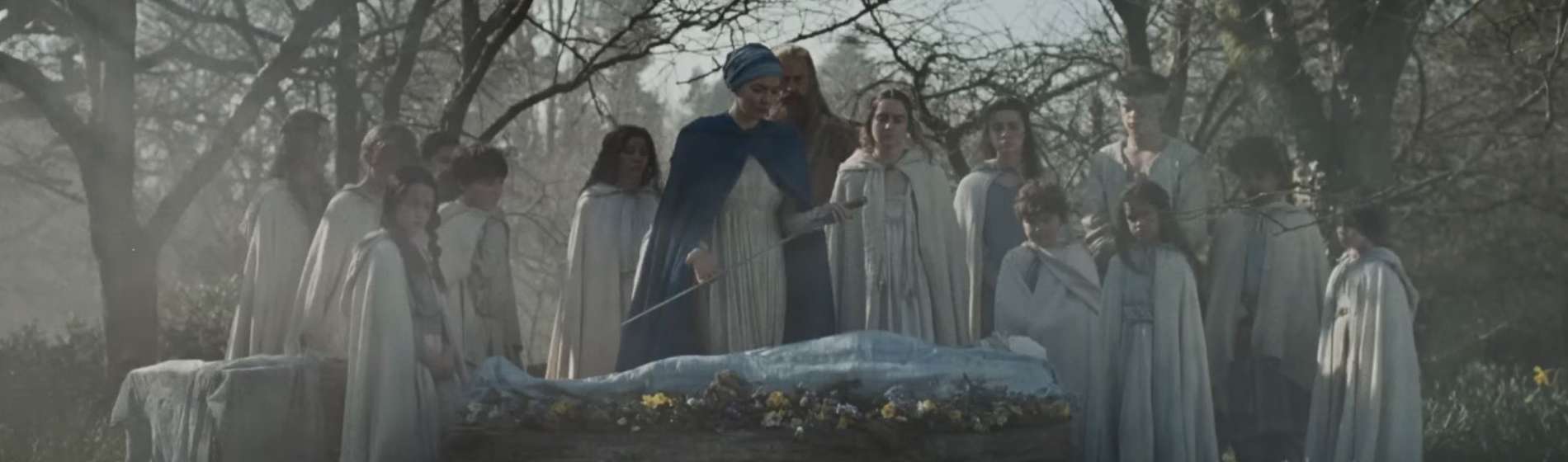
That level of graphic, realistic violence, both by and on Robin, raises The Death of Robin Hood’s central question involving the possibility of redemption. Sarnoski eventually offers an answer (a qualified maybe), but audiences are just as likely to disagree. No grace, no mercy, no empathy should be shown to this particular Robin. Sarnoski, however, offers the character a bit of grace through an island sanctuary and the prioress, Sister Brigid (Jodie Comer), who oversees it with an unselfish generosity.
Left at the island sanctuary to heal from near-fatal wounds by Little John and later joined by Little Margaret, Robin begins a leisurely, sometimes meandering journey towards redemption and/or death. Key to that journey, Robin must confront Arthur (Noah Jupe), another sanctuary seeker bent on a vendetta/blood feud to avenge his relatives.
Elevated by Pat Scola’s stunningly tactile cinematography, the film’s foreboding, mist-filled Northern Ireland locations stand in for 13th-century England. Meanwhile, an expressive, nuanced performance by Jackman as the world-weary killer seeking peace is complemented by Comer’s layered, morally conflicted prioress, and, among others, Murray Bartlett’s turn as an island-dwelling leper and de facto spiritual guide. The actors and artisans collectively offset the film’s abrupt tonal shift and occasional narrative stumbles as The Death of Robin Hood reconfirms Sarnoski as a filmmaker carving out a welcome auteurist niche.