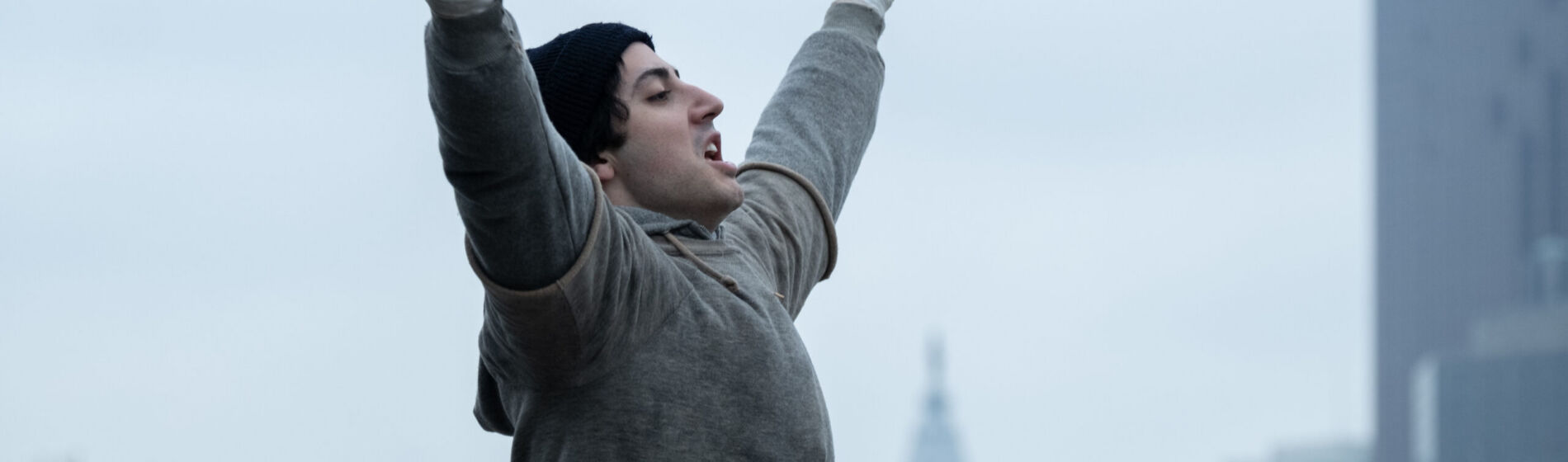


While highly regarded as one of the greatest sports movies of all time, Rocky wasn’t exactly the smoothest film to make. With a low budget, a tight schedule, and the studio constantly trying to boot Sylvester Stallone out of the title role, bringing it to the big screen was an uphill battle. Peter Farrelly’s upcoming flick, I Play Rocky, tells the true story of how Stallone overcame these obstacles to make the 1976 Best Picture Oscar winner.
That Shelf’s Shawn Peer sat down with Farrelly (Dumb and Dumber, Green Book ) during the 2026 Toronto International Film Festival to discuss the making of the film, the true story behind Sylvester Stallone’s Rocky journey, and the challenges of bringing that timeless story to the big screen.
Shawn Peer: What were some of the interesting insights you learned about the actual making of Rocky as you started peeling back the layers?
Peter Farrelly: I was 17 when Rocky came out, and I loved it. And I knew the stories about how he was down and out. I even knew that he’d done softcore porn, and that kind of stuff, but the stuff I didn’t know, like the relationship with the father. When we talked to Stallone after he read the script, he goes, “My dad comes across pretty good here; he was way worse.” I was afraid he was gonna say we can’t do that, but he was the opposite.
There’s also the steady cam. That was the first time they used a steady cam. Garrett Brown invented it. And by the way, the steady cam in the movie is the first steady cam. We got it from Garrett Brown. And he was on set that day. And in the movie, we had the woman running up the stairs. That was the real tape he’d done back then. That’s from 1974. That was his wife, running up the stairs of the Philadelphia Museum of Art, and that’s the only reason they put it in the movie.
It’s one thing after another. I knew there was a battle for Stallone to get cast, but once he was in it, I thought it’d be smooth sailing. But no, they were trying to sabotage him, or at least it appears that way, to replace him. He was in the hospital four times during the making of the movie.
SP: There were stories that Stallone was averse to it at the beginning. Did you bring him around?
PF: The first thing I said when I heard about this movie was that I’m not doing it unless Stallone signs off. And then we gave the script, we met with them, and I said, I’m not doing it unless you want us to do it. He goes, “I love it. Let’s do it.”
And then we had a debate about whether he should be an executive producer. And I said I don’t think he should. I think it hurts him, because if the movie ends, then you see “Executive Producer – Sylvester Stallone”, people are going to think that’s why it comes across so great. But he had nothing to do with it. A week later, he’s doing an interview, and someone goes, “What do you think about this Rocky movie?” He says, “I know nothing about it.” The guy reports that we’re making a movie and never talked to him. We called him and asked him what he was doing. He said, “You said to separate.”
SP: It’s a very difficult film to talk about without talking about Anthony Ippolito, and I would love to know a little bit about how you found him and how that casting came to be.
PF: We had a great script by Peter Campbell. It’s an amazing script, but everybody was asking where we were going to find Stallone. And we were gonna do a worldwide search, and my casting agent, Rick Montgomery, called me one morning and said he got Stallone. Some kid sent him a tape in the mail. He tracked down the script and then shot three scenes in his grandmother’s basement. I was emotional watching him and knew he was the guy. We never looked past him; we never looked at anybody else.
SP: I noticed in the credits that Griffin Dunne gets a special thanks. And I think he’s truly one of the most under-appreciated talents in the industry. What were his contributions to the movie that earned him that special thanks?
PF: He called me out of the blue and said he knows the perfect Paulie. So we called him up, and he came in and was just the perfect Paulie. We are grateful, because it’s hard finding those people. Mickey and Adrian, and getting people that look like Apollo Creed, and that’s how it all came together. And that’s why we thanked him.
SP: One thing that really impressed me is the score for this film, which I think evokes that same optimistic spirit but is also very much its own thing. So I just wanted you to speak a little bit about the score and how you came to separate it from the original, but still make it feel like it was capturing the same spirit.
PF: Putting music in is my favourite part of making a movie. You see it without the music, and it’s not the same movie. And the whole time I was filming this, for some reason, I was listening to Andrew Bird. I love Andrew Bird, and I was listening to him the whole time, and I started feeling that energy, so I called and asked him to do the score. He doesn’t like doing scores, but he gave us a bunch of new music that’s not out yet. So I got my usual composer, Dave Palmer, to come in and take pieces of his and Andrew’s stuff and merge them. So, it’s a team effort; they both got credit. When we first played it, I got a little pushback from a couple of people, just like when they played the Rocky score. They thought it seemed a little sad. But Sylvester’s down; he’s doing pornos. You know, he’s homeless; he’s selling his dog. It should be a little sad. I’m so glad that he allowed us to use his music.
I also spoke with Stallone about music. I asked him if he remembers what he was listening to at that part in your life. He said early Hall and Oates and Buffalo Springfield, amongst other things. So when he’s writing the script, we have Rock & Roll Woman by Buffalo Springfield playing.
SP: It’s been 50 years since the original Rocky and 20 years since Rocky Balboa. Why do you think now is the right time to bring audiences I Play Rocky and learn the origins of the movie?
PF: Rocky is the all-time greatest inspirational movie. It makes you want to believe you can do anything after you see this movie. And this movie has the same feeling. Stallone’s life mirrors Rocky, but it is better than Rocky, and here’s why: Rocky, at the beginning, has a job. He’s breaking bones.
Stallone is homeless; he’s doing pornography, and he sells his dog. In the end, Rocky doesn’t win. Rocky survived. Stallone wins. Rocky won Best Picture. And the best thing about it? Rocky is not true. This is a true story. And I think people need this right now. They need inspiration. These are rough times. Everybody is doing everything for money, and it’s not about money. It’s about Sylvester holding out and saying, “No, I’m not doing it. You can give me 1 million. Give me 10 million.” That’s not the point. I love when his dad says, “Money, you know, act, you know, money’s real. Acting’s not, you know?” And it is real. What’s in your heart is more important than the money. And I just think it’s a great time for another inspirational movie to come out.
SP: Rocky has one of the greatest opening shots of all time, and you do feature it in the movie. The opening shot of your film has a lot of parallels to it; you have “Jesus Saves” and the Marquis of the Triple X. Can you talk about how you decided to open the film because it’s such a monumental thing to live up to?
PF: Making a movie is a team effort, you know; you can’t do it all. I talk to my DP, Sean Porter, and my 1st AD, JB Rogers. We discussed what we wanted to start with. I looked at the movie, and they started with Jesus. But it’s a team effort. I didn’t cast this movie. Rick Montgomery cast. He brought me Anthony [Ippolito]; he brought me AnnaSophia Robb, Tracy Letts and P.J. [Byrne]. And my DP, he comes up with how it is going to look. He gets the palette, and he figures it out. And when Stallone walks out of his apartment the next morning, when he’s about to drink the eggs, we go by Jesus too. It is funny how I hadn’t noticed it until we were examining the movie, and it starts on Jesus.
SP: There’s a pivotal moment in the film where they talk about the potential of cutting the scene in the ice rink. Obviously, that ends up making the film in real life because he had so much rich history to play with here. Is there a shot that you filmed that, for whatever reason, didn’t make it?
FP: We had the scene where he was drinking the eggs in the apartment. And there was the boxing at the end. But when you put it together, there’s a flow. We’d already done the eggs on the sidewalk; we’d already seen it. We had a bunch of Apollo Creed auditions. We had six guys trying out for Apollo Creed before Stephan James came in. They were all goofy, not right, or trying too hard. It was fun, but it got old. We also had Talia Shire come in and audition. We had a whole thing there, but there’s just a feeling at some point that we’re labouring this. It’s a 2-hour movie, and I didn’t want to turn into 2 hours and 15 minutes.
SP: What was that moment in your career where everything just clicked for you and fell into place?
PF: Well, it’s never been a moment. My brother and I were out there for 9 years writing scripts and selling them, and finally, we got one made. Tenderfoots. We were never on the set. Nobody ever asked us anything. We never heard anything, and then they showed us the movie when they were done, and it was a piece of shit. I didn’t want my name on that. My agent thought I was kidding, but I’d rather die without a credit than have one credit, and it be that. So we pulled our name. But I learned that I have to direct my own work.
Also, the thing I learned from my agent, Richard Lovett, is to stop telling people you’re trying to make a movie. Tell them you’re making a movie. If they think you need them to make a movie, it’s not going to happen. If you say you’re making a movie, they don’t want to miss the boat.
SP: You have a background in creating comedic films, but I just wanted to ask you a little bit about balancing comedy and drama in I Play Rocky. Did that come naturally to you, or was it difficult to find that balance?
PF: I don’t sit around thinking I’m going to make something funny. I see an opportunity, like when Sylvester and Sasha were in that car in the rain. Originally, that was their car. But then I realized we’ve never set up that they have a car. And they might not have a car, and I thought, what if she just got in a car? I remember when I mentioned it, everyone thought it was kind of dumb. But when you’re coming off a very serious moment, that’s the best time to have a joke, because nobody sees it coming. You just see an opportunity and take it.
When we made Green Book, I told everybody I just made my first drama.
We did a screening, and my friends came out and said, “It’s not a drama; it’s the funniest thing I’ve ever written.” I wouldn’t call it a drama; it just came naturally. It’s the actors’ delivery. You just let the actors find their way. And, again, that’s what making a movie is all about. Everybody is doing something and pulling their weight. And the actors did, too.
I Play Rocky hits theatres on November 13, courtesy of Elevation Pictures.
This interview has been edited for length and clarity.