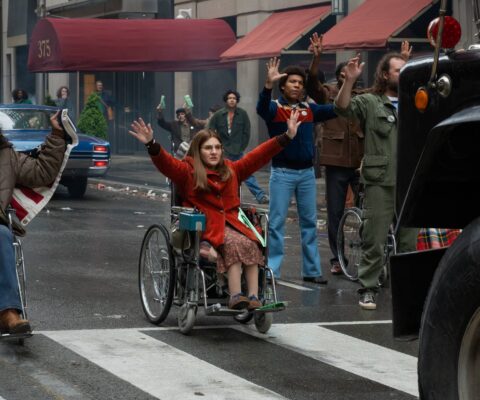


Following up her Oscar-winning film CODA, director Siân Heder turns her camera on Judith Heumann and her uncompromising fight for disability rights in the U.S. during the 1970s. Featuring a breakout performance by British TV star Ruth Madeley, Being Heumann is a feel-good activism movie with a strong heart. It makes for an entertaining watch, despite playing it safe.
Based on the late Heumann’s 2020 memoir, viewers are introduced to the activist in 1972 and her tireless efforts to pressure the government to implement Section 504 of the Rehabilitation Act of 1973. Five years later, Heumann led a 26-day sit-in at a San Francisco government office to pressure new U.S. Secretary of Health, Education and Welfare Joseph A. Califano Jr. (Mark Ruffalo) to sign the regulations enforcing the law, which would prohibit discrimination against people with disabilities in programs receiving federal funding, including public education and federal employment. Califano had refused to sign off on the regulations, citing the high costs of implementing such measures. Orchestrated by Heumann, the peaceful sit-in brought together disability rights activists and allies from gay action groups and the Black Panthers, and localized rallies across the U.S. Local San Francisco TV reporter Evan White (Dylan O’Brien), who goes from begrudgingly covering the demonstration to becoming embedded in the protest, helped bring the activists’ fight to a wider audience.
A runner-up for the People’s Choice Award at the Toronto International Film Festival, Being Heumann does a good job of showing how being patient and polite won’t get advocates for change very far when they’re facing off against the government machine. However, this drama shouldn’t be lumped into the category of movies about people with disabilities being an inspiration to others. Instead, it is correctly about what it means to demand rights and accommodations, despite the uphill battle and indifference. Heumann rejected the notion that disability was a tragedy, and Heder’s film views the story the same way, much as she did in CODA.
However, for a movie all about breaking down barriers and being bold, Being Heumann plays it pretty safe. It’s a by-the-book biopic that, at times, feels like a bunch of motivational slogans cobbled together and misses the mark on capturing Judy Heumann’s spunk and spark. We get glimpses of it through Madeley’s performance and by telling the story from Heumann’s point of view, but ultimately, the script lacks true oomph. Though she’s dubbed a “radical crip,” it doesn’t feel like it, and it still succumbs to the same clichés as other “message movies.” Namely, one disability group isn’t interchangeable with another, and every person has their own accommodation needs. Deaf people don’t want to be lumped in with wheelchair users, whose rights and needs differ from those of blind people, and so on. Here, interpersonal conflicts among the protesters feel more like co-writers Heder and Rebekah Taussig checking off boxes as they work through the story.
Despite the more rote aspects and niceties of the story, it’s hard to dunk on a movie with such strong performances. Being Heumann is Madeley’s time to shine, and she does so with aplomb as the complex Heumann. Already a star in the UK, the movie is likely North American audiences’ first introduction to the actress— and it’s a good one. She’s the central force behind change in the story, and Madeley’s take on Judy makes it believable. The story dips into cliché territory as it reminds us that people with disabilities have sexual desires, a sense of humour and can be, well, assholes, which Judy rightfully owns up to. By all accounts, Heumann was bluntly honest and forthright, and the film successfully captures her spirit. Being Heumann illustrates the internal conflicts among the protesters over how best to approach the fight, setting up an opposing dynamic between the blunt Heumann and the sweeter approach of wheelchair advocate Kitty Cone’s (Madeline Delp). The supporting cast, which includes actors with various disabilities, all work together as part of a strong ensemble.
With such strong performers in the cast of protesters, it’s a shame that Ruffalo’s Califano Jr. is relegated to exasperated huffing and puffing as he brushes off signing the regulations. He’s not painted as a villain, but rather as an obstacle standing in the way of civil rights; his character isn’t developed much beyond that.
Being Heumann is a heartwarming, feel-good movie about advocacy and the hard-won progress that paved the way for liberties we take for granted in 2026. While there is still plenty of work to be done when it comes to the rights and accommodations of people with disabilities, Heder’s movie makes a compelling case for the power of collective action and the importance of refusing to accept less than equal treatment. It may not have quite the fire of its subject, but it leaves no doubt that the fight for accessibility and equality is far from over.