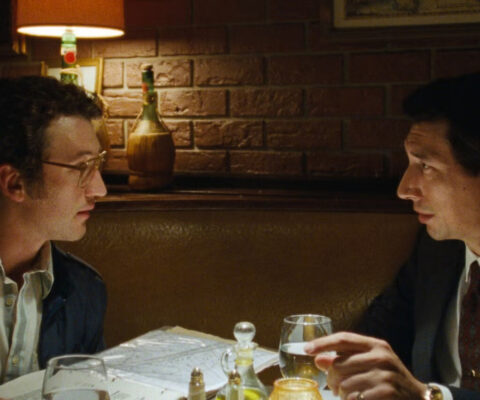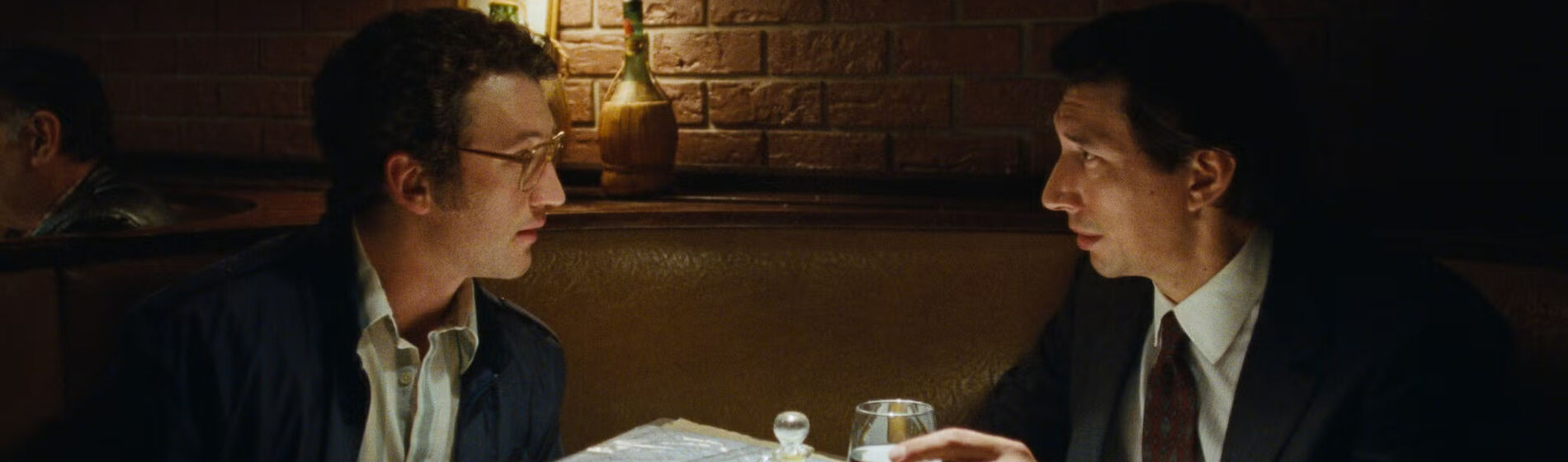



Paper Tiger is set in Queens circa 1986. It continues the trend of deeply personal, autobiographical filmmaking for writer/director James Gray.
In a recent interview, Gray disavowed his filmography from his time at the Weinstein Company (The Yards and We Own the Night). Despite his understandable misgivings, those films are propulsive, exciting crime thrillers, though he felt he never had full creative control over any film until he made Two Lovers. Paper Tiger feels spiritually tied to those earlier films, so it must feel like a bit of a course correction for Gray. An opportunity to set the past right. A theme that binds Adam Driver’s and Miles Teller’s characters, too.
Fathers drive most of the conflict in the director’s past films: Ad Astra, The Lost City of Z, We Own the Night. But here, Gary (Driver) and Irwin (Teller) reckon with the consequences of decisions they’ve made. Philosophically, it’s Gray’s personal evolution. When the choices of your elders doom you, it feels like fate. Blameless but inevitable. But the gut punch hits harder when you know your children will suffer for your own decisions. Gray positions Gary and Irwin as Cain and Abel, using the brothers’ clashes to push Paper Tiger’s tense plot.
Upward mobility in the United States is built on opportunity and the juice to pull levers when necessary. Gary, an entrepreneur and ex-cop, has the juice. Irwin, an engineer and father of two, does not. Gary offers his brother an opportunity to make it big. An investment that will propel them into upper-class homes and have them glad-handing with important people. Irwin can’t resist looking like a big man, so when he takes sons Scott (Gavin Goudey) and Benjamin (Roman Engel) to Brooklyn to see the Russians work on the canal, he hopes his boys will see him in the same light as successful Uncle Gary. But Irwin’s son sees something he shouldn’t have, and now the whole family is in danger as the Russian mob moves in on a Mafia neighbourhood with ruthless efficiency. One wonders what they’d do to people who can’t protect themselves.
Gray has tackled crime and family in earlier films, but Paper Tiger thrives at both elements where earlier entries did not. Other protagonists have known fear and violence firsthand. But Irwin has only experienced a comfortable existence. Even Gary’s time on the force didn’t scar him. These men don’t know hardship, not really. Gary is a blowhard, no question, but for all his performative braggadocio, he loves his brother’s family. Which makes it a question of how far he will go to undo the wrongs he’s caused.
Love fosters affection, but also expectations, and disappointment. No one carries those grudges harder than family. Hester’s (Scarlett Johansson) presence is a monument to unmet expectations. She set her ambition aside years ago, after having two children right after marrying Irwin. After risking their livelihoods to make a few more bucks, Irwin counts on Hester to comfort him for his mistakes. A request that’s one bridge too far. In another, lesser film, the three leads would have bombastic arguments punctuated with long-held secrets flung at each other. Gray wisely lets the anguish and tension sit silently. The resulting resentments drive Gary, Irwin, and Hester to act out in ways they never anticipated.
Driver gets the showier part, but Teller really wows you with his performance. One scene features a camera push on Teller’s face that amplifies his paranoia. He stops looking like a family man and starts resembling an animal caught in a trap. The second half pointedly features little dialogue, but you know precisely what Teller’s thinking. I hope the Academy takes note come awards season. Driver’s demeanour shifts between cool and vulnerable, letting on how much of Gary’s identity is performative. The easy confidence that makes him loved wherever he goes dissipates when he meets a man who wields real power (Victor Ptak).
Two sequences set Paper Tiger apart. One, the initial break-in at Irwin’s home. And two, the tall grass sequence. Saying anything further about either scene would break the spell they cast. But either moment easily rivals the car chase in We Own the Night—a fraught experience that lingered well past the credits. There’s nothing more terrifying than rousing out of sleep to hear “someone might be downstairs.” Composer Christopher Spelman wisely knows when to drop the music and ratchet up the tension with cues. The home invasion sequence is the mark of someone who knows how frightening quiet can be.
Gray brings back cinematographer Joaquín Baca-Asay (We Own the Night and Two Lovers), who shot Paper Tiger on dreamy 35mm, echoing the 70s films that inspired the director. Gray loves crafting an image that speaks to the film’s themes. The Gowanus Canal, the site of the cleanup Gary and Irwin invest in, is a visual shorthand for what happens when inattention and corruption seep in. His trademark blocking and framing are also present. Several shots in the film would make fine prints.
Violence waits around every corner, and it’s hard to ignore that the feeling will follow the brothers forever. This is a stark contrast to the film’s intro, where Irwin, Hester, Scott, and Benjamin enjoy a serene moment at the public pool. Fate and hubris haven’t felt this intertwined since The Counselor. While Paper Tiger may feel like well-trod ground for fans of Gray’s filmography, this is his most assured effort. A film with the same locales and ties between family and crime as his other films, but made with a steadier, more mature hand. A director in control of considerable talent.