

AKI, the new documentary from Darlene Naponse ( Falls Around Her , Stellar ), captures slices of life within the Anishinaabe community and the glorious Northern Ontario nature that surrounds them. The Anishinaabemowin word aki means “earth” or “land” but it also stands more broadly for “that which is sacred.”
It’s the perfect title for Naponse’s documentary. The Anishinaabe director captures the harmony of people and plant life through wordless scenes of humans and nature co-existing in Atikameksheng Anishnawbek (formerly Whitefish Lake).
Unlike most slices of life portraits, AKI shows its audience experiences with which they might be unfamiliar. A woman skinning a fluffy white rabbit for the night’s dinner; people collecting birch sap from homemade taps. These are commonplace to the people of the Atikameksheng Anishnawbek First Nation, but settler viewers may find themselves walking through unknown territory with piqued curiosity.
There’s no trace of traditional documentary structure in AKI . Instead, the story emerges solely through captured footage taken with creative cinematography and editing – split screens, drifting aerial shots, underwater takes, macro lenses, time-lapses, etc. There is no verbal exposition save a handful of words spoken in Anishinaabemowin. There are four ‘acts’ with each one focusing on a season of the year, which is made clear by title cards giving the Anishinaabe words for summer, fall, winter, and spring.
The film’s experimental nature may ward off viewers who prefer more expository documentary conventions. Viewers who are open to less conventional practices will enjoy the calming and comforting experience with meandering landscapes and quiet microcosms. As such, AKI leads its audience through a visual journey that grounds them to the natural world – a place that is frequently forgotten, and often unreachable in today’s fast-moving, technology-obsessed environments.
The smaller beings in life that go unnoticed have a spotlight here. A mossy brook that babbles. An ant who looks for his next meal. Water drops that fall from little leaflets. These moments are tranquil and restorative. There are also lively scenes that abound with action. Water splashes ferociously through a turbulent river. Ice cracks as a lake thaws after biboon (winter). A silhouette of an animal can be seen trudging through the snow amidst a storm. The quiet, slower scenes transition abruptly to ones that are fast and full in a back-and-forth conversation between contrasting elements of the land. In short: Everything is alive, and everything has its story.
The score works beautifully with each scene, reflecting the underlying emotions and creating some new ones too. In some moments, the instrumentation is peaceful, made so by a cello played by Juno-nominated cellist Cris Derksen, which vibrates with deep, resonant notes.
In more discomforting settings, the strings are played in a forlorn minor key, and in cinematic shots, the instruments swell boldly. The most eccentric and creative musical decisions involve modern sounds like synths. They help viewers to see the liveliness where it seems hidden, shich as in shifting light in a dark forest that resembles a night club, or simple summer blooms turn into a flora party thanks to some catchy rhythms.
The Atikameksheng Anishnawbek region is beautiful and teeming with life, and AKI embodies it. The documentary captures the spreading industrialization that plagues most First Nations’ ancestral land. Shots of mining facilities are taken from afar, making the structures feel cold and impersonal. Smoke stacks are filmed from the ground as the camera cowers below such big, intimidating polluters. The only close-ups in such scenes show the destruction that industrialization causes, like the by-products that float on top of rivers, or the rust-coloured runoff that seeps into the dirt.
However, it doesn’t feel overly gloomy. Shots of forklifts and clear-cut forests are broken up with shots of full-bodied forests and animals prancing about in them. Playful angles and meaningful framing craft a rich message: nature will prevail despite the hardships cast upon her.
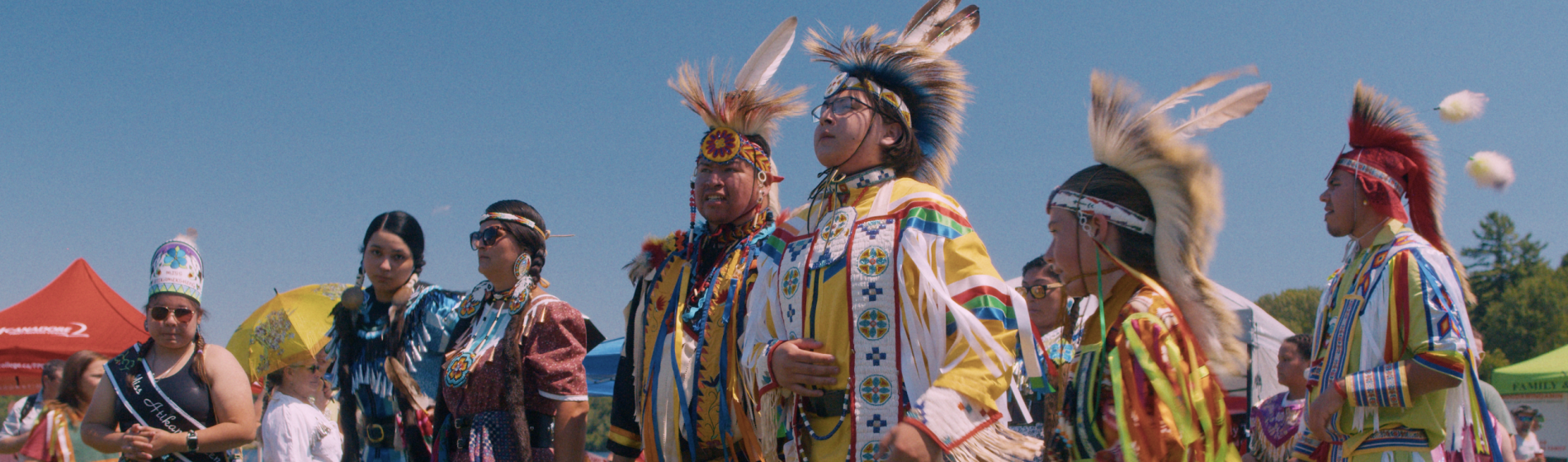
The Anishinaabe do too. The community hosts a powwow to celebrate and gather together in nature’s warm embrace. Attendees wear colorful, traditional garments and sing joyously. As others abuse and destroy Atikameksheng Anishnawbek, they pour love and respect into it. AKI makes it clear that the land of Atikameksheng Anishnawbek is full, alive, and rich with hope.