

“I want you to really go on her journey with her and be so close to Ann,” says The Testament of Ann Lee director Mona Fastvold. “I want to let you have access to her emotional life, her body—the breast milk and the blood and the agony and the ecstasy and the sexuality. And I want you to have access to all of it and to be close with her and to empathise with her–but I’m also not trying to convert you all to Shakerism,” she laughs.
The Testament of Ann Lee probably won’t inspire many converts to the Shaker movement that Ann Lee forged in England before bringing it to the new world in the 1780s. It’s a brutal story, but one that finds beauty in the hardships of creating something new. Mother Lee imagines a church where gender equality reigns. Congregants commune with through song, dance, and an affinity for artisanal labour. The Testament of Ann Lee seems more likely to inspire converts to unconventional musicals, as Fastvold, who previously directed The World to Come and co-wrote last year’s epic The Brutalist , among other films, imagines a divine, if self-consciously unreliable, portrait of Lee’s strength and spirit. It’s a miracle of a movie for audiences who prefer their religious experiences on the big screen.
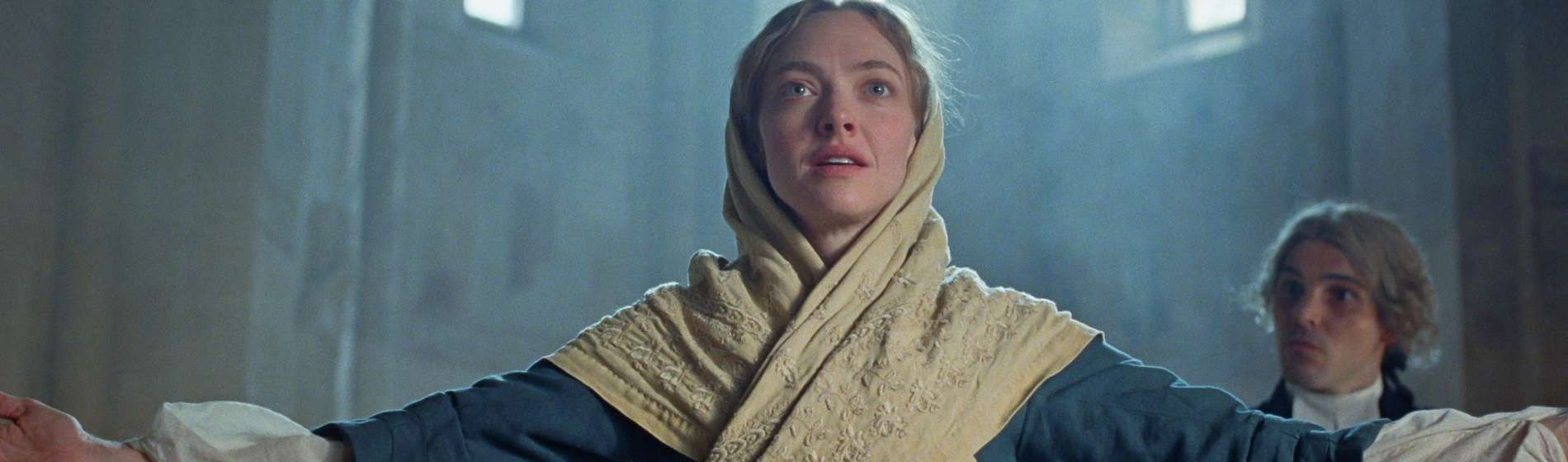
The film stars Amanda Seyfried as Ann Lee in a career-best performance that earned her a Golden Globe nomination. Seyfried, speaking with That Shelf in a separate interview, agrees with Fastvold that it was important to give audiences a visceral window into Ann’s body and soul.
Seyfried says she found her way into character especially while performing the number “Beautiful Treasures.” The song comes early in the film amid a devastating sequence that sees Lee endure a series of miscarriages. Her heart breaks again and again as her few babies that survive childbirth die prematurely.
“I got to sing live half the time and I got to move in ways that I’ve never moved and try to unlock what that grief might have looked like,” explains Seyfried. The star says she did three versions over the song over two days to begin production.
“It was the best thing to start with because it really grounded me in that I was portraying her in certain parts of the song as a newly-in-love young woman,” says Seyfried. “The second version was of an expecting woman and the excitement and the nervousness that comes with that, and then the grief after she’s lost [her children]. We wanted to depict those moments in her life and then surround that with the actual deliveries, which by the way, show me a movie that shows that kind of graphic reality!”
The Testament of Ann Lee offers graphic, but realistic, depictions of childbirth during mid 1700s’ England. There’s lots of blood and little hygiene, more screaming and tears of pain than signs of joy. It immediately thrusts audiences into Ann’s personal and corporeal sacrifices as she risks death repeatedly with hopes of bringing new life into the world.
“That’s what Mona and I say was always lacking in movies, and so to show that, I mean, it’s harrowing, but it’s the truth of how babies are born,” Seyfried continues. “Whether they’re cut out or they’re delivered vaginally, it’s gruesome. It’s ecstatic and it’s emotional and hard. I think you really feel that. And then you really earn that profound grief, which is the reason that you hold onto the whole story.”
When the film cuts to Lee dancing in a room with other women, it deftly contextualizes her role as a spiritual leader at a time when society afforded women minimal agency. “You have to understand where she came from and why she built what she did at a time when there was nothing but limitations on women,” says Seyfried. “That was profound for me.”
For Fastvold, who has long wanted to bring Lee’s story to screen, the mix of spiritual ecstasy and physical ache was one reason why she wanted to explore the Shakers’ story on such a unique canvas. “There’s so many cinematic elements that I was excited by, but then to discover a story about this woman who was poor, illiterate, a blacksmith’s daughter, who immigrates to America, crosses the ocean and then creates one of the largest utopian societies in American history—they had over 6,000 followers at the height of it. And they had complete equality between gender and race, and they were artists and they were craftsmen, and their crafts and their arts are still so significant and such an important cornerstone of American design,” says Fastvold.
“But Mother Ann Lee was just erased from history moment. You can barely read anything about her. And a lot of the things that you can find out there online are just also not correct.”
While Fastvold has some key texts to work with, including the published testament of Ann Lee’s witnesses, which she pulls into the Zoom to display a rare and handsomely bound book with pride, the film leans into the fissures of history. “I wanted to tell a story where I wasn’t debunking her. I wanted to keep exploring it as a myth, which is why I call it a speculative retelling. It’s a fable,” explains Fastvold.
“I thought it was more subversive and interesting to take them at their word, but at the same time, I needed to have an unreliable narrator at the helm of it because they’re contradicting themselves at times as well.” That narrator comes in the form of Thomasin McKenzie as Lee’s friend and follower Mary Partington. Her story obviously comes skewed through her devotion to her leader, but also her literally and figuratively limited eyesight following a violent attack on the Shaker commune.
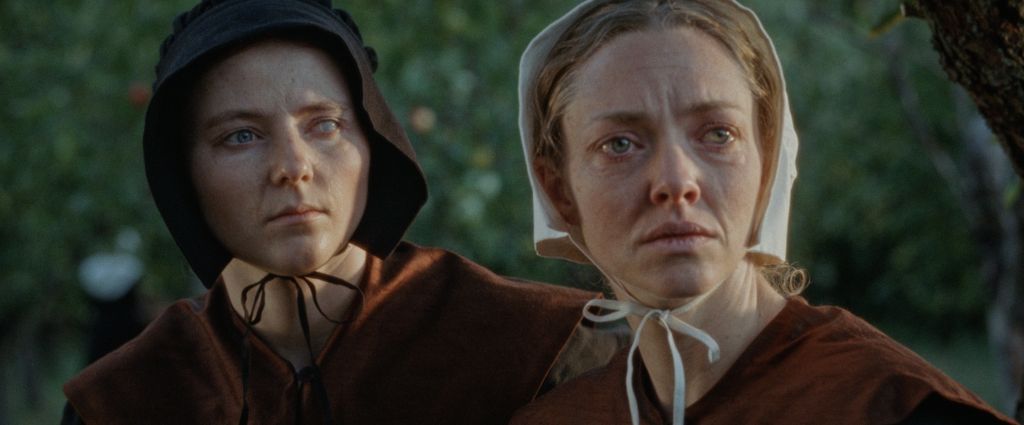
Seyfried adds that Fastvold’s immersion in Lee lore made her an ideal tool to draw from. “She wanted the version of Ann Lee that I played, who was relentless in her belief and her need to create space for people,” says Seyfried. “I understood that level of compassion and that need to comfort people and that need to create unity. I understand that from the foundation of my being. I’ve always felt that. And to connect to someone’s courage to do that is empowering.”
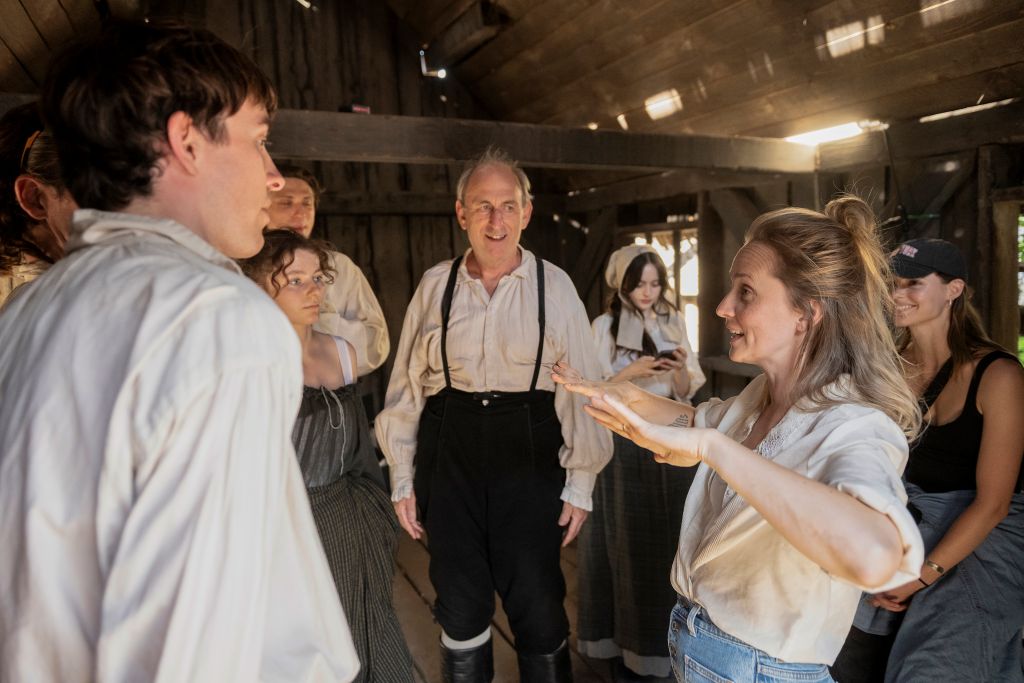
The actor likens her director to Lee herself with the communal environment of the production. “There’s no hierarchy on a set, which is hard to find,” adds Seyfried. “Everything’s made for the greater good of the story of the project. But I also had incredible hymns to draw from. The lyrics, the words in these prayers, these gift songs that they would sing to each other. They’re so old, but they’re so timely.”
The Testament of Ann Lee reimagines traditional Shaker hymns throughout the score. Some of the songs offer non-verbal hymns as the faithful celebrate changes in the season or mark the fruits of their labour through music. Others punctuate the film with moments of spiritual growth, or, in the case of one of the film’s two original songs, offbeat humour as a character follows his finger to new land. No matter the form the songs take, faith guides the singers.
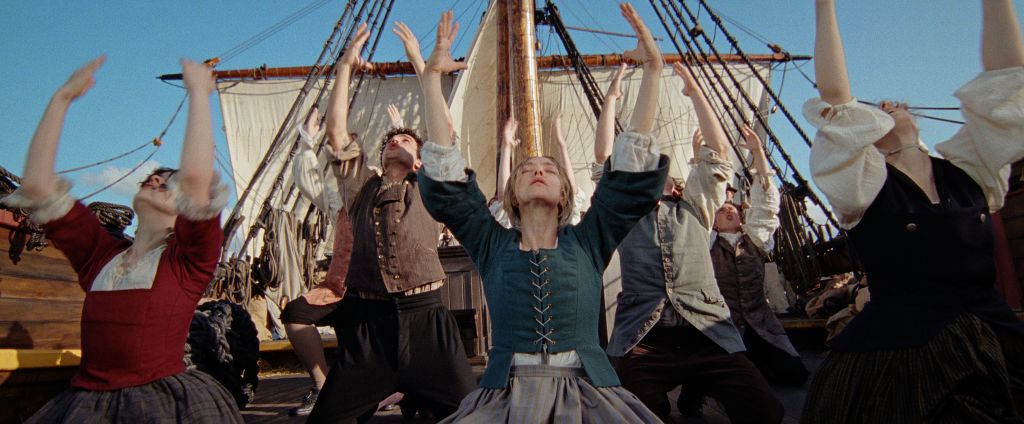
“The Shakers worshipped through ecstatic song and dance, so they would dance and sing and move for days at end, and they would break into ecstatic song and dance and movement,” notes Fastvold. The film’s choreography draws from the physical exhalations the Shakers would perform while communing with God. What transpires onscreen is a blend of the old and the new as practices rooted in history meet the rhythms of contemporary dance.
“The movement made me feel completely grounded in her,” adds Seyfried. “It made me feel more grounded in myself too. Movement always does that for us as humans and movement with a group of people too. Changing energy, exchanging energies is so powerful.”
“My composer [ The Brutalist Oscar winner Daniel Blumberg] dove into their musical history and our journey with that was finding musical pieces that would not necessarily support the story so much, but the emotional journey because the songs are an expression of prayer,” explains Fastvold. “They’re not a traditional musical number where you’re singing dialogue or you’re trying to further the story in that way.”
Fastvold points to the film’s highlight hymn of “Hunger and Thirst.” Seyfried creates a transformational moment as Ann Lee awakens in a cell to which she’s been confined following a fit of perceived madness after her miscarriages. The refrain offers Lee a vision to sate her spiritual hunger as she has a premonition about her journey to the New World.
“We found that song and, first of all, it’s an incredibly beautiful song, but then also it’s about this moment where she’s yearning for more and for knowledge and to give yourself truly down,” notes the director. “We took a lot of licence with how we [used them]. Some of the songs are much later in the Shaker History. Some of them are really early on. The wordless hymns are from early on in the songbook.”
As the camera gets intimately close to Seyfried as she performs “Hunger and Thirst” in a long take, Lee draws audiences into her spiritual reawakening as the songs intuitively explore her story. The sense with which Seyfried navigates spaces both theatrical and cinematic makes her performance as Ann Lee an intriguing counterpoint to her turn as an opera director in Atom Egoyan’s Seven Veils , released earlier this year. That film sees Seyfried’s character Jeanine breathe contemporary vision into Salomé while trying to shake her mentor’s shadow.
“They really are complimentary,” observes Seyfried when asked about the two roles. “I was thinking more about the empowerment that [Jeanine] had to perform. She had to perform as strong and valuable when she was feeling weak and confused, which is very different from Ann Lee, of course. [Ann] was on another plane because she had to be, or she’d die. But I feel like I found it more valuable for me as an artist and as an actor to portray somebody who’s in power. I’m always looking for people like that because I feel like I’m always back-footed as Amanda. I mean, I’m less so than I ever have been. I am 40 and a mother, so I have to be front-footed and find my own power.”
Seyfried takes a moment and assess the two roles to reflect upon how she approached portraying Ann Lee in a musical after playing a director of musical theatre. “Music comes in all forms. It’s all genres,” says Seyfried. “Especially an opera singer, that sound comes from so deep within someone’s body and it has to be connected to the soul. If it doesn’t, it sounds wrong. That’s exactly the same idea with the way Ann Lee uses her voice. It’s not because she wants to sound pretty and create a song and sing a song. It’s because that’s how she worships. It comes from a desperation and it comes from necessity.”
Seyfried says that playing the two roles together helped her lean deeper into the way that Ann expresses herself body and soul through music. “Even though opera is very well-trained, your whole body is vibrating,” she notes. “I used to sing from my neck and from my chest. That came from my own judgment, and now I sing from my body. I have a whole new sound.”
The Testament of Ann Lee opens in Toronto in 70mm on Jan. 16.
It expands to more theatres on Jan. 23.