

Fashion icon Coco Chanel once gave the enduring advice, “Before you leave the house, look in the mirror and remove one accessory.” However, Boots Riley seems to have taken one glance at a cut of I Love Boosters and added 27 accessories. The sophomore feature from the Sorry to Bother You director offers chic maximalist filmmaking. It’s a bold retort to the excesses of consumer culture and well-placed jab at a capitalist society that treats people like commodities. Riley takes a rallying cry of socialist spirit and makes it fashion.
The director serves an impressive glow-up on his second film, which says a lot since Sorry to Bother You heralded a distinct voice in American independent film. I Love Boosters proves equally refreshing for its unabashed politics and sense of style.
As aspiring designer Corvette (Keke Palmer) assembles an entourage of “boosters” to pilfer garments from the stores of fashion icon Christie Smith (Demi Moore) and sell them on the sly, she learns about the dark underside of the industry she idolizes. Her mission intersects with workers in Smith’s Chinese sweatshops, who are striking in search of safe working conditions and fair pay. Boosters uses the fashion industry as a hook for a wider and wilder treatise about labour rights. It proudly wears its politics on its sleeve.
Riley, speaking with That Shelf in Toronto ahead of the release of I Love Boosters, says there’s no separating politics from art—a point that got Wim Wenders in hot water back at Berlin when he said that films had to keep out of politics.
“I’ve been dealing with this my whole career,” says Riley. “It’s all political. What’s very political is when you don’t know when they’re trying to hide their hand, when they’re saying, ‘This is just regular. This has no politics in it.’ When there’s a Disney show and everybody in their world has healthcare and doesn’t have a problem paying the rent, and the only people that are poor are people that are making bad decisions—that’s very political.”
In I Love Boosters, Riley brings elements of economic inequity into the fold. Corvette squats in an abandoned chicken joint. Her friends Mariah (Zola’s Taylour Paige) and Sade (Sorry Baby’s Naomie Ackie), meanwhile, basically work for free in Smith’s operations under the expectation that staff wear her high-priced clothes—without a five-finger discount.
“All of my stuff often seems political because it’s coming with a different politic,” Riley observes. “And so what we’re really just talking about is should left or radical politics be in movies? Of course, I think I’ve made my argument with my films.”
There’s a swinging Robin Hood ethos to I Love Boosters as Corvette and company liquidate Smith’s stores. Riley lets the personalities of the boosters shine as they rob from the rich while defying a fashion line that forgets how clothes serve as a great mode for self-expression. The killer fits in I Love Boosters rival The Devil Wears Prada 2, especially a slick jumpsuit that lets Corvette waddle out of Smith’s store like she’s Marge Simpson at a candy convention.
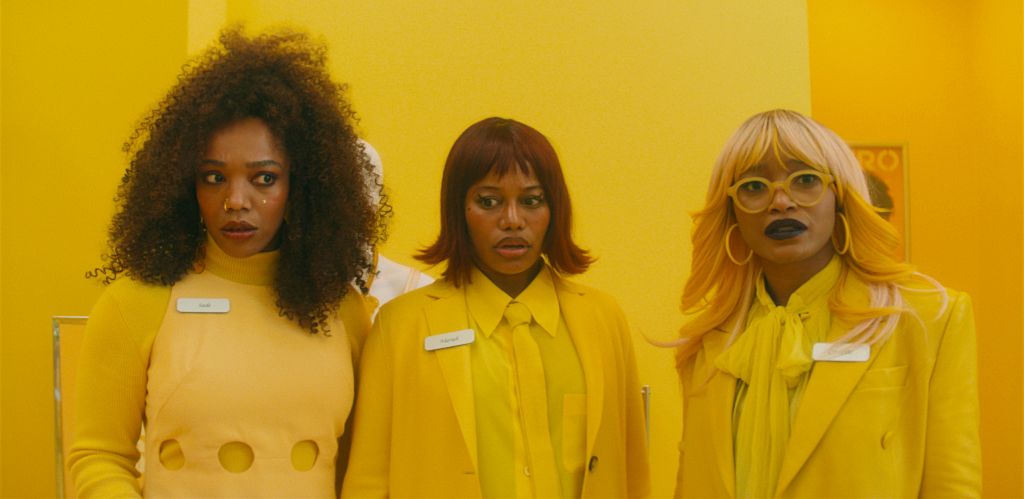
“Some of the stuff is written into the script,” explains Riley. “This is the kind of thing we need to have for the story: ‘There’s a plaid thing that’s in there, etc.’” Each of Smith’s stores also has a specific palette as locations favour a single colour, garments and interior decorating alike.
The carpet matches the drapes, so to speak. Riley says that finding the right looks for each character came through months of collaboration with costume designer Shirley Kurata (Everything Everywhere All at Once).
“A lot of it is just me picking the right person and Shirley Kurata that has a style that I love,” he adds. “She knows what things I want and I already know what wheelhouse she likes to be in. It was mainly her being like, ‘Okay, Boots, this is what we got.’ Some of it was limited by what we could get in time: her calling designers, some of the stuff is her making a thing.”
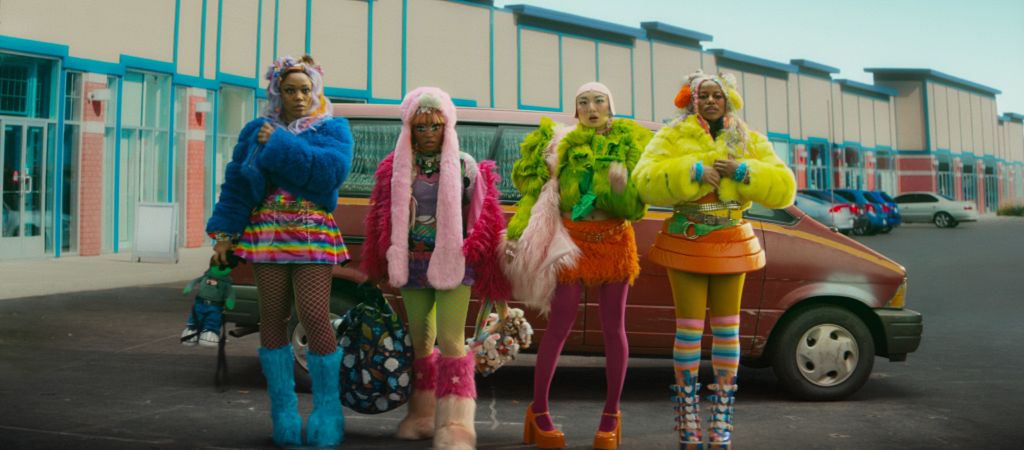
Riley mimes the designer rifling through a closet to capture the range of options at their disposal to create the grab bag of styles. “Then there’s a montage where they keep coming out of the van. One of them is decades. The other one is flowers. The other one is anime fans, that sort of a thing,” says Riley.
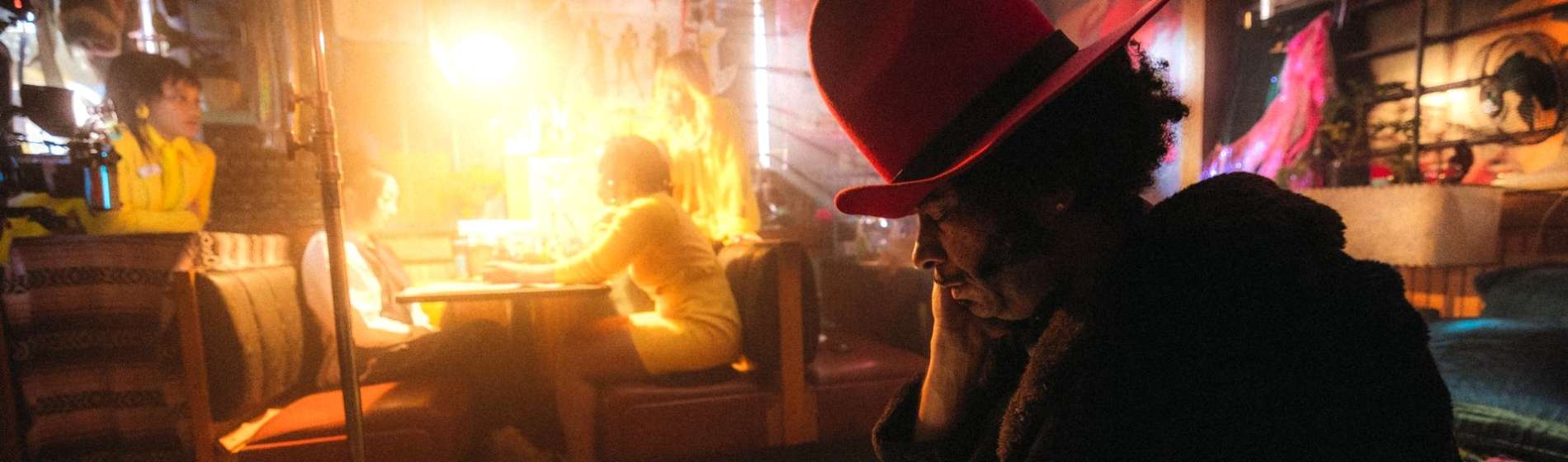
However, Riley, clearly weary at the end of a very long press day, doesn’t like talking about clothes as much as he does politics. (But it should be noted that he has a great sense of style, particularly his hat game.) Bring the conversation back to workplace equity, though, and he’s ready to let the junket timer buzz us out.
“What I’m putting forward is that the change will come when we change the whole economic system,” Riley says. The director adds that his production walks the walk by working with unions and all that entails with pay and structure—factors that Smith disavows and Corvette’s comrades fight for.
“It’s really hard to figure out how to do something different than how the economic system dictates,” Riley continues. “I don’t put forward in my art that the people at the top are just choosing to do it in a way; they could choose to do it a different way. I put forward that the answer is that the working class overthrows the ruling class and creates a world in which the people democratically control the wealth that we create with our labour. That’s the real thing.”