

“No, I don’t have experience in musicals. I hate the musicals!” Emilia Pérez star Karla SofÃa Gascón says with a big, infectious laugh. The actress admits it wasn’t easy playing a former drug lord who undergoes gender affirmation surgery and then tries to atone for her past in Jacques Audiard ’s acclaimed (and controversial) narco-musical. But besides playing two facets of the same character pre-and-post transition, she says singing a handful of diverse musical numbers—in two octaves, no less—was the hardest thing she’s ever done. “I think I sing very well, but not for level of Camille and Clémont [Ducol],” she laughs, referring to the musical duo behind the songs and score . “They want perfection. I learned a lot about music, voice, and singing.”
Gascón, speaking with That Shelf with the aid of an interpreter, gives one of the year’s most revelatory performances as Emilia Pérez. The star, now 52, is likely to make history as the first openly transgender actor to be nominated for an Oscar, and perhaps even win after she shared Best Actress honours at Cannes with co-stars Zoe Saldaña, Selena Gomez, and Adriana Paz. The weight of the opportunity isn’t lost on Gascón, whose turn in Emilia Pérez marks her first film role since she began her physical transition in 2018, although she’s done some television in Mexico in the interim.

But she’s especially excited to talk about her work as an actor and how she found diverse ways to inhabit such a multifaceted and refreshingly messy character. Gascón’s tricky feat of playing Emilia both pre-and-post transition is her choice, moreover, as the script by Audiard ( Dheepan ) initially called for different actors.
“I can only approach my characters in the way I know, which is to put my entire soul, all of my experiences, everything I know into the service of my characters,” says Gascón. “Evidently with these two, even though it’s the same character arc, they have two different ways of speaking, two different ways of moving, two voices. So it got to be really complicated. But fortunately, I had the best guides and the best teachers and the best director for the work to be what it is today, which I think is one of the most important works in cinema.”
Gascón says that her experience with Audiard was highly collaborative. She credits the French director for having an open ear to adapt Emilia Pérez and make the character more authentic. “I worked with Jacques for a long time before the other actresses joined us,” she says. “I was very fortunate because I got to be there from the beginning. It allowed me to bring things up, to provide feedback, and provide suggestions based off of my own experience. Most importantly, it allowed me to be listened to by a director. There were a lot of things that I also didn’t want in the film because I believe that it would have changed the meaning, but the film ended up evolving with time. It would’ve been something very different.”

Part of what Gascón says she drew upon was her relationship with her daughter to capture Emilia’s effusive love for her children and her determination to get them back after she escapes her former life. That mother/child relationship in Emilia Pérez also means two sets of actors play the kids at different ages: before and after Emilia’s transition.
“Many times because of the nature of my work, our relationship had to move forward from afar,” Gascón says, reflecting on her daughter’s influence on the film. “A lot of the memories that I have with her are through applications. I would get puppets and then, through a video camera, I would play with her. So in a way, I was with her from afar, but I was still able to be close to her.”
Gascón says she brought this sense of play to building her relationship with her young co-stars—she admits that she doesn’t particularly love working with kids—but found it a great way to make the characters connect. One example? That funny downhill skiing arcade game that Emilia buys for the kids when they say they miss the slopes in Switzerland. (Emilia’s family goes into hiding when she fakes her death to facilitate her transition.)
“At some point, they’re talking about they miss the snow and they want to go skiing, so something that I suggested was if Emilia is so rich, why can’t they [make] a ski place outside her house?” says Gascón. “That got reduced into the ski machine. They said, okay, we’re not going to do a whole ski resort, but we’ll do the ski machine. It was really fun.”
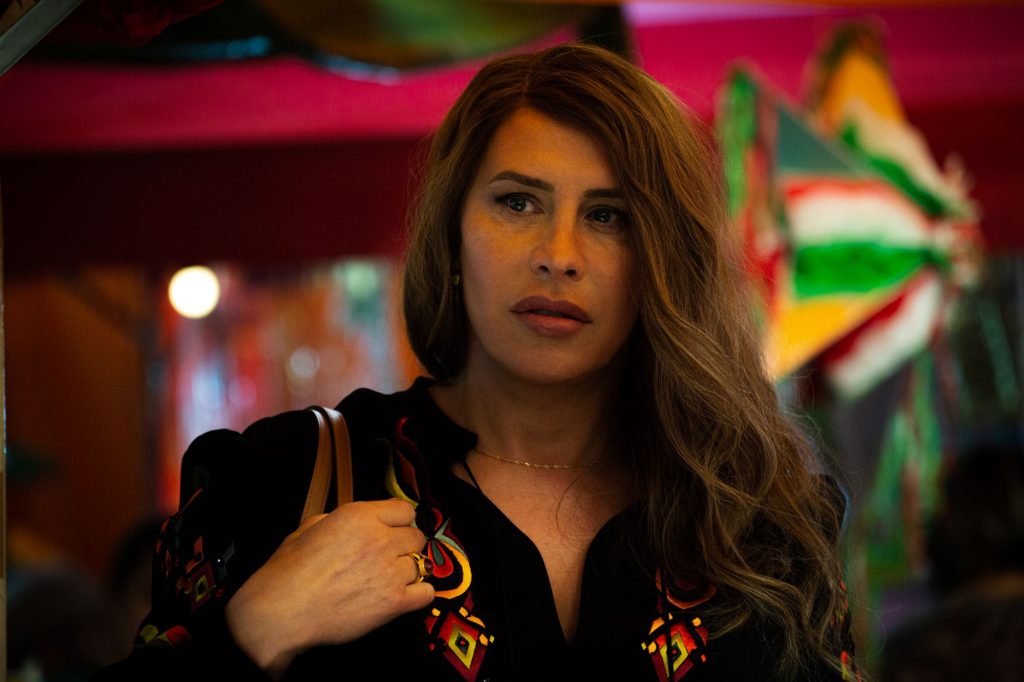
Most important, Gascón says, was understanding why Emilia wants to transition in the first place. (Early drafts had her character transition to escape the law and responsibility, and then grow into it.) She explains that it was essential for both her and the audience to recognize that the drug lord wasn’t merely escaping violence—she was escaping a tortured soul. She also says the character was funnier in the original script—something of a surprising change given her own natural sense of humour.
Moreover, the actress brings another perspective to the feedback loop of Emilia Pérez . The Mexico-set co-production–France’s Oscar submission this year–features an international cast and crew. For Gascón, who was born in Spain but moved to Mexico in 2009 with her wife and daughter, Emilia Pérez offers a chance to honour her second home.
“I think if I hadn’t lived in Mexico for as long as I did, I would not have been able to interpret this character as well as I did,” says Gascón. “I’m familiar with the idiosyncrasies, the vocabulary, and certain words that they use. I’ve done wonderful things in Mexico, but I have also seen a lot of things that I didn’t like. I know what it’s like to be there, and I think that definitely has an added value to the character and to the production. I don’t think that I would have been able to create a credible Manitas [Emilia’s name pre-transition], a credible Emilia if I didn’t have that Mexican baggage with me.”
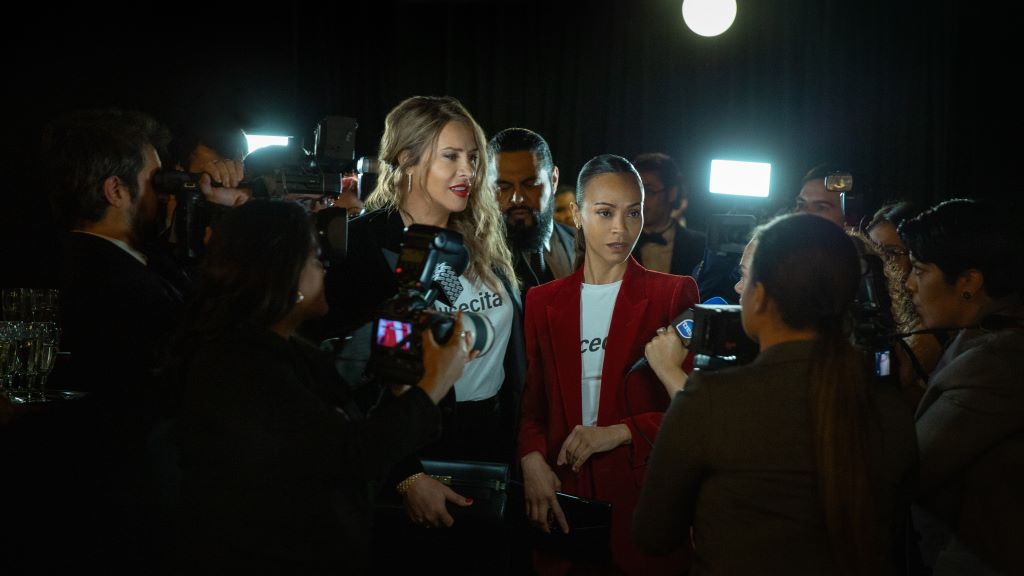
She also says that bringing the mix of perspectives added to the experience. “Working with a French director and an international cast, I think we’re able to provide a perspective that would not have been able to come out if we had been doing it within Mexico,” adds Gascón. “Sometimes it takes someone from outside to provide a different perspective, but at the end of the day, this is not reality. It’s a creation. There’s a lot of creativity that is trying to come forth.”
Gascón especially likes talking about the creative energy with her co-stars. Ask her about working with Saldaña and Gomez, and she’ll switch from Spanish to English, offering a candid break from her press junket composure. She says her favourite scenes include her final confessional ballad with Gomez, but also her first scene with Saldaña in which she addresses her plight through rap. “Obviously for Manitas, when Rita [Saldaña] arrives at the track, I do the rap song and say, at the end, ‘I want to be a woman!’ This, for me, is amazing. This is the most important scene, I think, in the movie.”
Whether or not Gascón makes history on the awards front, she’s already a winner by landing such a juicy role and running with it. But, for her, the responsibility that comes with playing Emilia Pérez is one she embraces, especially now as transgender rights–and, in turn, queer rights–are as hot-button a topic as ever with arguments before the U.S. Supreme Court just yesterday.
“All people are different, so why do we insist on hating difference?” she asks. “No one is the same.”
Gascón also takes a moment to note the importance of separating one’s sexuality from one’s professional worth. “Our professional worth is unrelated to our sexuality, to our gender, to who we go home with. I think we need to stop trying to control other people’s bodies and focus on controlling our own,” she says.
“There’s a lot of people who are selling hate and there are those who are buying into that hate. I hope that whatever I can express for the people that are following this platform is that we all love, we all suffer, we’re all capable of the same things, and we should all have the same rights and the same obligations. It is when we’re expected all to have the same obligations but not the same rights that we have to be careful. We have to be careful right now because we are at the cusp of possibly repeating the mistakes of the past.”
She admits it might be a tough moment, but turns from the serious note to one of levity while reflecting on how much Emilia Pérez challenged her to find her own voice, literally and figuratively. “I’m really so grateful for everything that happened to me during this film,” says Gascón. “There’s a lot of things that I didn’t want to learn. I think life just said, ‘You didn’t want to learn it on your own, so now we’re going to force you to learn it.’”