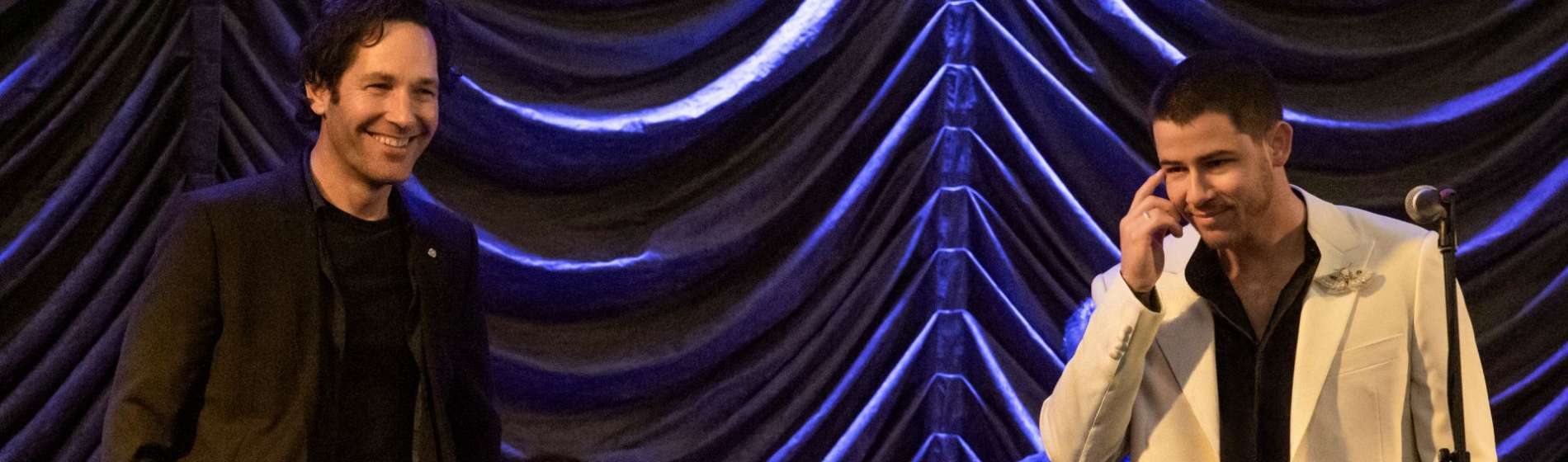


It takes balls to call a movie Power Ballad and task anyone but Diane Warren to write the film’s signature track. However, Once maestro John Carney delivers another sweet ditty in Power Ballad with the recurring theme “How to Write a Song (Without You).” The power ballad first appears as a work-in-progress that faded-rocker-turned-wedding-singer Rick (Paul Rudd) shares with former boy band icon Danny (Nick Jonas). The song wafts in an out of the film as Danny produces the track on his own. It proves a massive hit and launches the next phase of his career, but Rick receives no writing credit. Power Ballad follows Rick’s quest to get the credit he deserves, but also to gain closure over this deeply personal earworm.
Part of Rick’s quest for authorship comes in decoding the mystery about whom the song addresses. Danny never reveals the unnamed recipient of those words “I don’t think I’d know how to write a song without you.” But they become the biggest collective expression of love and commitment since “Simply the Best” reframed wedding songs on Schitt’s Creek. Rick’s emotional journey with the song extends far beyond the royalties and kudos for which he’s cheated. The credit becomes an act of reclaiming himself, his memories, and his love that inspired the tune. Like the best power ballads, the film soars by unabashedly tapping a sentimental sweet spot.
“Rick, he’s kind of discovering things along as the story progresses and really coming to a place of understanding where he was when he wrote it, what it was about,” says Rudd, speaking with That Shelf via Zoom. “What he really does learn [is] about music being for the people listening to it and what it can mean for them. All of these things that he realizes along the way make me look at those lyrics a little differently. And so the song has, I think, a little bit more emotional resonance when I look at it through Rick at the end of the movie versus Rick at the beginning of the movie.”
Rick faces a strange awakening while his song becomes a hit. Danny completely misses the point of the song, but nevertheless connects with the hearts of listeners worldwide as his souped-up take on “How to Write a Song” gives fans all the feels. People begin requesting it at weddings to Rick’s chagrin. However, he ultimately recognizes that the power of the song is its universal resonance.
Carney, speaking in a separate press event with Jonas, credits co-writer Gary Clark for conceiving the lyric “how to write a song without you,” but reflects that it comes from a place in life they share with Rick as they navigate middle age. “He was hit by that nice little poetic moment where it’s like the older we become, we’re not writing songs for people anymore because we’re married or we have kids and we have mortgages to pay. And it’s our job,” notes Carney (Begin Again, Flora and Son).
“But how do we continue to do it if the person that we started with isn’t there? I find that a very interesting question: why you’re writing songs when you’re 20. It’s pretty straightforward—you’re trying to get the girl or get the guy. You’re trying to punch the air. You’re trying to tell people in school to go screw themselves. These simple dynamics become a lot more complex as you get older. We were writing more about [the question of], ‘How do I continue this job of songwriting now that I’m married and I have mouths to feed?’”
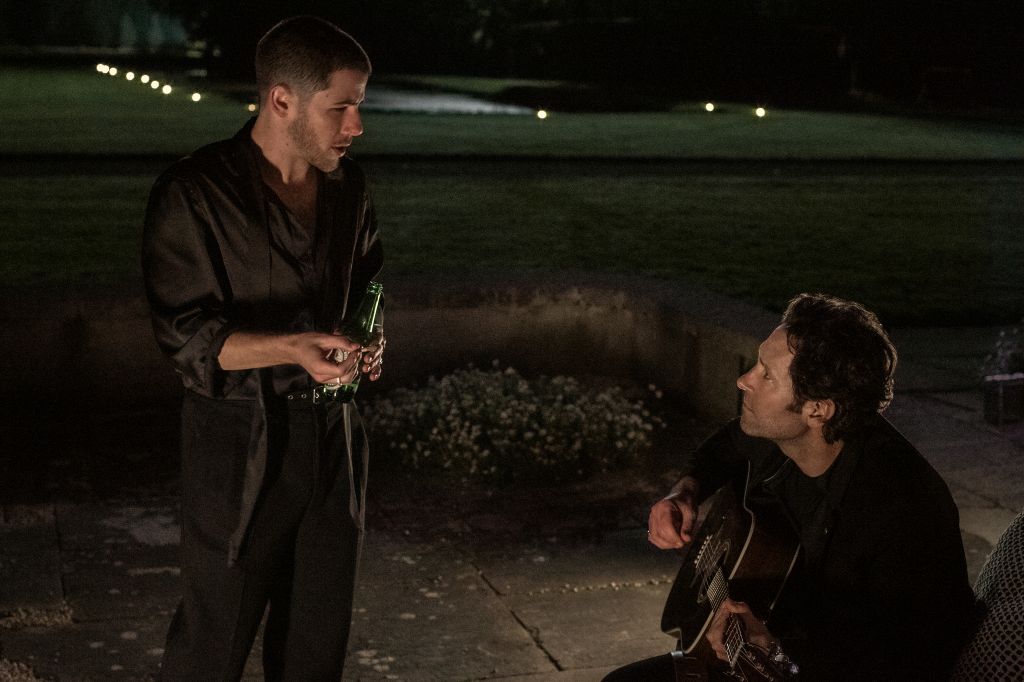
Jonas, meanwhile, says that Danny’s interpretation of the song comes from his hunger to rediscover himself artistically, even if it means perfecting someone else’s work and making it his own. “I tried to focus on the growing anxiety and the layers beneath it that were causing this stress, in addition to, this desire to find himself,” notes Jonas. “I actually think Rick and Danny are more alike than we might even think in that they both, kind of, ask the question, ‘How far would you go to get everything you ever wanted and at what cost?’”
Danny’s success with the song lets Power Ballad ask a question about authorship among creatives: If Danny refashions Rick’s song anew, does it still belong to him? The power resides as much as in the vocal performance and production as it does in the writing. “This song, it really tests the vocal range. It starts in the lower side and then opens up in that chorus,” explains Jonas. “As a songwriter myself, it’s always interesting to sing someone else’s song. I was thinking about how Danny’s voice would be slightly different than mine, and little nuances that were fun to play with. Even the writing style that John and Gary have is different than my usual sense of melody.”
Jonas and Rudd create beautiful harmony together as Danny and Rick perform the song again and again, finding an irony in the titular lyric as the former belts out the hit to global stardom without the latter. As Rick decides to finally confront Danny and the record label with the only shred of evidence to prove his claim for authorship—the authentic truth that inspired it—the wedding singer faces an awakening. Part of writing a song is letting it go as the audience receives it. Rick learns that emotional truths of “How to Write a Song,” as varied as they may be, ultimately outweigh the refinements of Danny’s record.
“It zeroes in on some sort of emotional truth or is timeless,” Rudd says when asked what makes a great song. “It probably doesn’t focus too much on pop culture references or anything. It deals with big issues that are big any year of any decade of any generation, and they pinpoint what it means to be a human being and that is what makes it timeless. Some of the best movies ever made [are] in black and white or they’re from different countries all over the world.”