

Does happiness mean staying together or calling it quits and moving on? Director Jay Roach’s latest, The Roses , asks that very question of its protagonists, Ivy ( Olivia Colman ) and Theo Rose ( Benedict Cumberbatch ), and they both have wholly different ways of answering it. Their darkly humorous journey of reflection and discovery is a total treat to watch, especially if audiences can get past a few less stellar bumps along the way.
Loosely based on the 1981 novel The War of the Roses by Warren Adler, and its original cinematic adaptation starring Michael Douglas and Kathleen Turner from 1989, The Roses follows the husband and wife pair from their first meet-cute in a London restaurant–Theo, a frustrated architect bursting with ideas and Ivy, a chef with big plans for her own career–to their settled married life in California, with two kids, a beautiful house, and very few ambitions achieved. As Theo’s career flounders and Ivy’s suddenly takes off, their relationship is tested again and again. Barbs are exchanged, things are said in the heat of the moment, and eventually, things boil over in spectacular fashion. Which isn’t so much a spoiler, given the film’s advertising.
What sets this film apart from its predecessor is the connection between Theo and Ivy. Never once do you doubt they care for one another, that each is the other’s person. Even when at odds, they still feel like a team against the rest of the world. As they discuss their “sporadic hatred” of each other, Ivy even goes as far as to say the only person in the world she can stand is Theo. And when they give couples therapy a try, they trade so many pointed insults that they seem to scar their therapist, while the pair themselves find the process equally amusing. So when they finally let rip at each other in a serious (but darkly humorous way), it hits that much harder. Not only because they know exactly how to push each other’s buttons, and know each other so well, but because these are two people you’re rooting for. Their complaints are both valid and silly. Some are spot on, and some are insecurities about imagined slights with seemingly unshakeable foundations. Perhaps it’s because they go so hard at each other when things start to crumble that it’s possible to see something redeemable in their pairing still. After all, as Susanna Hoffs sings in the soundtrack, love hurts.

The success of their on-screen relationship is primarily due to two factors. Firstly, Colman and Cumberbatch have nailed these characters down to their marrow and are equally convincing as a couple totally consumed by each other, then comfortably settled in their lives, and then as two people totally at odds despite the love that still exists. The two actors, and long-time friends off-screen, are clearly relishing the opportunity to step into these roles and are having a ball with them. Colman’s Ivy is a bit of a free spirit, fun, mischievous, and talented, but has a penchant for being too blunt and finds it hard to apologize when she does go too far. Cumberbatch plays Theo as a smart man driven by his ideas, confident in his place in the world and devoted to their life as a family. But when he’s not getting a chance to shine through his work, and when their parenting roles get reversed and he becomes a stay-at-home dad, he becomes resentful and somewhat bitter as he yearns for that lost creative outlet.
Theo’s parenting style is light-years from Ivy’s, and they clash constantly over how to raise their two kids, Hattie and Roy. Although not the main point of contention, it may be the most interesting and moving aspect of the film. Ivy has a very laissez-faire attitude to their lives, while Theo is more into guidelines and ambition. Ivy lets them gorge themselves on sweets until they’re sick (a lesson learned), while Theo is more into protein shakes and wind sprints. It’s clear that both dearly love their son and daughter, and that their kids love them right back, but they don’t shy away from the hardships of family life.
The emotional devastation Ivy feels at missing out on so many key moments with both kids because of her burgeoning restaurant empire is heartbreaking, and something so many working parents can relate to. “You stole my children from me,” Ivy shouts as she finally voices the thing that’s hurt her the most. Though not true, it strikes at the heart of her insecurity. Theo has been able to raise their kids to love the things he loves, naturally, but the result is that Ivy can no longer relate to her own family. That it’s a direct result of her own choices means she’s furious at herself, but isn’t that often the problem? Don’t we often take out our anger at ourselves on others?
As Theo becomes more confident in his role as an ersatz single parent, you can see the light within him dim. He’s doing what’s right, but it’s draining him as opposed to fulfilling him. His altruism and supportive nature (such as it is) begin to give way to bitterness as well. There’s no outlet for his creativity, which is an essential part of him, and it sours him to the world at large. When he finally has an epiphany and truly looks inward at how he feels, it’s a devastating moment for both the characters and the audience.
Both Colman and Cumberbatch are pitch-perfect in both those deeper, darker moments and in the lighter comedic moments, too. But what really sells everything is the emotion that we see underneath: the love still there, the sadness of perceived failure, and the devastation of feeling alone when your spouse is right beside you.
The other factor is the script itself. Tony McNamara ( Poor Things ) balances just the right amount of genuine emotion and spite when it comes to this couple. As crazy as things ultimately get, they still never veer too far from reality, and so the story of The Roses remains grounded in a way its predecessor did not. It’s self-aware (noting the fact that these are well-to-do white people with first-world problems) without becoming frustratingly meta or intrusive. However, they may have dropped the wink to Cumberbatch’s Doctor Strange character. It’s cute, but it takes you out of the film. In addition, the advertising campaign for the film might make you think all the good lines have been spoiled for audiences long before they hit the theatre, but McNamara’s screenplay is so packed with them that there’s lots more to be had and laughed at.
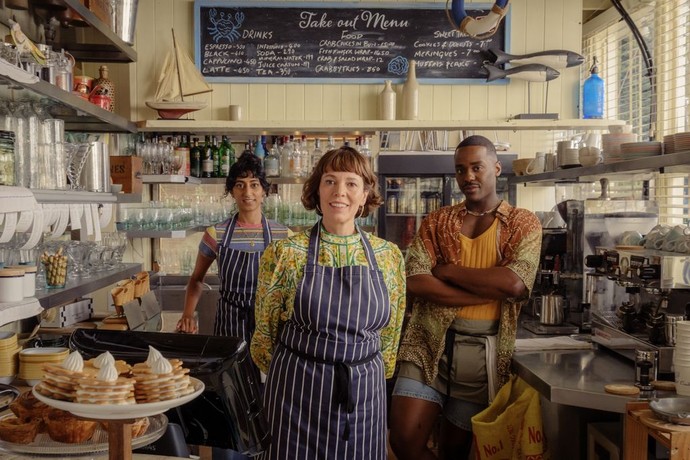
What works less for The Roses is its supporting cast, which comes down to both actors and the script. Though Andy Samberg (as Theo’s best friend Barry), Ncuti Gatwa and Sunita Mani (as Ivy’s restaurant staff and friends), and Allison Janney (as Ivy’s divorce lawyer) all get in some great lines and fit well within the action, the rest do not. The differences between Americans and Brits become comic fodder one too many times, and feel old-fashioned and dated. The former are more than guns and rudeness, and the latter are more than repressed emotions and bon mots.
Jamie Demetriou and Zoë Chao, as fellow architects, are portrayed as the epitome of entitled Americans and come across as the rudest and most unlikable people you could ever encounter. It seems implausible that anyone would invite them to anything after meeting them even once. They’re supposed to provide some comic relief in the major dinner party showdown at the Roses’ new, gorgeous, Theo-designed home, but they come off as characters in a completely different film. As does the typically glorious Kate McKinnon. As Barry’s wife Amy, her supposedly funny, constant sexual come-ons to Theo (and to Ivy), not only slows the film at moments when it should be pushing forward, but also just land flat. You’re left wondering what exactly the point of her character is and whether that’s clumsy direction or uneven scripted scenes, it’s hard to tell. But it just doesn’t work.
Those are minor complaints, though, given the film is essentially a two-hander for its leads. The supporting cast adds a little something, but they’re not what you’ll remember once you leave the theatre. Neither, unfortunately, is the direction. For such a witty, pointed script, Roach’s direction is fairly lacklustre and staid. The filming locations are gorgeous, as is the set design (especially the new house that becomes a sticking point in the divorce), but the camera sits fairly flat and adds nothing to the overall film. Perhaps that was the goal–to remain unobtrusive, in which case, mission accomplished.
Alongside the fantastic leads and (mostly) fabulous script, Theodore Shapiro’s score perfectly underlines the nature of each and every scene. It feels fresh and original; memorable without being overwhelming. In fact, the music is a plus overall. The iconic Susanna Hoffs (who is married to director Jay Roach), provides some excellent tracks, including a cover of The Turtles’ “Happy Together” sung as a duet with Rufus Wainwright. The song first appears over a great animated opening credit sequence — a rarity these days and a reminder of how those first few minutes can be used to engage with audiences in a visually creative way. Let’s bring those back!
There are some significant differences between this new version and the 1989 adaptation, and thankfully, each improves upon the original material. Most particularly, the ending. To say why would be spoiling a bit too much, but it feels far more satisfying as a wrap-up given the time we’ve invested in the lives of these two people. Perhaps it’s because the leads are so likeable here, despite the spiteful decisions and sniping.
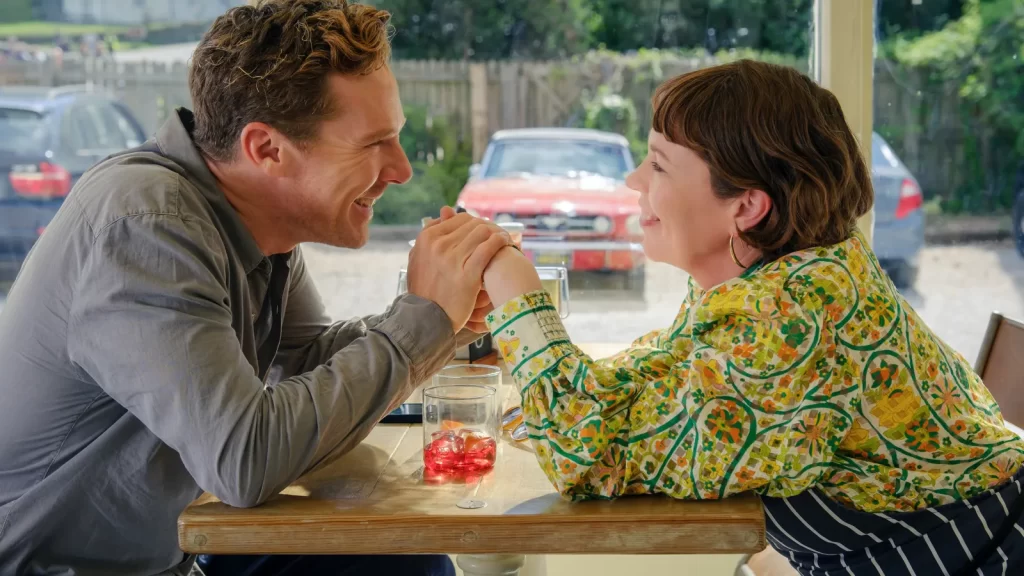
Does it manage to answer the question at the heart of the film? About happiness, and what it might mean and what it might cost? It could depend on your viewpoint, but it definitely addresses numerous contemporary issues of relationships and family, which should evoke a sense of recognition and understanding in audiences. Everyone will find something to connect to in both Ivy and Theo, even when their coping mechanisms level up to pure bonkers levels of slapstick destruction. They are never less than real characters, and it gives The Roses a depth that may surprise you.
There have been many recent films that have dissected all stages of a marriage and family. Some, like Marriage Story and The Squid and the Whale (and even Together ), have been emotional gut punches, while others have taken a lighter yet loving approach, like About Time and Palm Springs . The Roses sits comfortably between these two groups. It is both deeply hilarious and unexpectedly touching, making for an excellent showcase for two actors at the top of their game.
The Roses is in theatres nationwide now .