


“One cellphone has the power of millions of pens,” states counter-surveillance professional Matt Mitchell early in Sidney Fussell and Jennifer Holness’s searing documentary #WhileBlack .
As the world observed the murders of Philando Castile and George Floyd, the simple act of using cellphones to document tragic events can be a powerful tool for bringing awareness to injustices. It not only provides real-time accounts of unfolding events but also helps to curb false narratives that often arise when incidents of police brutality occur.
By shining a light on racial violence that others would rather keep in the dark, technology has become a vital tool for citizen journalism and community organizing. While the ability to record, live stream, and share incidents across various platforms has been beneficial when attempting to speak truth to power, Fussell and Holness show that there is a disturbing side to the tech as well: the same corporations that are providing the tools being used by Black witnesses are also the ones profiting off of Black trauma.
When Diamond Reynolds, the girlfriend of Philando Castile, opened Facebook and started using the new live-streaming feature, she had no idea of the impact it would have. She merely wanted a way to record the encounter with the police officer who had stopped them over a faulty taillight. Despite informing the police that he had gun in the car, as he was a legally-licensed gun owner, the officer panicked and repeatedly shot Castile as he was reaching for his ID, in front of both Reynolds and her daughter.
Since the tragic incident was live streamed, the police could not delete the footage from her phone. Though they initially tried to do just that, it hit a whopping 50K views on Facebook. While Reynolds grieved the loss of her boyfriend, the social media platform had found its viral moment—one that would make their live feature a household name. By 2020, Meta Platform Inc., which own Facebook, was earning $16 billion in ad revenue. Some of that came from ads that used footage of police brutality towards Black people to garner attention.
This commodification of Black trauma, and the repeated ways images are circulated, not only re-victimize those who experience the brutality, but also those who bare witness to it, as well.
This is something that Darnella Frazier discovered when, at 17-years-old, she recorded (then officer) Derek Chauvin slowly killing George Floyd. Uploading the video to combat the false narrative officials were giving the media, it went viral within hours and helped reignite the #BlackLivesMatter movement that had started years earlier. However, as people risked their lives during the pandemic to protest the injustice that cost Floyd his life, Frazier began receiving threats and vitriol from those who blamed her video for causing the volatile encounters that eventually occurred when the police chose to meet the peaceful protestors with force.
In detailing how Frazier and Reynolds’ lives were turned upside down after their videos went viral, #WhileBlack ponders the cost of Black witnessing in the digital age. The film notes that companies like Facebook not only own the footage that goes viral on their platforms but have also become increasingly accommodating to law enforcement. Considering the police’s usual tendency to paint themselves as the victims and Black individuals as the aggressors, one cannot help but wonder how this partnership between social media companies and the police dictates which version of an incident is told.
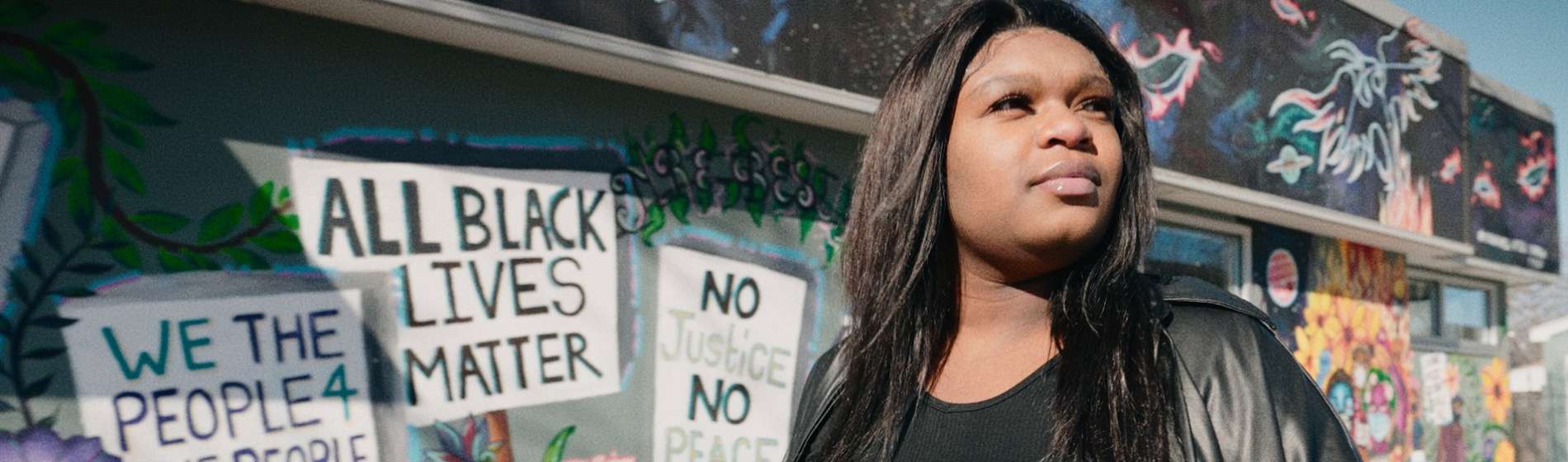
Understanding the power of controlling one’s own narrative, Fussell and Holness focus on both the activists, such as the AGAPE Movement, who are working to protect the community and ensure that the plights of their constituents are heard, and the artists, who are using their art to convey essential truths. As it conveys the importance of outlets that strengthen community bonds and provide a voice for those who often go unheard, #WhileBlack challenges audiences to think differently about the virality of Black trauma.
It’s a film that evokes strong emotions; it’s hard not to feel a sense of anger and grief watching the acts of violence in the documentary. Even years later, the clips still pierce viewers’ hearts like a freshly thrown dagger. A thought-provoking and moving work, #WhileBlack is an urgent call for change. One where the important practice of witnessing cannot be left in the hands of the corporations that seem more than happy to profit off of Black pain.