

“You don’t fool people, Stan,” says Lilith (Cate Blanchett) in Nightmare Alley. “They fool themselves.”
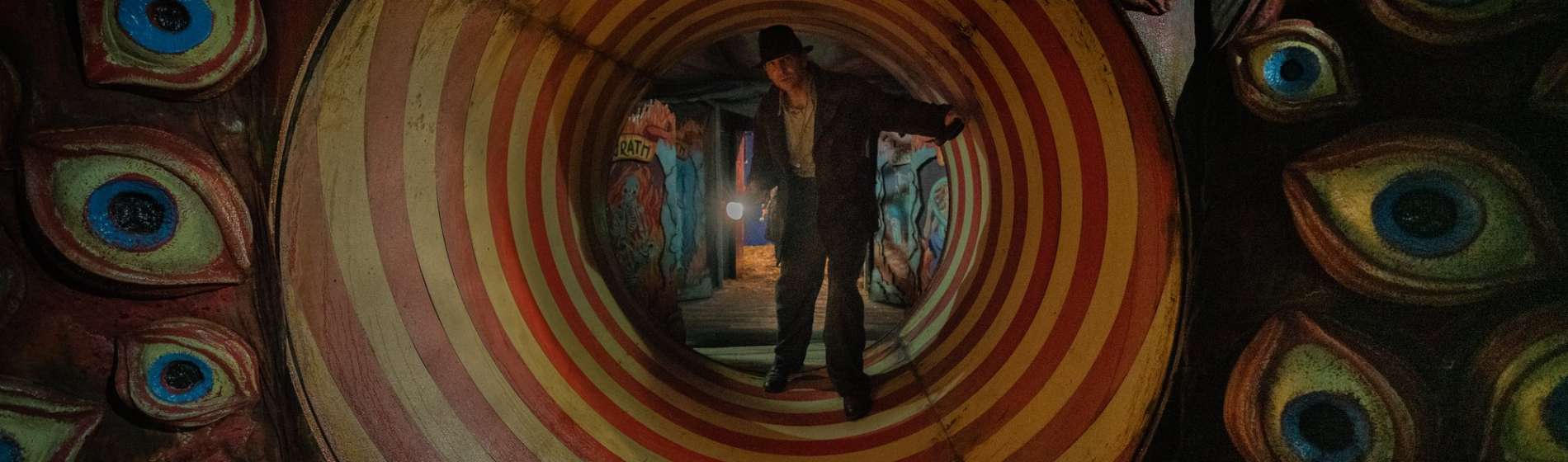
The con is on in Guillermo del Toro’s Nightmare Alley. Cate Blanchett delivers a femme fatale for the ages and joins her director’s inspired vision in making this Nightmare Alley a worthy adaptation of William Lindsay Gresham’s classic novel. This Nightmare Alley is darker, sexier, and pulpier than its literary origins. Rooted in classic film noir tropes, del Toro makes a fantastic addition to the genre. Nightmare Alley does for noir what Crimson Peak did for gothic horror. It’s an atmospheric maze through fun house mirrors with conniving carnies. The film grows more grotesque with each scene as smooth hustler Stan Carlisle (Bradley Cooper) sees an opportunity in the desire for escapism that visitors to his travelling carnival crave.
Stan arrives at the carnival on a dark night while running from his past. He lands a gig as a jack-of-all-trades, but quickly strikes up interest with Zeena, the carnival’s resident “psychic,” and her husband Pete (David Strathairn). As he watches Zeena work the crowd, Stan sees how easily people are willing to suspend their disbelief. Colette is spellbindingly good here. Offering just the right theatrical edge, she plays to the crowd. However, the second audience—the one in the theatre—can see the playful wink. She brings a level of showmanship that gives the opening act of Nightmare Alley the hook we also need to let our guards down and go along for the ride.
Zeena, however, isn’t a con artist: she just puts on a good show and gives people what they want. But as Stan learns Zeena’s tricks, and sees an opportunity in Pete’s debilitating alcoholism, the psychic power of her show assumes darker dimensions.
Adapting Nightmare Alley
Guillermo del Toro says he hadn’t seen the 1947 adaptation of Nightmare Alley directed by Edmund Goulding before penning his own script, but he oddly makes choices similar to the ones by screenwriter Jules Furthman. Both Nightmare Alleys unfold with a first act similar to the book. Stan’s entry into carny trade generally sticks to the page, although del Toro’s take unfortunately under-writes Zeena’s part. It’s a small but memorable role for Colette, but Zeena’s relative absence might rumple fans of the novel who expected Nightmare Alley to be Collette’s moment for Oscar gold. It’s perhaps inevitable that Zeena needs to take one for the team to get the story moving.
Both adaptations of Nightmare Alley, however, sag a little in the middle. After Stan builds his own act upon Zeena’s methods, he hitches up with younger carny Molly (Rooney Mara) as his assistant. Molly, as a role, has little substance in early incarnations of Nightmare Alley and, unfortunately, this sentiment holds true for the adaptation. Mara has little to do besides accentuate the triumphant flare of Cooper’s performance. Her wain innocence underscores Stan’s descent, too, as grows meaner as he gains confidence with each act. Zeena’s caveat to Stan is that a seer never preys upon memories of the dead. Stan does just that. He finds golden tickets in mining grief from members of his audience hoping to connect with loved ones. As he performs the acts, however, one feels him digging his own grave.
Enter: Lilith
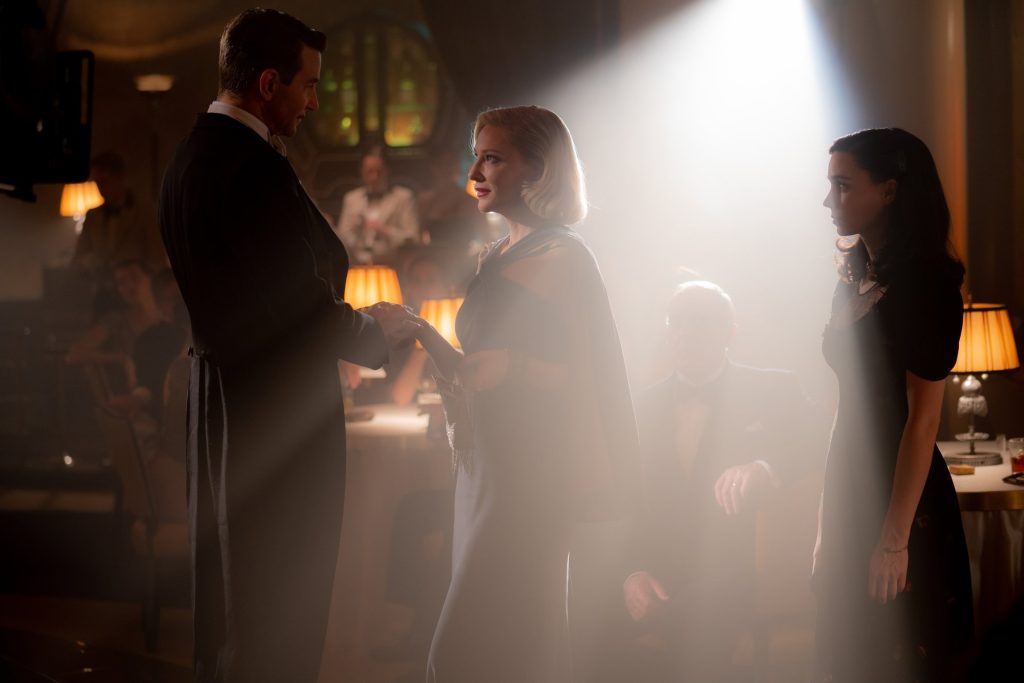
If Nightmare Alley sags in its second act, though, it comes fantastically alive when Lilith Ritter enters the scene. Del Toro seems to know what he has when an actress like Blanchett meets such a juicy role. This Nightmare Alley expedites Lilith’s entry into the story. (The book has a tangential subplot with Stan’s mother and mopey stuff with Molly.) Lilith, a psychologist, upstages Stan at his own show. She then invites him to be her partner in crime. The ruse is simple yet wicked: she will connect him with her high-profile clients and provide personal information gleaned during therapy sessions. From grieving parents to a millionaire mourning a lost lover, Lilith knows the easiest marks with the biggest wallets. All Stan needs to do is convince them that he can commune with the dead.
Nightmare Alley, like many del Toro films, is also a monster movie. The monstrosity in Nightmare Alley is Stan’s gradual loss of humanity. Cooper gives one of his better performance as the soulless huckster. There are great layers to this performance as Stan constantly presents himself as someone he’s not. He has an additional performance that tries to mask his desperation. He’s a crook addicted to inflicting misery on others, yet fully aware of his inevitable damnation. The final scene of Nightmare Alley might be the best work of Cooper’s career as Stan unleashes the monster within.
These factors make him an easy mark for Lilith. A much better con artist than Stan, she’s impossible to read. Cold as steel, yet warmly seductive, Blanchett’s Lilith is a calculating enigma. Her screen presence is hypnotic, as is Lilith’s effect on Stan. As good as Cooper is, Blanchett steals Nightmare Alley. Each time she enters the frame, she elevates the film to another level.
A Film Geek’s Carnival
Every good noir defines itself with the calibre of its femme fatale, and Nightmare Alley gives us one worthy of the bars set by Rita Hayworth and Barbara Stanwyck. Blanchett relishes the part and is at her beguiling best while drawing upon the iconography of classic bad blondes. Del Toro also crafts an unexpected twist on the source novel to give the adaptation a saucier finale. Nightmare Alley displays his signature cinephilia as it oozes classic noir from its pores.
Aesthetically, a del Toro film has never looked as good as this one. Working with many of the same collaborators from his Best Picture Oscar winner The Shape of Water, including Canadian producer J. Miles Dale and Canucks Shane Vieau and Luis Sequeira on set decoration and costumes, respectively, del Toro crafts a note perfect period piece. The world of Nightmare Alley is dark, captivating, and menacing. The atmosphere is deliciously rotten as one can all but smell the stale cigarettes, cheap booze, and carny musk in the cinematography by Dan Laustsen. This is a noir crafted by someone who truly appreciates and understands the genre. Nightmare Alley takes its time revealing its hand, but boy—does it ever play its cards smartly!