

If Glicked serves as the Hollywood event of the year, then The Brutalist offers the arthouse sensation of the season. Brady Corbet’s epic meditation on the American dream and immigrant experiences, truly, is nothing short of “monumental.” (As the film’s marketing drolly illustrates.) At a time when Hollywood churns out superhero movies and IP renewals, a four-hour behemoth with an intermission and a nerdish affinity for architecture is a bold sell. But it’s a brilliant antidote for anyone feeling cynical about the state of filmmaking.
“Denis Villeneuve and I did a round table together last weekend, and he’s spoken about this a lot,” Corbet tells That Shelf via Zoom. “I think that if you want people to get off their couch and go to the cinema, we have to create a very uniquely cinematic experience for viewers.”
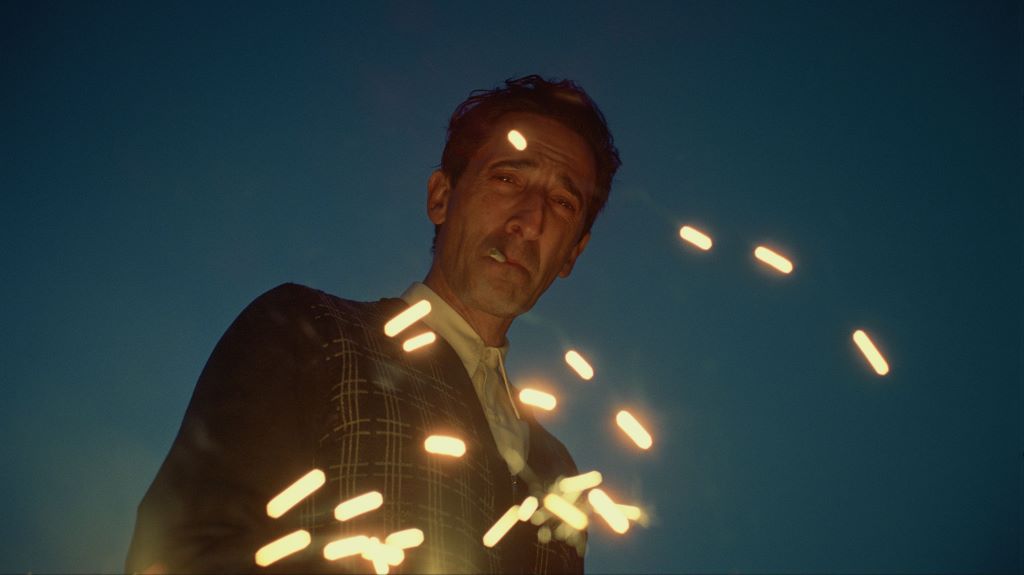
The film, which recently scored seven Golden Globe nominations and won Corbet Best Director at Venice, follows Hungarian refugee László Toth (Adrien Brody) as he arrives in New York City having survived the Holocaust. A renowned architect back home, László makes ends meet at his cousin’s furniture shop until a bold proposal from wealthy tycoon Harrison Lee Van Buren (Guy Pearce) dangles the American dream before him like a carrot. The job—refashioning a library and then building a monstrosity of a community centre—transforms László, for better and for worse.
For Brody, though, László offers the mightiest role of his career since his Oscar winning performance as Wladyslaw Szpilman in The Pianist. Intriguingly, the characters offer something of a before and after—although with obviously extremely different stories, as The Pianist focuses on Szpilman’s miraculous survival of the Holocaust, while The Brutalist observes the hell that came for László after escaping it.
“They’re vastly different characters,” says Brody in a separate interview. “However, a lot of the work that I had done in preparation to honestly portray Szpilman in The Pianist did give me tremendous insight to that time in history and the hardships that were experienced by so many. That has never really left me and has shaped a great deal of my understanding and my own gratitude on a daily basis.”
Brody pauses, offering some of the same introspective consideration that punctuates his brooding turn in The Brutalist. “But it definitely gave me insight into what László is leaving behind as he embarks on this new journey into the United States and all the hopes and dreams, especially having been victimized and traumatized to such extent in the past.”
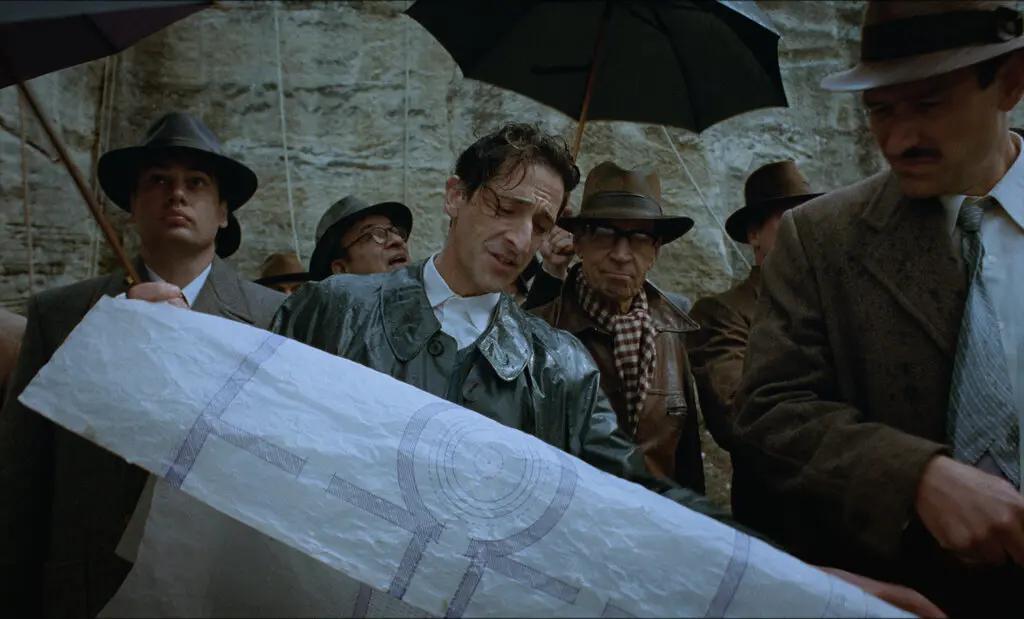
The film tasks Brody with a Herculean character arc as László finds salvation in his brutalist designs. Corbet’s film is a tactile immersion in environments as the architect rebuilds his new life using by combining methods of his past and materials from both sides of the ocean. A highlight of The Brutalist is Brody’s active engagement with the physical space and settings: László constantly finds inspiration in the tactility of his materials, getting a feel for surfaces and navigating the light of open spaces after years of confinement. He also serves as a mirror for the gargantuan Van Buren centre whose design fuels the second half of the film.
“The actual construction of this institute, this brutalist structure that László creates, is representative of his own self and past traumas and how that post-war psychology has affected post-war architecture and how they’re interrelated,” observes Brody. Created by production designer Judy Becker, the Van Buren Center evokes the ghosts of the Holocaust and the negative spaces of László’s own life, meeting the many demands of his employer, such as having a chapel among the building’s features. László completely commits to his designs as he awaits news of his wife (Felicity Jones) from whom he was separated during the Holocaust.
“This walled shell and fortress-like structure with this hollow expansive interior very much speaks to where he ends up in a lot of ways, yet with this spiritual high ceilings and the ability to commune with a higher power and hope,” says Brody. “I think it’s quite beautiful and the relationship is very intimate. I think the journey of an architect to pour everything into it—the foundation of his own struggles and what he’s overcome—is the foundation to build such unique monuments like that. It’s one and the same. He’s part of all the creation of it from the ground up.”

Corbet says that the relationship between László and these spaces is obviously part of the script, but that he trusted Becker to envision the right designs to complement the architect’s emotional states. “The library, for example, was described almost to a T in the screenplay. The building, however, was not really described at all,” explains Corbet. “Judy came with poster boards full of references of synagogues that had been created in the brutalist style and the shape of the Star of David. She came with this idea of the cross and the absent space, and I loved it. And she had beautifully come up with a solution for a problem that the film’s final monologue proposes for a designer, which is how to evoke the camps in Dachau and do so in a way that didn’t feel heavy handed or like clumsy symbolism. That’s a hundred percent Judy Becker.”
Corbet adds that Becker’s work recreating 1950s’ New York for Todd Haynes’ Carol inspired him to reach out, especially for a film with such demands for scale on such a small budget. (Corbet reportedly shot The Brutalist for under $10 million, on VistaVision for a 70mm release, no less.) “She’s one of our great American designers, full stop,” says Corbet.
“I try to put everything in the screenplay,” Corbet continues, “even the intention of the frame. Is it a medium [shot]? Is it a wide? A close-up? By the time everyone arrives, we’re mostly executing the draft. Adrien fully comprehended the material in a way that maybe only he could because of his background.”
Brody cites his upbringing, too, following an observation that László joins some of his other characters, notably Szpilman in The Pianist and his memorable turn as Salvador Dalí in Midnight in Paris, in which he delivers his best work playing creatives. “I am the son of an artist,” Brody says. “My mother, Sylvia Plachy, is an immigrant who fled Hungary in 1956 during the Revolution. She is a remarkable artist.” Plachy is an acclaimed photographer, best known for her work with The Village Voice and several award-winning photo books, including the personal tour of Central Europe in Self Portrait with Cows Going Home.
“That instilled a lot in me and my own hopes and aspirations and yearnings as an actor and as an artist,” says Brody. “But I also grew up in New York City through the Seventies and Eighties and Nineties. It was a very creative and diverse place. My mother photographed at The Village Voice for many of those years, and I encountered so many artistic types along the way. I think I like to be around artistic people. I like to be around people who have found ways to express themselves and the human condition through creativity.”
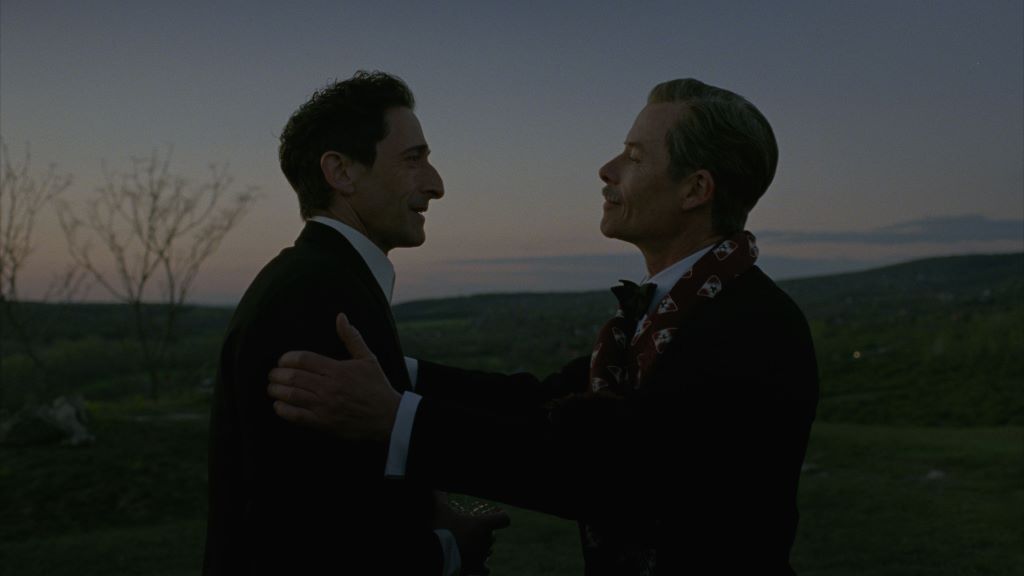
Brody obviously finds such a match in Corbet, who makes an incredible leap forward as a filmmaker with The Brutalist after the hypnotic pop star drama Vox Lux and the World War I film The Childhood of a Leader. The ambitious sense of scale, of epic tragedy, finds inspiration on Corbet’s own family story, just as Brody’s performance draws from his own life. Corbet credits the stories he’d hear from his grandfather, who grew up in a former region of Hungary, now Serbia, and served in the Air Force during World War II.
“It was only when I was a young adult that I could fully comprehend that he was clearly traumatized from his experience,” says Corbet. “It was very common, especially for men of the mid-century, to have a real inability to express themselves verbally. So it was important for me that Adrien’s character was only able to express himself through his work and that he is constantly bickering with his wife. He can never say anything particularly kind to her, and yet this entire project is about her and for her, which I think it is the most beautiful gesture, of course, but it’s also a frustrating symptom of the era—his inability to ever say what he meant.”
While Corbet acknowledges that it may be tough for audiences to witness László’s own brutal corruption, he thinks cinephiles will find that going to the deep and dark places that The Brutalist takes them is an event worth undertaking. It’s a reward for audiences who dare to be challenged as it contrasts painful emotional intimacy with sights of cinematic grandeur.
“If you think about very intimate movies from the 1970s’ that were about human relationships, they were still major events: Louis Malle‘s films or Bertolucci’s films,” says Corbet. “I think that, unfortunately, a lot of contemporary cinema has become so formulaic and so algorithmic that it has sort of inadvertently become content. I think that that’s obviously something we all need to be steering away from in the filmmaking community.”