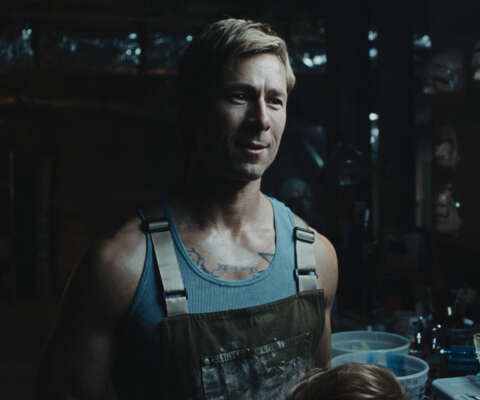


Mark Kerr is considered a unicorn of sorts in the world of the Ultimate Fighting Championship (UFC). He was a hulking man who had the rare combination of strength and speed. While his intimidating exterior no doubt instilled apprehension in the opponents he faced, his most shocking feature was his soft and gentle voice. Similar to Kerr, Benny Safdie’s solo feature debut The Smashing Machine defies conventional assumptions.
Marketed as the type of sports drama that made The Fighter and Cinderella Man hits, but with the UFC octagon replacing the traditional boxing ring, it easy to dismiss Safdie’s film as a tale of struggle and triumph from the outside. Its interiors are far more intriguing though, offering a sense of realism that strikes at the core of Kerr’s duality as a gentle giant and destructive force. Flowing on a hypnotic wave of tension and emotion The Smashing Machine takes many of the tropes of the genre and remixes them in fascinating ways. Like its protagonist, the film is laser focused on the intangibles that made Kerr a compelling individual in and out of the arena.
Taking place between 1997 and 2000, Safdie introduces audiences to Kerr (Dwayne Johnson) as he is participating in his first UFC match. Coming from a wrestling background, and backed by his good friend and former UFC champion Mark Coleman (Ryan Bader, a real mixed martial arts fighter), Kerr quickly proved he was a force to be reckoned with. While the pay was not great, which is why he jumped to the Pride Fighting Championship in Japan during the years the film covers, he displayed all the characteristic in the ring of a legend. He took down his opponents with precision and ferociousness that was opposite to his demeanour outside the ring. When asked by a Japanese journalist a hypothetical question about losing, he couldn’t answer because it just didn’t happen.
Defeat may not have been in his vocabulary at the time, however, that didn’t mean he couldn’t spell pain. Doing up to three matches a day per event, Kerr turned to pain killers to manage the wear and tear on his body. As Safdie’s camera zooms into the label of medication, highlighting the addictive nature of the serum he routinely injects into his body, the audience is given all they need to know about the real battle the wrestler will face.
In observing Kerr navigate his addiction, and the way it impacts his relationship with his girlfriend Dawn (Emily Blunt), Safdie weaves a visceral portrait of the price one pays to achieve a dream. Questioning if the sacrifice is truly worth it, The Smashing Machine is most fascinating when observing the volatile way Kerr and Dawn’s union slowly erodes.
As the sand washes out from beneath their feet, and they become more unstable, Kerr desperately tries to maintain the firm grip of control on a relationship he frequently took for granted. Both wanting Dawn by his side and annoyed by her presences, he thought he could compartmentalize her the same way he did the brotherly bonds of the locker room and his addiction. Blaming his regular violent outbursts at home on the stresses related to training for a tournament that would crown the winner the best fighter in the world, he failed to see how his actions, which resulted in various broken doors and dishes, were pushing his biggest supporter to her breaking point.
For all the vicious blows given and taken in the ring, the film’s sound design and cinematography are sensational. But the raw nature of Kerr and Dawn’s dynamics are the pulsing heart of the film.
Barely recognizable under the prosthetics and make up, Johnson delivers one of the best performances of his career. Ferocious and vulnerable in equal measure, he brings a level of humanity to the character that allows the audience to remember that Kerr is a mere man, albeit a flawed one, and not a hulking monster. Blunt complements the performance nicely by allowing her gestures and facial expression convey the growing hurt and disappoint brewing inside. Dawn desperately wanted to be there for Kerr, but some emotional locks are simply too hard to pick.
In Safdie’s skilled hands, the couple’s emotional rollercoaster is filled with tender and shocking moments. Avoiding the familiar tropes of the genre, there are no big uplifting speeches or grand rock-bottom falls. It is a film where so much happens under the surface. Safdie is more fascinated by the real moments, the ones that can cause the mind and body to freeze in panic when you need motion the most. Incorporating a documentary feel, and positioning the camera in ways that it seems as if it is eavesdropping on the couple’s daily life, Safdie’s approach to realism is as invigorating as the performances he is capturing. After collaborating with his brother Josh on several great films including Good Times and Uncut Gems, the director shows that his unique cinematic voice is more than capable of standing on its own.
A compelling work that often defies convention, The Smashing Machine is a revelation. It shows that the most brutal punches are found not in the ring, but in the bonds we often take for granted.
The Smashing Machine screened as part of the 2025 Toronto International Film Festival. It arrives in theatres nationwide October 3.
Head here to get all our That Shelf TIFF coverage.