


Born Doris Mary Anne Kappelhoff in 1922 in Cincinnati, Day initially trained as a dancer. As part of a duo with a performer named Jerry Doherty, she had initially planned to go to Los Angeles to take advantage of the success they’d been having in national competitions. These plans were curtailed when, at the age of 15, she was in a car accident that destroyed her right leg and threatened her ability to walk, let alone dance, ever again. While recovering from her injury, she listened to Ella Fitzgerald on the radio and practised singing, and it wasn’t long before she would make plans to head west again, this time to make it as a vocalist. Legend has it that on the night before she was set to give up and leave Hollywood after pounding the pavement and getting nowhere in the movies, she sang at a party that director Michael Curtiz was attending. At that time, he was casting 1948’s Romance on the High Seas, which had been intended for Judy Garland but then given to Betty Hutton, who had to drop out due to pregnancy. Curtiz heard Day sing, she was cast, and a star was born.
The fifties was a successful decade for Day, but it was in the sixties, with the release of Pillow Talk and her pairing with Rock Hudson, that she would make it to the A-list and inspire Oscar Levant’s immortal quip, “I knew Doris Day before she was a virgin.” By the end of that decade, her film career would be over and she’d learn, after the sudden death of her husband Marty Melcher in 1968, that her finances were in shambles thanks to his squandering her earnings. Following the completion of her 1968 film With Six You Get Eggroll, which featured a young Barbara Hershey as her daughter, Day decided she was done with movies. (She was offered Mrs. Robinson in The Graduate but found the material sleazy.) Melcher, it turns out, had signed her up to a television show without her knowledge, but she honoured the contract that bore her name, completing four seasons of The Doris Day Show from 1968 to 1973, after which she gave up acting for good, only appearing on television again for a brief stint as the host of a talk show called Doris Day’s Best Friends, in which she showcased her love of animals.
Day is often held up as an icon of American showbiz hypocrisy, the squeaky-clean, Goody Two-Shoes whose uncomplicated singing was for nerds and whose movies were preposterous trad wife propaganda. Viewers who love the undercurrents in most of her movies, such as the running joke of Hudson pretending to be gay as a way to seduce her, don’t credit her with being in on the joke, but I can’t help finding something exciting in Day’s presence on screen, despite the fact that she’s the opposite of the liberal firebrand we love celebrating in our movie heroines of the past. There’s an integrity there that suggests that not only is she in on the joke about herself, but that she is decent and fearless, she won’t abide injustice of any kind to anyone despite their not being from her side of the tracks (and stories of her professionalism and her friendship with Hudson at the end of his life do support this).
From the 2000s on, Day declined most of the invitations she received for public appearances and was rarely seen beyond the walls of her Carmel home, where every year on her birthday, fans gathered for a public festival whose proceeds went to her animal foundation. Her son, Terry, who was connected to the Charles Manson murders in the late sixties, died at the age of 62 in 2004, fifteen years before she would pass away at the impressive age of 97. Per her request, there was no funeral or grave marker.
These are my favourite Doris Day movies:
10. Caprice
Frank Tashlin, 1967
I did an episode of Bad Gay Movies on this film, which represented a low point in Day’s career, she filmed the whole thing knowing the script was a mess and wasn’t surprised that it turned out to be one of her biggest failures. So why is it on this list? Because the camp value has turned it into a classic, and because it’s a great example of how indefatigable she was, coming off smelling like a rose no matter how big a cinematic pile of dung she was flung into. She plays a corporate spy who has been fired by her employer and goes to work for his rival, secretly on assignment to get the scoop on a breakthrough cosmetic product before discovering the company’s connection to her own personal past. Underwhelming direction by the very celebrated Tashlin ruins delightful production design and the charming chemistry between Day and co-star Richard Harris, but her wardrobe is worth the effort.
9. The Thrill of It All
Norman Jewison, 1963
Day’s most famous collaborations are the three films she made with Rock Hudson, but she filmed plenty others with different co-stars that followed the same outline. In this one, she plays a gorgeous housewife to a successful obstetrician (James Garner). Her enthusiasm for a product being made by a soap magnate she meets at a dinner party convinces him to make her the star of the brand’s commercials, which turns her into something of a television celebrity, which means the worst possible situation in an American home: she’s not always there to cook dinner! The highly dated misogyny, reminding women of their place in the home, would be unwatchable today if it wasn’t for Day’s vivacious performance and humour that keeps it afloat.
8. By the Light of the Silvery Moon
David Butler, 1953
Looking in to cash on the success of MGM’s Meet Me In St. Louis, Warner Bros. came up with its own musical comedy about a wholesome family in turn of the century America, On Moonlight Bay. Copying everything right down to the crotchety maid (originally Marjorie Main, this time Mary Wickes) and the patient, hapless father (Leon Ames in both films), they followed it with this superior sequel, with Day once again the spunky lass who continues to romance returned serviceman Gordon MacRae. She sings a gorgeously produced musical score, which centers around the title song. For twee virtuousness, you could do a lot worse.
7. The Pajama Game
George Abbott, Stanley Donen, 1957
Newly unionized workers are campaigning to get a seven-and-a-half cent raise at a pyjama factory, their new foreman (John Raitt) determined not to give in to the chairman of the grievance committee (Day) until he notices what a va-va-voom number she is. Adapted, surprisingly faithfully, from the hit Broadway musical that also launched Shirley MacLaine’s career (thanks to producer Hal B. Wallis attending on a night that she was performing as an understudy), this delightful film features a host of brilliant musical numbers, choreographed with exuberance by Bob Fosse. The cast is reunited from the original production with the exception of Day, filling in for Janet Paige and giving one of her most charming performances.
6. Romance on the High Seas
Michael Curtiz, 1948
Day plays a nightclub singer who switches places with a society dame (Janis Paige, who played Day’s role in The Pajama Game on Broadway) who wants to test her husband’s fidelity: she makes him think that she’s gone on a South American cruise and left him with all of New York’s women at his disposal. He counters by hiring a private detective (Jack Carson) to shadow his “wife”, but Carson has no idea that Day is a phony: which is a good thing, because when they fall in love with each other, the audience doesn’t have to worry about the sticky moral quandaries that adultery can produce. Filled with lush, romantic music that reaches its highest point with the Oscar-nominated “It’s Magic”, the film is a wonderful treat that gives ample reason for Day’s later success as a movie star.
5. Young Man with a Horn
Michael Curtiz, 1950
This highly entertaining melodrama by the great Curtiz, allegedly based on the life of Bix Beiderbecke, eventually gives way to hokey soap opera but is rife with fantastic music including the (dubbed) trumpet solos by Kirk Douglas and Day’s incredible singing. Douglas plays a musical prodigy who ruins his potential romance with a good girl (Day) over his devotion to his instrument, then enters a miserable marriage with a mysterious socialite (Lauren Bacall, brilliantly playing a messed-up, over-the-hill debutante at 26 years old) that nearly destroys him. For a career well known for sunny comedies that make cynical modern-day audiences cringe, this is a rare chance to see Day in a sexy, atmospheric potboiler with more than a few hints of sexual transgression (Bacall’s character is coded as lesbian for a lot of viewers) and musical numbers that are more intense than her usual chirpy pop tunes.
4. Calamity Jane
David Butler, 1953
I don’t know if Doris Day ever sounded lovelier than in this wonderful film, an attempt to cash in on the success of Annie Get Your Gun that outdoes that film with its score. Jane, played by Day in one of her favourites of her own roles, is a gun-slinging gal of the Old West who will never get a guy with her rough and tumble ways; she moves in with a female pal and learns a few things about going from butch to femme in time to woo her love interest, Wild Bill Hickok (Howard Keel). The songs are non-stop and they’re all great, with the absolute pinnacle being the Oscar-winning theme “Secret Love”.
3. Lover Come Back
Delbert Mann, 1961
Two of Day’s movies with Rock Hudson are among her best, this one their first reunion after the immense success of Pillow Talk. She is once again a working woman who is manipulated by Hudson’s lifelong bachelor, this time as professional rivals working for different advertising agencies fighting over the account of a new product that she doesn’t realize he has invented to please a jilted girlfriend. Sunny photography, Day’s beautiful outfits and a couple of songs make for a witty and sophisticated treat.
2. Storm Warning
Stuart Heisler, 1950
Somewhere in between all these marvellous musicals and comedies, Day also appeared in one of the most gripping and upsetting dramas about injustice in America, giving the performance that inspired Hitchcock to hire her for The Man Who Knew Too Much. Ginger Rogers plays a dress model on her way to a sales conference who decides to get off her bus early in the town where her sister, Day, lives, because she hasn’t seen her in some time. She’s plunged in a strange world that Heisler creates with fascinating eeriness: the cab driver tells her there are no taxis, the bus station turns off all its lights and she has no choice but to walk ten blocks to the recreation center where her sister works and, en route, sees a crowd of Klansmen exit the town’s courthouse with a bound man whom they kill before her eyes. It’s a plot that would be at the centre of more cultish, exploitative fare a couple of decades later but here is treated as a kind of morally robust film noir (with typical hypocritical delicacy of studio films of the time, it’s the only movie about the Ku Klux Klan I’ve ever seen that doesn’t feature a single African-American either in person or in theme). Rogers gives a fully committed, blistering performance, and Day is even finer, her presenting the conflict of feelings between her morals and her family results in one of her most complex and moving appearances in a film.
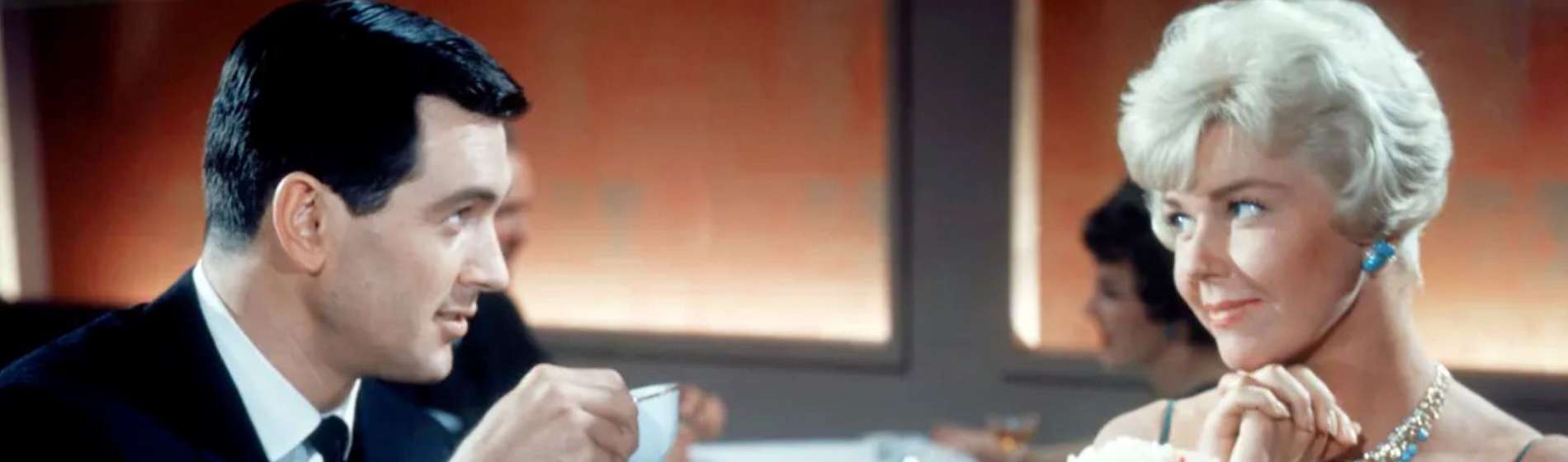
1. Pillow Talk
Michael Gordon, 1959
The first of three hugely successful romantic comedies starring Day and Rock Hudson is still the best and most popular, and despite the fact that much of its content is hopelessly dated, the enjoyment of it is not. Earning her only Oscar nomination in her career, she plays a successful, single interior decorator who is frustrated with a songwriter (Hudson) with whom she shares a ‘party’ line across town, unable to make business calls because he is constantly on the horn wooing countless women. Smacking with the era’s hallmarks of film ‘sophistication’, martinis, jazz bars, coy references to sex and even some retro gay humour that audiences will now find even more absurdly funny, it’s a classy outing that doesn’t seem to have lost any of its charm. Day was already successful when this film came out, but the film’s box office success turned her into a major star of romantic comedies at the improbable age, in the youth-oriented business of Hollywood movies, of 37. The film’s massive box office intake and Oscar for writing also initiated an era of romantic comedies labelled by screenwriter Jay Presson Allen as “DF” movies (which stands for “delayed f*ck”), films that built on the machinations of screwball comedies by focusing on the delaying of sexual satisfaction until after marriage, but which from the first minute were obsessed with nothing else.