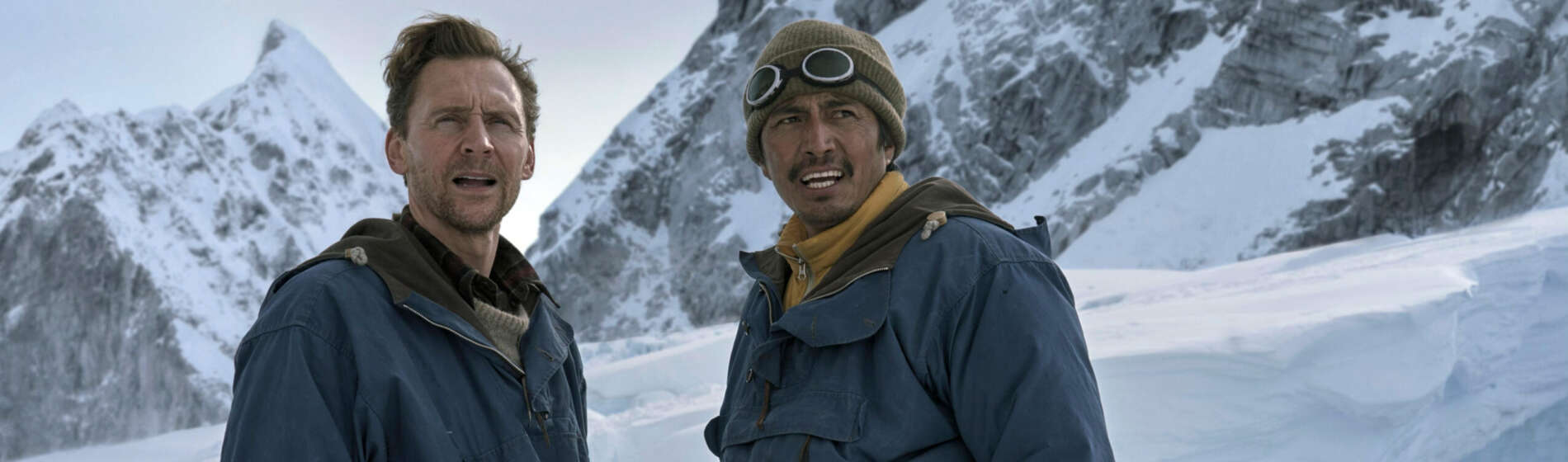



Few achievements are as monumental as reaching the summit of Mount Everest first. The stamina, drive, imagination, and bravery needed to achieve such a feat outpace most of us. It’s almost unfathomable, and yet it happened. And the duo that first stepped where no other human beings had ever set foot–Tenzing Norgay and Edmund Hillary–became household names almost as soon as they returned to their expedition’s base camp. But just how did those two get there in the first place? Jennifer Peedom’s latest feature, Tenzing , takes us on that journey through Norgay’s eyes. What follows is a fairly standard biopic, but one elevated by stunning visuals and a dedicated, charismatic performance from its lead.
It All Starts With An Idea
The film kicks off with a young Tenzing (Samdrup Dorje Lama), a son of a yak herder, standing in awe of the great Everest–one that Tibetans call Chomolungma, which means “Mother Goddess of the World”. We quickly learn that in local Buddhist culture, the mountain is revered as a living divine being, and people are more comfortable worshipping her from afar than trying to conquer her. Unwilling to just dwell in her shadow, he meets the first foreign expedition to climb Everest, led by George Mallory (Johnny Flynn), and makes it his life’s purpose to reach the summit once he’s older, no matter the cost. Though their meeting is mere speculation rather than fact, it’s an excellent framing device for what follows.
Due to circumstances beyond his control, Tenzing is abandoned by his family at a monastery in Nepal as a boy . As he grows into a teen (now played by Tenzin Dalha), the young man ends up making a living working the land for Sherpa families above his station. He bonds with the daughter of one of those families, and they spend quiet moments studying Chomolungma from afar and speaking of the young man’s dreams. Eventually, the two run away to Darjeeling and marry, getting by with odd jobs until one day Dawa (Thinley Lhamo) hears of a new expedition the British are mounting to climb Everest. Facing racism and othering (as he is not ethnically a Sherpa, nor does he speak English or have any experience), Tenzing (played as an adult by Genden Phuntsok) uses his wits and charm to finally make the grade and begin a lengthy career liaising and climbing the great mountain.
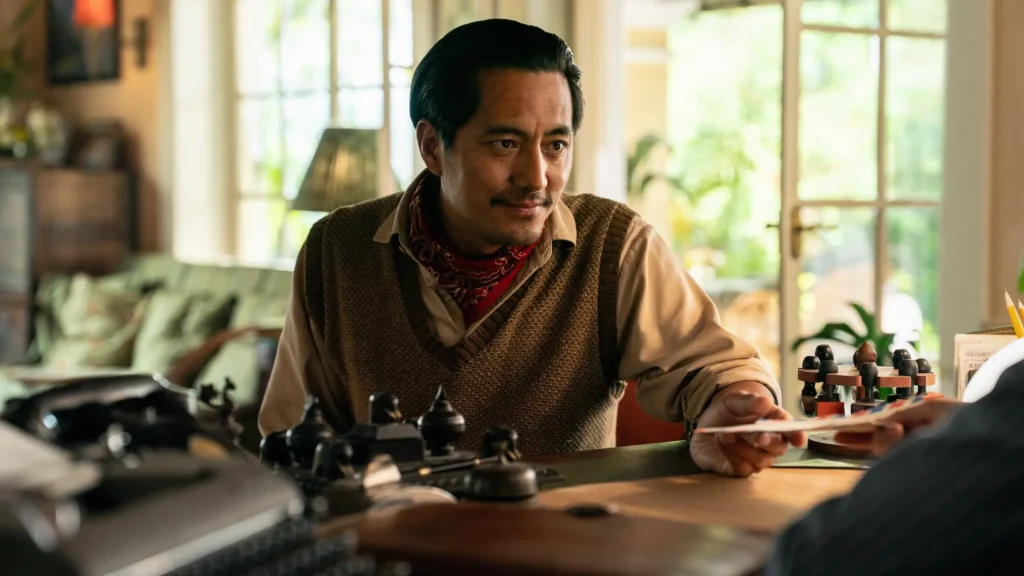
Fast-forward to 1953, and having just set a new altitude record with a Swiss expedition (which missed the top by just 800 feet), Tenzing negotiates a position as a full-fledged climbing member of that year’s foreign permit team–the British, led by military man John Hunt (Willem Dafoe). Again caught between the colonizers and locals, he walks a fine line of diplomacy to reach a point no one had been before. Along the gruelling journey, he forms a friendship with Kiwi climber Edmund Hillary (Tom Hiddleston), and after fighting blizzards, hypoxia, climbing accidents, and more, the two make history as the first to stand on top of Everest–ironically making the claim for Queen and Country, despite neither being British.
A True Mountain’s Majesty
Given the subject matter, the visuals are suitably majestic. Stefan Duscio’s cinematography shows the mighty peaks of the Himalayas as equal parts imposing and intriguing. The idea that anyone would want to climb even the smallest peak seems insane, but it’s hard not to feel the same pull that Tenzing and others must’ve felt in the presence of their greatness. The careful framing of that singular calling, and the immensity of the expedition’s task, brings to mind George Mallory’s famous response to the question of why he wanted to summit Everest: “Because it’s there.” The Nepalese and Himalayan scenes are stunning and evocative of another time entirely, while New Zealand locations ably stand in for some of the historical climbing locations–all of which are still used on the Southern route up the mountain.
On the technical side, most of the riveting climbing scenes were done by Phuntsok and Hiddleston themselves–both having come to the film with no mountaineering experience at all. Even Dafoe, who director Peedom said in interviews is afraid of heights, insisted on doing some of his own work on location. The actors had no shortage of experts coaching them through the toughest bits, as the cast and crew had over 61 Everest summits between them, with two Sherpas serving as assistant cameramen, too.
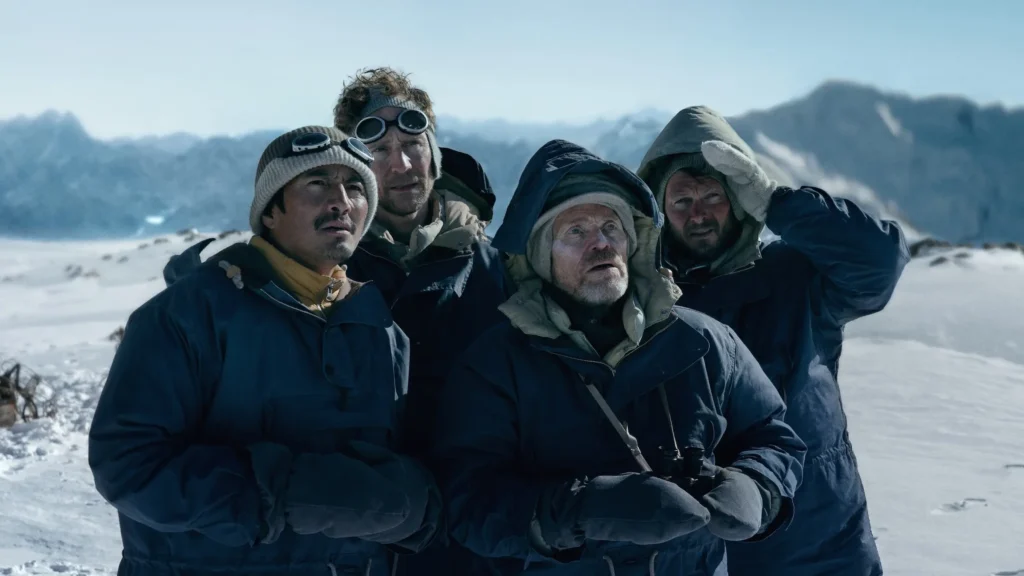
Tenzing also pays close attention to details, particularly when it comes to climbing. Watching the recreated expedition confront the harsh elements above 26,000 feet with what now looks like flimsy and antique equipment is eye-opening. It’s amazing to think any of them survived. The route they took is still the one favoured by most climbers, though the “Hillary step” – the final big obstacle before the summit, a key moment in the film and in the historical summit – no longer exists due to shifting on the mountain after the 2015 Nepalese earthquake.
In the Shadow of Greatness
That grandiose setting, perhaps understandably, overpowers a fairly standard, but obviously well-meaning script from writer Luke Davis. Though it tries to mix things up with a bit of non-linear storytelling–revisiting moments from Norgay’s life as he ascends with the 1953 expedition–it checks many of the standard biopic boxes, while only providing real depth to the central subject. It feels as if the production focused more on the momentum and tension of the core story, which both buoy the film as almost physical manifestations of Norgay’s ambition, rather than weighing it down with supporting character development. Perhaps understandable, given the film is called Tenzing . But his arc would have benefited from a more well-rounded portrait of his wife, Dawa, and his time with his family, given how important both later become to his Everest mission. That also carries particular weight, since the story is factually and accurately male-centric, so any added dimension to the women present would’ve been welcome.
Davis does his best to inject pertinent topics of colonization, racism, respect for the environment, and religion, but few ideas are given enough space to build into anything of real, solid significance. He is most successful in his positioning Norgay as an outsider–from both the British and from the Sherpas. There is satisfying narrative payoff there, too, as he is eventually accepted by both groups due to his dedication, his bravery, his expertise, and his innate intelligence. His winning over the Sherpas by subtly but successfully subverting the Brits’ stiff-upper-lip racism is particularly rewarding to watch. It’s hard not to cheer as he finds ways time and again to advocate for these amazing men whom most expeditionary forces treat as mere servants. There’s a particularly touching moment when British expedition leader Hunt finally realizes Norgay’s obvious talent and wishes him well for the final push to the summit, and he does so in broken but sincere Nepalese. It should come off as cheesy, but from Dafoe, it carries real meaning and regret.
The film also seems to suggest that despite everything that makes Norgay great, it shouldn’t take someone being almost superhuman to win over opposition or marginalization. But Peedom is savvy enough to show that, unfortunately, that is not the world Norgay, or indeed her contemporary audience, inhabits.
The film also highlights cultural gaps and differences in how people approach the mountain. To the Sherpas, the goddess of the peak is to be respected, and her protection sought before setting forth. When things go wrong, the Nepalese worry they have wronged her by being there or that they have not given her enough deference in her presence. The supporting cast of Sherpas conveys that fear of retribution well. Norgay himself hopes to find his wife’s spirit on the mountain and thank the goddess for his family and life. That Indigenous viewpoint is very obviously juxtaposed with the European mindset of conquering the obstacle they see in Everest. They mount their expedition like an invasion, focused only on vanquishing an enemy, and in doing so, subjugating nature itself. It’s a completely foreign way of looking at the world that sets Norgay and the Sherpa’s teeth on edge. The film doesn’t mince words about these differing mindsets, giving us dialogue that’s about as subtle as an ice hammer, but given our current climate crisis and the number of people still cleaving to outdated notions of warring with Earth, maybe the more obvious the better in 2026.
Fame and Fortune
As mentioned, Norgay himself is played by not one, but three actors–all at different stages of his life. Both Dalha and Lama portray the young dreamer as a child and teen, learning to make his way through difficult circumstances, but the lion’s share of the emotional and physical heavy lifting falls to Phuntsok, in his English-language debut no less. He imbues Norgay with determination and confidence that’s almost tangible, while still keeping him warm, charming, and resilient. He wears his past obstacles metaphorically on his back, but never lets them weigh him down. When he encounters pushback, largely in the form of racism, or feels under-appreciated, he finds ways to fight back and stand up for himself. He never wavers in knowing his worth, talent and, frankly, singular abilities. Phuntsok bears a striking resemblance to Norgay and, as an actor, knows just when to deploy that famous, million-watt smile, too.
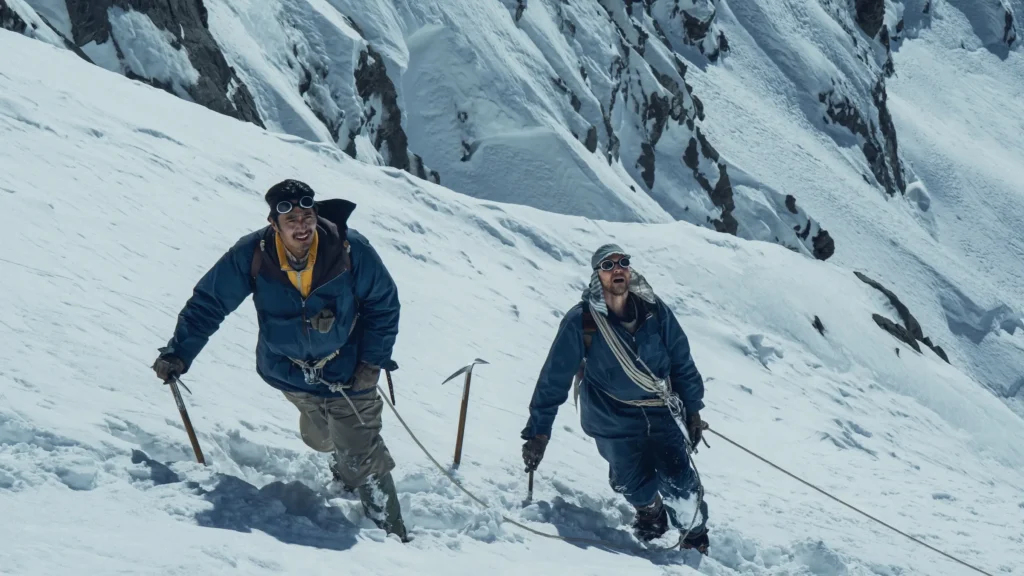
In an important, but largely supporting role, Hiddleston brings a quiet passion and reserve to Hillary. He’s aided by a script that steers clear of any white saviour tropes, noting that the Kiwi was also an outsider on the 1953 expedition. Though this was far less of a detriment for him than for Norgay, it allows a natural friendship to form between the two climbers. They both recognize something similar in each other and note an elusive chemistry that could prove key to their success. The actors allow us to see that bond forming, their opinions of each other thawing, through looks of understanding, brief moments of dialogue, and appreciation of each other’s not inconsiderable mountaineering skills. It solidifies as the hazardous climb continues, and they experience not one but several moments where teamwork is the only thing standing between life and certain death. It’s not at all surprising when the credits tell us the men’s friendship continued long after their amazing feat, not just because they were brought together by fame, but because of a true appreciation for the other that both actors convey extremely well.
Despite being almost 30 years older than his character, Dafoe sells every scene as the expedition’s leader. From being almost giddy at the thought of summiting Everest on behalf of the newly crowned Queen Elizabeth II, to a man overwhelmed by pressure and imminent failure, to the true joy of having done what no one had done before, he gives depth to a character that could have been one-note and forgettable. Though in much smaller roles, the same can be said for Lhamo, CaitrÃona Balfe (as the Secretary of the Himalayan Club who convinces Tenzing to join the climb), and Tenzin Jigmey (as Tenzing’s doubting Sherpa). All three elevate fairly basic roles, necessary for the plot but little else, into more memorable characters, which add some needed shades of colour to Peedom’s storytelling.
The Pinnacle of Achievement
When you get right down to it, though, the star of Tenzing isn’t actually Norgay, but Chomolungma/Everest itself. It dominates every frame and will leave even the toughest audience member in awe of its majesty. And though the film has its paint-by-numbers moments, it still manages to be a fitting, long-overdue tribute to a true icon. From stunning visuals to a dedicated lead and supporting cast, it showcases the otherworldly tenacity required to attempt not only to reach the top of the world, but to achieve it. Though many have climbed the peak since, Norgay and Hillary’s achievement remains almost unbelievable even upon seeing it, albeit a fictionalized version, with our very eyes.