

Uncensored, restored, and rereleased, filmmaker Ken Russell’s The Devils, a controversial, if undisputed, masterpiece, returns for a one-week theatrical run courtesy of Warner Bros. and its soon-to-be-shuttered Clockwork subdivision. Condemned at the time of its release in 1971 for its supposed blasphemous themes, rampant onscreen nudity, and depictions of sadomasochistic torture, The Devils was — and remains — far more than mere provocation aimed at reactionary moviegoers and cultural critics. It’s certainly provocative, and even now, conservative Catholics will likely take offence, but that just makes The Devils as vital today as it was 55 years ago.
For Urbain Grandier (Oliver Reed), the 17th-century Roman Catholic priest at the centre of The Devils, keeping one of the key vows to the Catholic priesthood, celibacy, is simply one he can’t keep. As Grandier self-servingly argues to an indecisive partner, celibacy isn’t mentioned anywhere in the New Testament. It’s a rule made by fallible Churchmen for other fallible men. Naturally, Grandier feels justified in breaking said rule when his natural, God-given urges take over.
Driven by carnal pleasures and conscience-stricken by the demands of his religious faith and spiritual calling, Grandier represents a deeply flawed but not irredeemable tragic figure of classical Greek or Shakespearean drama. He’s undoubtedly a sinner, but his love and affection for the walled city of Loudon, France, and the community he serves as priest also suggest a kind of purity. Grandier serves Loudon’s community with the dedication of a true believer in the Roman Catholic faith, as when he sets aside concerns for his own health to minister to a dying woman in her final moments. Her body covered with the telltale signs of the bubonic plague, Grandier prays over her as she dies with a seriousness of purpose, compassion unhindered by cynicism, and a belief in the heavenly salvation to follow in the next life.
Later in The Devils, Grandier’s naive, unfounded belief in the king’s deity-like benevolence — a belief undermined by Russell’s depiction of the king’s debauched presence onscreen — leads to his inevitable downfall. Inevitably, he becomes the target of politically motivated religious persecution. Church authorities accuse Grandier of witchcraft, of committing crimes against the Church, the State, and the people of Loudun. Like Grandier, Loudun’s citizens become unwitting pawns in a larger political plot, one involving Cardinal Richelieu (Christopher Logue), the scheming, power-hungry advisor to Louis XIII (Graham Armitage), a simple-minded, easily bored, easily entertained monarch under the cardinal’s nebulous influence.
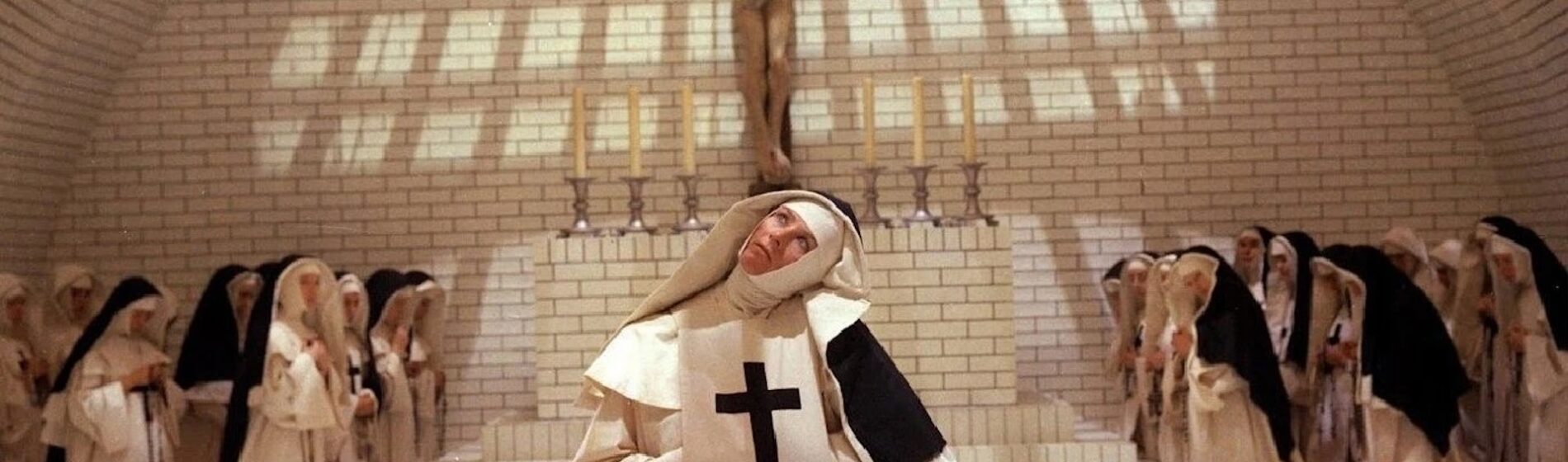
Cardinal Richelieu sees, perhaps rightly, a walled city like Loudon where Roman Catholics and Huguenots (Protestants) have lived peacefully together, as a potential threat to the centralized power represented by the French monarchy in Paris. But to break Loudon’s real or imagined resistance, and tear down the city’s walls, the cardinal needs a pretence. The cardinal finds exactly that pretence in the feverish rantings of Sister Jeanne des Anges (Vanessa Redgrave), the Mother Superior of a cloistered nunnery situated inside the city’s walls. She’s obsessed with Grandier, a man she’s never met in person, but only seen from afar or in her sex-starved imagination.
For the disabled Sister Jeanne, Grandier isn’t a mere man or even a priest. He’s all men she’s ever desired or will desire. In one telling “vision” (hallucination), Sister Jeanne sees a Christlike Grandier walk across the water, a blasphemous image if ever there was one, before he approaches her for an unholy communion, presumably one involving their bodies. But like everything about the sexually repressed Sister Jeanne, the vision curdles into a public spectacle with Sister Jeanne as an object of ridicule and contempt.
Sexual desire isn’t the root of all evil, at least not in The Devils. Here (as elsewhere), however, it leads good men and women astray and, worse, it allows the Powers-That-Be to manipulate those desires into political repression. Grandier badly errs, both by breaking his vows, possibly leading to his exile from the Church, and callously rejecting Philippe Trincant (Georgina Hale), the niece of one of Loudon’s city leaders, after she becomes pregnant with his child. Even worse, Grandier falls in love with — and ultimately secretly marries — a pious young woman, Madeleine De Brou (Gemma Jones).
When one of the cardinal’s allies, Baron De Laubardemont (Dudley Sutton), enters Loudon, soldiers at his side and a human-powered siege engine at the ready to knock down the city’s walls, Grandier steps in as the de facto leader to object, citing a long-standing promise from the king to leave the walls untouched. Grandier wins a temporary reprieve from the baron’s wrecking crew. That reprieve, however, comes at a price Grandier only truly comprehends when it’s far too late to reverse course. Resistance marks him as a potential rebel. As a potential rebel, he becomes both an obstacle and foe to the cardinal and his plans for the city.
Grandier’s anti-dogmatic actions may be worthy of banishment from the Church and its secular benefits (housing, stipends, status), but not as the rationale for accusations of witchcraft directed first at Grandier and later, Sister Jeanne (who pens the accusatory letter against Grandier) and the cloistered nuns under her supervision. Once accused, Grandier, the witchcraft-tainted nuns, and the possible threats they represent to the social, political, and cultural order must be publicly condemned, irrevocably excused, and their figurative ashes scattered to the winds.
In bringing the Loudon possession story to cinematic life, Russell hews closely to the historical record. He leaves no doubt as to the institutional powers aligned against Grandier. As Grandier learns, one man alone cannot stand against the Church or the State. One man alone can’t resist the predetermined outcome of a show trial. But one man alone, strengthened by his religious convictions and an implacable faith in his innocence, might withstand the medieval tortures used to extract a confession of witchcraft from Grandier or the “demonically” possessed nuns.
By 1971, Russell had established a reputation as an iconoclast and provocateur. The Devils left no doubt that his reputation was more than well-deserved: Russell depicts Grandier’s torture by Church authorities with cringe-inducing graphic realism, intentionally connects the nuns’ “demonic” possession to sexual repression and its orgiastic expression (aka, “The Rape of Christ”), and refuses to turn the camera away during Grandier’s excruciating final moments. Shorn of his worldly vanities, Grandier has been transformed into an object of ridicule foreshadowed (and reversed) in Sister Jeanne’s first vision, a violent public spectacle used to pacify Loudon, erase any possible resistance, and reestablish the monarchy’s absolute control over the city.
The Devils opens theatrically on Friday, October 16th, via Warner Bros. Check local listings for showtimes in your area.