


Family dramas have been a cinematic staple since the onset of feature films. It’s hard to add anything new or fresh to the well-covered genre, and so it often comes down to hard-hitting performances and pointed scripts to make a film stand out. But Pablo Trapero’s English-language debut inserts a unique sci-fi twist to the proceedings and, for the most part, it actually works–thanks to central, committed performances from Bill Nighy , Imelda Staunton , Johnny Flynn , George Mackay , and Noah Jupe. The script, penned by Trapero and Sarah Polley , gives each of those actors at least one big moment to shine, but ultimately doesn’t provide enough depth to make & Sons wholly satisfying or worthy of its outstanding acting.
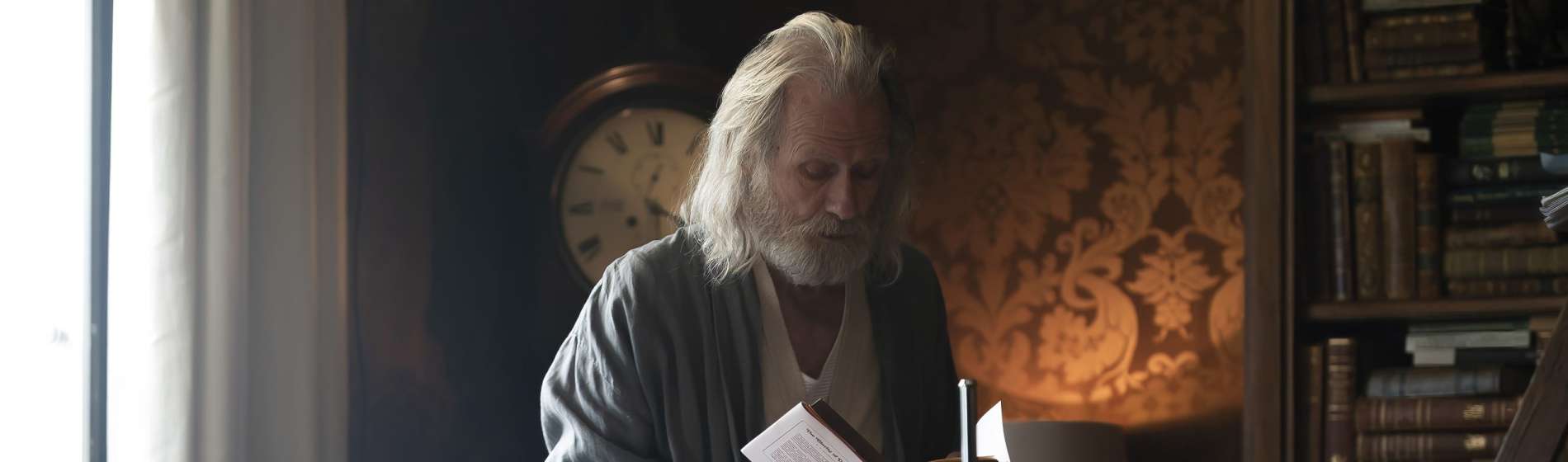
Based on David Gilbert’s novel of the same name , Nighy stars as internationally lauded, reclusive novelist Andrew Dyer. Dyer lives in a massive manor house in the English countryside with his youngest son, Andy (Jupe), and his housekeeper, Gerde (Anna Geislerová). He does little with his days other than listen to jazz, feed his prescription drug addiction, and sleep, all in his large, chaotic den-cum-bedroom-cum-office. Believing he is close to death, he invites his two estranged sons (Flynn and MacKay) to visit so he can share a deep secret about their younger brother’s parentage. To reveal more of the plot would be to ruin the surprise, but suffice it to say neither son reacts well, nor does Dyer’s ex-wife (played superbly by the always fantastic Staunton).
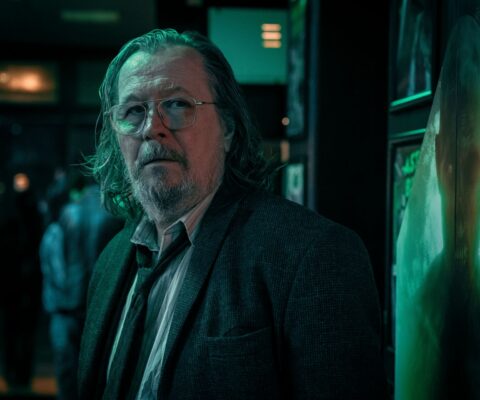
Nighy is almost unrecognizable as the dishevelled author. Gone are his Saville Row suits and perfect laconic delivery, traded in for stringy, long hair, a beard, and bursts of almost unintelligible chatter. His reliance on Gerde and Andy is absolute, and his helplessness is rivelled only by his stubbornness. It’s not a part one would think of for the actor, but he rises to the challenge beautifully. His scenes with Staunton are particularly striking. Watching the two acting treasures battle wits and plumb the depths of their emotional past is worth the price of admission alone.
Flynn and MacKay are both excellent as Dyer’s older sons, though it’s hard not to wish each able actor had more time to explore their characters’ inner workings. Each loathes and resents their father, but they each return at his request for very different reasons. Richard (Flynn), now a New York City screenwriter, turned to drugs as a teen to escape the pressures of a famous father who never saw his son as good enough, but has been sober long enough to establish his own loving family. He returns not because of his father’s invitation, but because he’s hoping to turn his father’s bestseller “Saturn’s Salute” into a feature film. Jamie (MacKay), is an artist who decided to heed the invitation so that he can document the reunion and his father’s final days on film for an exhibition. He too struggles in the shadow of his father, but hates Dyer more for the abandonment of their mother than anything else. They are both under the impression that Dyer had an extramarital affair 20 years earlier that produced their younger half-brother, so both have avoided their father and sibling ever since.
The confusion they both feel at the startling revelation is exquisitely rendered. Flynn portrays Richard’s struggle in the face of the bombshell as so all consuming, it shows physically. He externalises so as not to endanger his hard-won sobriety. Mackay’s Jamie, on the other hand, is quiet in his disbelief. He hides behind his camera, allowing himself to internalise and be more a passive listener than actual participant in the family drama. But when around their mother, they flip almost totally, as Trapero establishes Jamie’s comfort level with her–one that Richard no longer has, having lived in America for years. There is extreme attention to emotional detail here that pays off throughout for viewers tuned in enough to take it all in.
The fact that neither the audience nor the family are ever quite sure if the revelation is true or not makes things even more intriguing. While the characters are hung up on the facts and recently revealed fictions, it’s clear that Trapero (and the original author) are more intrigued by the overall family dynamic and whether children can ever rise above their origins or circumstances. Jupe as the young Andy is the personification of that. Upon learning more about his brothers, and after really taking in his father’s decline, he becomes terrified that he’s destined to turn out exactly like his dad. After all, he’s been closer to him for his whole life than either of his brothers ever were. Jupe perfectly conveys his desperation, alongside his extreme naivete and fragile hope. If his performances in & Sons and Hamnet (both screening at TIFF) are anything to go by, he has proved himself a real talent to watch.
Given the title of the film, though, it’s a shame that it feels like we never get to spend quite enough time with any of the sons or really dig into their relationships with each other. We’re given so much to initially ponder, about themselves and their relationship to Dyer, that a deeper dive seems like a likely next step–but the film never fulfills that potential. How did they help or hinder each other? How has their relationship evolved over the years? They seem almost like strangers themselves, but we know that’s not the case. Though the film sits at a two-hour runtime, it’s hard not to feel like it could’ve benefitted from one or two more meaty family scenes. These are actors who would’ve served up something even more special if given even more to work with. But they’re just not given the space to do so.
In a film with so many good performances, it’s hard to convey just how much Staunton still manages to stand above the rest. The majority of the film is given over to male excess, in a way, both internalized and externalized, which is necessary given the story being told. There is cursing, yelling, ranting, years of stunted emotional growth, and then even more yelling and cursing. But the second Staunton enters the picture, the film becomes exponentially better and more interesting. This is a woman whose heart was broken, but who had to pick up the pieces and move on for the sake of her sons. She is long past the point of screaming and crying, but the rawness of her hurt is still there, just under the surface. To watch her grapple with the fact that much of her life has been based on a lie is something to behold. She doesn’t need additional scenes to serve you her character’s inner depths, it’s there in every look and every quiet word. It is perhaps her wealth of acting experience that allowed her to give us more than the script gave her, but it does make you wish the other characters were as well represented.
Polley has proven herself to be an exceptionally talented screenwriter, but she’s particularly intuitive when it comes to writing for her female characters. Polley and Staunton are a match made in movie heaven, so perhaps it shouldn’t be surprising that it’s those scenes and that character that make this movie spark. The emotional layers of the remaining parts are certainly well thought out, and Flynn’s performance particularly pulls at the heartstrings, but they are maybe more generic in their motivations than the story really calls for.
Speaking of generic, Dominic West shows up in a small role as a stereotypical movie producer looking to get access to Dyer through Richard. West clearly has fun with the flamboyant small role, but the part is written as a caricature, rather than as a three-dimensional addition to the story. That said, his presence does give fans of the film Pride (which screened at TIFF in 2014) a chance to see four of its star reunited here: Nighy, Staunton, Mackay and West.
Trapero’s direction serves the narrative well, too. His lens almost dances with Nighy in scenes where he manically moves about in the safety of his study. But his creative camera work never distracts too much from the action, providing interest without going too experimental. Between that and the overloud needle-drops of jazz, that Dyer loves but that his youngest must tune out in order to get any sleep, Trapero pulls you into the main character’s madness just enough to be effective. To get a real sense of where this character finds himself, without passing judgement on him or his situation.
Despite that, it’s also possible to picture & Sons as a successful stage play. There are a host of gorgeous locations used in the film, but given it’s the discussion that form the backbone of the piece, you could easily do without them and focus on the dialogue. Perhaps that small distance between actor and audience might make the lack of depth (in places) seem less obvious and more deliberate.
Either way, Trapero’s feature makes a big swing and almost fully connects. Thanks to a cast filled with A-grade talents and a pointed script that mostly holds its own when it comes to its dynamic characterizations, & Sons makes a good, but not quite great, addition to the pantheon of cinematic family dramas.
& Sons screened as part of the 2025 Toronto International Film Festival .
Head here to get all our That Shelf TIFF coverage .
It is set to hit theatres in Canada via Elevation Pictures sometime this fall or early next year.