

“Hypothetically, in the book, the love of your life is dating another guy, and the other guy happens to be your best friend. What do you do?”
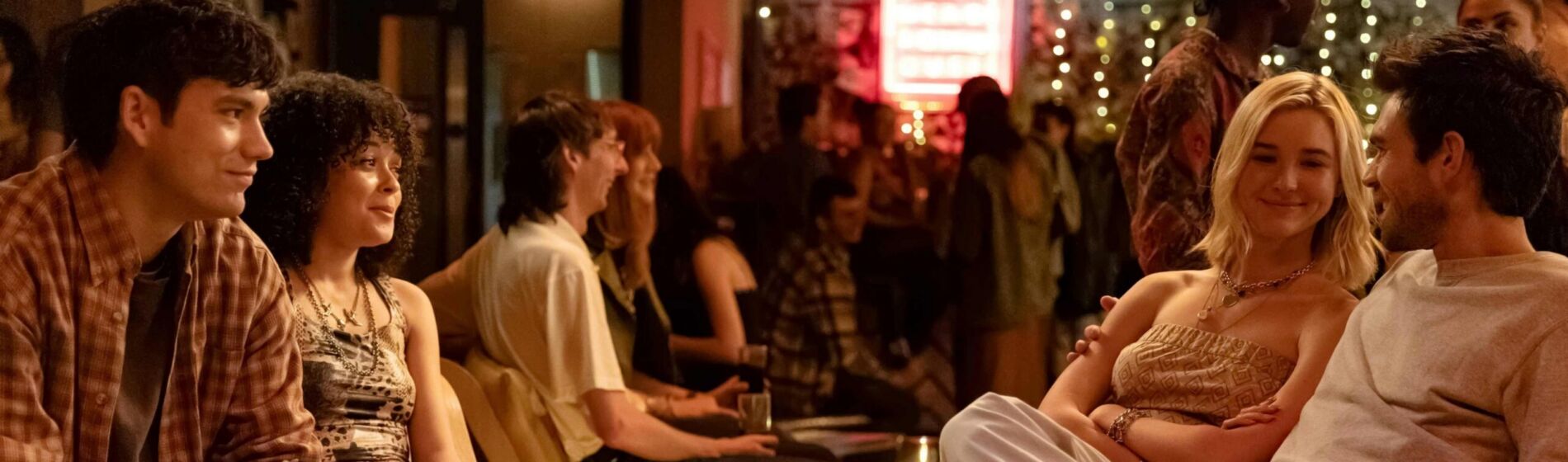
That “hypothetical” isn’t actually in the book that main character Johnny is writing. But it’s a question that haunts the character throughout Falling. James and Colin Krisel’s latest follows Jillian (Isabel May), Jack (KJ Apa), and Jack’s best friend, Johnny (Archie Renaux), three people who navigate the world in very different ways, but still manage to get tangled up in each other via a hushed love triangle.
The film opens with a trope-filled voiceover that sets the picturesque London scene and offers overt exposition on who Jillian, Jack, and Johnny are. Jillian is a free spirit who can’t stick around one place too long; Jack is a carefree womanizer who doesn’t take anything too seriously. Then there’s Johnny, a dreamer who’s constantly chasing “The One” alongside a career as a big-name novelist.
Rarely do romantic comedies like these transcend the genre’s well-worn clichés, character tropes, and story structure to reveal what love looks like. Falling is not an exception–but it might not want to be either
Around 10 minutes in, the “meet-cute” happens in typical coffee-shop fashion, with a less typical, wittier back-and-forth between Jack and Jillian. The next twenty or so minutes are all fun and games as the two dive headfirst into a stable, consistent relationship–a strange new experience for both of them. At this point, it’s only been 30 minutes; they can’t get their happily ever after just yet.
First, Johnny has to realize he’s in love with Jillian–and then he has to tell her about it. Queue drama and another hour of will-they-won’t-they-but-of-course-they-will.
This is a rom-com; derivative bones are allowed, expected, and kind of preferred–does life offer a better opportunity to sit back, relax, and turn the brain off? Jillian thinks not: “My favorite film genre is…a subgenre of cheesy, romantic comedy. And I don’t have to stress watching it because, you know, if everything goes to shit, they’re going to be perfectly fine.”
Likewise, Falling’s characterless characters are a genre norm, with the dialogue revolving mostly around their sloppy love lives and self-inflicted troubles. In the same vein, the professional-enough cinematography and slightly above-average colour grading stick with convention, too. Everything on the film’s surface is fine. Just fine.
What makes the film worth watching, though, is the all-around solid acting–and the third act. That lovely climax to such a mundane conflict proves Falling is actually an anti-love letter to the romance genre. This sheep-in-wolf’s-clothing movie has surprising profundity underneath the lovey-dovey eyes and steamy almost-sex scenes. The underlying story deals with fantasizing about greener grass rather than living a grounded life–a statement that’s almost oxymoronic to romantic comedy. Messy love affairs, so commonly romanticized by filmmakers and moviegoers alike, become the butt of a dry joke. Nobody in Falling gets a happy ending, and the film’s best life lessons have little to do with love.
Falling doesn’t want its viewers to forget that, even in a turn-your-brain-off romance movie as pretty as a postcard, bad things should, in fact, happen to bad people.
Falling is available on VOD/Digital now.