

Is there anything more American than football and war?
It’s 1941, and the bombing of Pearl Harbor has launched the United States and Japan into open warfare. Four college footballers (Nicholas Galitzine, Bill Skarsgård, Ray Nicholson, and Tom Francis) enlist in the Marines and go on to play in the famed, eponymous football game that unfolds before the Battle of Okinawa.
The Mosquito Bowl opens on a stark, cold satellite-style image of the spinning earth and a Herbert Hoover quote that says, essentially, older men declare war and younger men inherit everything behind that declaration. This is good preparation for the sombre, sympathetic tone that will take over the next few hours.
But before that mood settles in, viewers peek into the lives of young, spry John McLaughry (Galitzine), Bob Bauman (Skarsgård), Dave Shreiner (Francis), and Tony Butkovich (Nicholson) and their faux highlight 41’ reels. McLaughry and Bauman have some solid plays, but the real heat is on Butkovich and Shreiner in a game with a national touchdown-record opportunity.
Celebrations from the victors and lamentations from the losers follow said game. Proper ’40s-style sets and costumes sweep the scenes along with bars, beer, chanting, and cheering.
Then they get their induction letters. And, unable to say no to their country’s calling, the four men join the Marines and start island-hopping to Japan.
That first battle scene is beautiful, not in how it looks (rarely in how it looks, because this movie is appropriately as colourless as its content) but in how horrible it feels. There is no protection from the visceral, bloody, disgusting nature of war. No glorification, no “badassery,” no patriotism gleams off of the rifle-laden soldiers. Only pure chaos.
Shaky film shots careen along the bloodied, red, and furious ocean waves; artillery fire forces dirt and shrapnel onto the lens. The camera mimics men’s gaze, flitting from the fighter jets in the air to foot soldiers’ army crawling through the sand to the sea of bodies in front of them. There’s too much going on to focus on any one thing, and order doesn’t exist here.
This is one of two standout moments in this film. The other is, of course, the Mosquito Bowl.
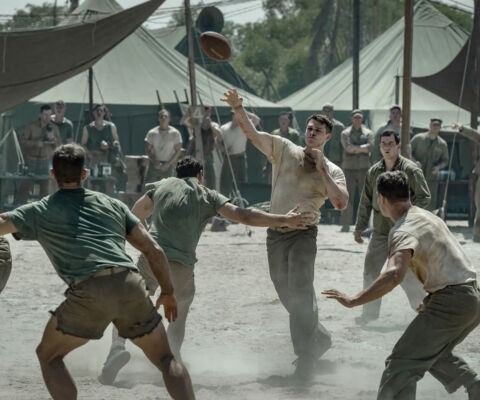
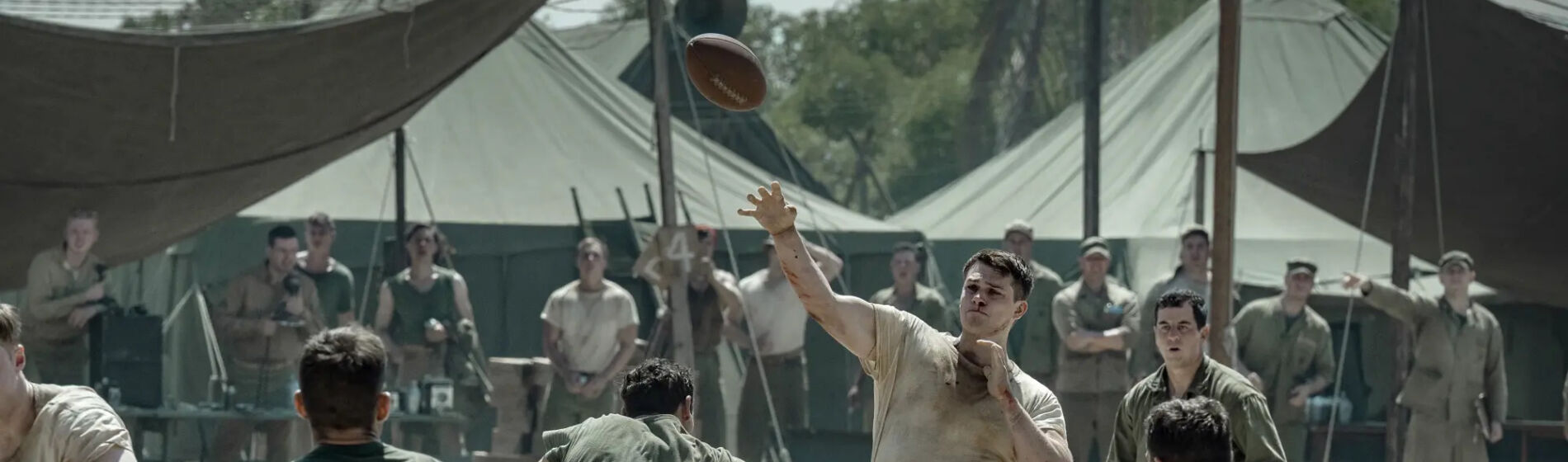
The football choreography there is stellar. The framing aptly captures the physical impact of those rough and primal tackles, and often shots glide through the fast-moving bodies, honing in on the almighty ball. When Butkovich is about to make the game-winning touchdown, the ragged, worn players-slash-soldiers run straight towards the camera. Genuine, raw smiles grace their faces. This is a violent sport, but it pales in comparison to what these men have dealt with for the last four years. Football is their only freedom.
And then it’s over. Next is the anticlimactic Battle of Okinawa. Dark and disturbing, but not as momentous as that first battle scene. Maybe it’s better that way. War doesn’t really have some big, dramatic culmination like it does in the movies.
The scene itself trudges along just like the four leads do as they make their way to the Japanese’s command post. This is the second time they’re seen marching forward amidst gunfire, flamethrowers, death, and worse. But this time, the experience feels strangely– unsettlingly–habitual, for both the viewers and characters.
Most moments around that first battle scene and the Bowl feel similarly sluggish. What happens in The Mosquito Bowl happens in every middle-of-the-road war movie. Moreover, the film offers few compelling characters beyond Bauman, McLaughry, Schreiner, and Butkovich. Even those leading four, though, feel tired with their Mary Sue martyrdom and balancing act of era-accurate patriotism and revisionist empathy for Japan’s people.
Like many war dramas, modern guilt seeps into The Mosquito Bowl and the ugly truths are edited to make things more digestible. “Do you understand the concept of nuance?” is a teasing question that pops up in the war drama, and ironically, it seems to not understand it itself.
The final shots follow McLaughry back home after the war. He slumps sombrely off the train into his wife’s arms; he visits his college’s football field and looks wistfully at the turf-painted grass, the thing he knew so well before the war.
Director Peter Berg makes U.S. veterans seem like a monolith. As if everyone who survives any war realizes how awful it is. But that’s just not true. There’s a big difference between U.S. WWII veterans, who came home as heroes, fighting for a “just cause,” and living in the Golden Age of Capitalism, and the U.S’s Vietnam and Afghanistan veterans who came home defeated after losing a morally grey mission, and in a time of economic ruin.
The real reason this movie ends up treading mediocrity isn’t that the anti-war message is wrong, or because of poor visual design–or even as a result of the uninspired characters. War is bad and it does have long-lasting consequences. The film is visually intentional, and the characters don’t have to be individualistic given their collectivist situation.
What makes The Mosquito Bowl so middling is that it fundamentally misunderstands the specific effects World War II had on its men, and it fails to capture what was so distinct about that era, those people, and these appalling events.