


There is something deeply satisfying about watching someone garden. The repetition. The patience. The quiet thrill of pulling something alive from the earth. Director Amalie Atkins understands this phenomenon, and in Agatha’s Almanac , she builds an entire film around it. The result is a documentary that feels less like a traditional portrait and more like an immersive sensory experience, one that demands audiences slow down, whether they want to or not.
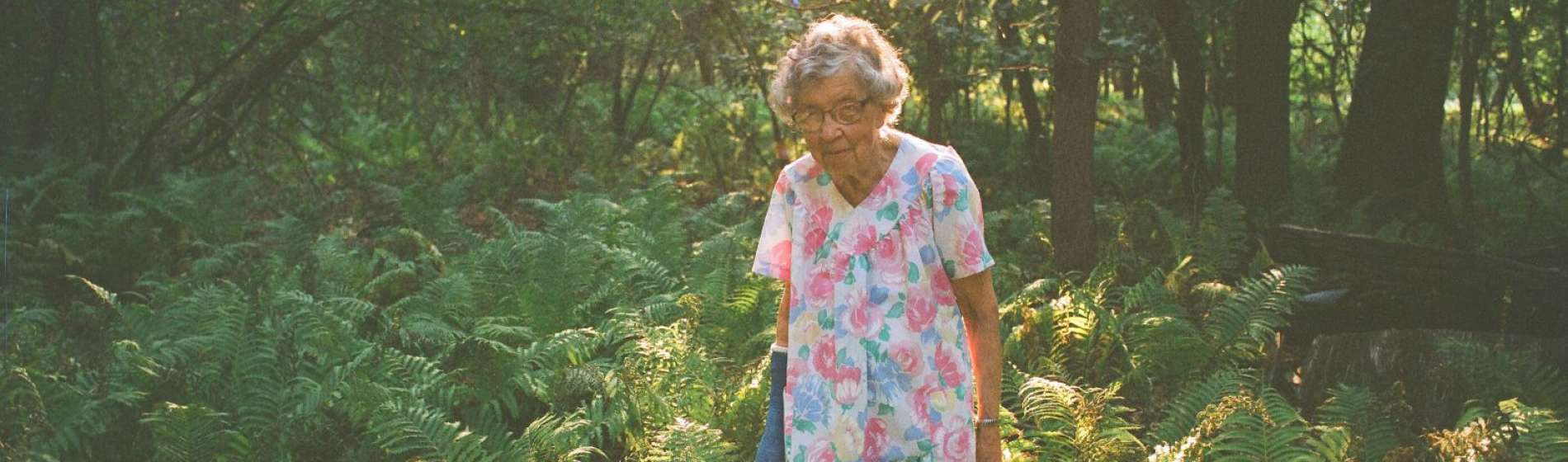
The film follows Agatha Bock, Atkins’s aunt, a fiercely independent 90-year-old who lives alone on her ancestral farm in southern Manitoba. There is no car in the driveway. No cell phone on the counter. No running water in the house. What there is, however, is a sprawling garden bursting with watermelons, strawberries, potatoes, beans, and herbs, all cultivated entirely by hand. Agatha tends to her land with a level of dedication that makes the rest of us look like we have never committed to anything in our lives.
Shot over six years on luminous 16mm film by cinematographer Rhayne Vermette, Agatha’s Almanac is visually stunning from its opening frames. The colour palette alone is worth the price of admission. Bright red strawberries practically glow against weathered wooden surfaces. Pink watermelons split open with a kind of cinematic grandeur. A warm, vintage colour filter blankets the entire film, making everything feel as though it belongs to a photograph from the 1970s rather than the 2020s.
Atkins, a multidisciplinary artist known for blending analogue film with performance and textiles, brings that same artisanal sensibility to every frame of her first feature. The editing is frenetic at times, punctuated by quick-burst montages and needle drops that feel more at home in a music video than a documentary about a woman picking potatoes. Slow-motion shots of Agatha’s hands at work give way to rapid-fire compilations of her labelled boxes, her coloured gloves, her meticulously organized belongings, each one stored in whatever repurposed container happened to be lying around—a Nike box here, an old Honey Nut Cheerios box there. The sound design keeps things moving, too, with a persistent ticking that morphs from a clock to dripping water to buzzing bees, ensuring the audience always feels a sense of forward motion.
It is an undeniably creative approach to documentary filmmaking, and for the most part, it works beautifully. But Atkins occasionally pushes her stylistic instincts past the point of impact and into the territory of excess. Some of the more aggressive editing choices feel jarring rather than artful, and a few sequences are so abrasive in their pacing that they become unintentionally funny. In a film that thrives on quiet intimacy, these moments pull the viewer out rather than draw them deeper in. The ambition is admirable, but a lighter touch in certain stretches would have let Agatha’s natural magnetism do more of the heavy lifting.
Plus, Agatha herself is more than enough to carry a feature film. She tells stories of her dating life with disarming candour, noting that she has been single her whole life but never lonely because she always had something to do. She washes her hair outdoors with two bowls of water and some shampoo. She makes pierogis from scratch, moulding each one entirely by hand. She glues the soles of her worn-out shoes back together rather than buying new ones. Her memory at 90 is astonishing. For much of the runtime, she sports an unexplained cast on her arm, and the film wisely never addresses it—a small detail that speaks volumes about both Agatha’s resilience and Atkins’ restraint as a storyteller.
What distinguishes Agatha’s Almanac from the standard documentary portrait is the relationship between filmmaker and subject. Unlike most documentaries where the director remains an invisible presence behind the camera, Atkins is audibly part of Agatha’s world. Agatha speaks directly to her niece, asks her questions, and seeks her responses. The effect is warm and personal, transforming what could have been an observational exercise into something closer to a conversation between two generations of the same family.
The film closes with Agatha singing gloriously out of tune, and it is perhaps the most charming moment in a documentary full of them. Agatha’s Almanac is not a perfect film. Its stylistic ambitions sometimes outpace the material, and its frenetic energy can feel at odds with the gentle soul at its centre. But it is a genuinely unique experience. The kind of documentary that has earned every one of its accolades—including the Best Canadian Feature Documentary prize at Hot Docs 2025 and a spot on TIFF’s Canada’s Top Ten list—by refusing to look or feel like anything else.
Agatha’s Almanac screens at TIFF Lightbox on Friday, April 3 , with a Q&A from director Amalie Atkins. For other Canadian screenings, head here .