

Movies that hinge on ‘inspired by a true story’ should always be approached with wary skepticism. It’s an unwritten rule: there will be embellishments and dramatization, and often the final story barely resembles the original, real-life inspiration. By Any Means, though, stretches the truth so much that it begins to feel like a piece of Laffy Taffy. But does that mean the overall film doesn’t land? Well, it does, and it doesn’t.
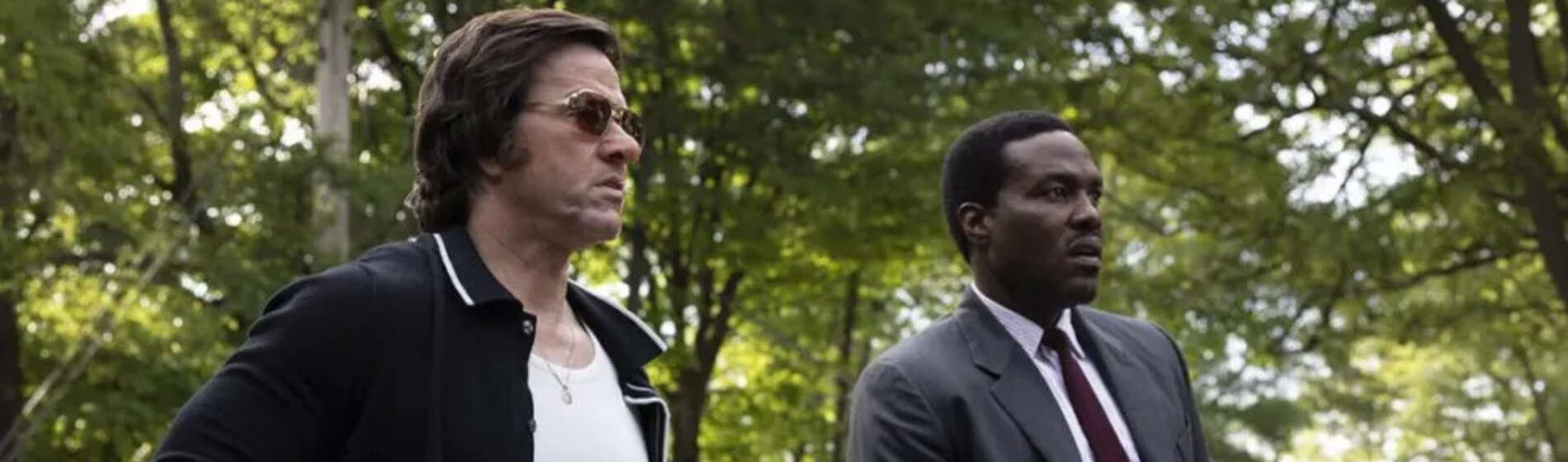
The story follows fictional Black FBI agent Wayne Strider (Yahya Abdul-Mateen II), as he moves back home to Hattiesburg, Mississippi, to investigate the murder of NAACP leader Vernon Dahmer (Giancarlo Esposito). Strider is forced to work alongside the ‘Grim Reaper’, Greg Scarpa (a questionably cast Mark Wahlberg), an FBI informant and capo in the Colombo crime family, to solve the case.
Strider is a well-dressed, by-the-book type of agent who believes the only way to get justice is to serve it. Scarpa’s an Italian mobster – from Brooklyn, not Jersey – who believes justice is best served with a baseball bat and some well-placed swings to the knee. This pointed contrast echoes the forced odd-couple pairings in movies like The Green Book. The Federal Bureau of Investigation makes Strider the informant’s handler. Really though, his task is a formality because Scarpa has no limits. Much to the dismay of the agent, Scarpa seems to be allowed to get information ‘by any means’ necessary. The movie title is a double entendre referencing both their brutalist method of investigation and also Malcolm X’s motto about fighting racial disparity.
By Any Means fits snugly into the thriller genre with a seedy murder and a drawn out investigation where witnesses keep their mouths shut and evil is always lurking. Villainous KKK members — who are often dowsed in shadows and glowing, fire-orange hues — are unsurprisingly behind the violent crime. And as Scarpa and Strider delve deeper into the case, a jazzy score settles in, and things get bloodier and darker. The pair, who begin as moral opposites, slowly come to agree that their mission requires a more violent but effective approach. After all, there’s only so much disrespect and downright cruelty that a man like Strider can take before his rage supersedes his law books. At least that’s what director Elegance Bratton and screenwriter Sascha Penn seem to think.
The visual allure within By Any Means is inviting. The set design is impeccable, and everything is coated in a warm, rich colour palette. Vintage cars, ranch homes, and mid-century modern decor all breathe life into the American ’60s setting. Costumes are equally as artistic, with Strider often roving the Southern town in eye-catching suits. Strider’s wife — who is given a ‘kind and abiding, but characterless housewife’ persona — gambols around in A-line skirts and darling button-up sweaters. The only lacklustre production elements are Wahlberg’s shaggy wig and prosthetic nose (which unfortunately looks like the schnoz on Mr. Potato Head).
Medium shots are characteristically modern with blurred backgrounds and heavy foreground focus. These are interlaced with more thoughtful takes. A POV angle of Vernon Dahmer firing his pistol at attackers aptly triggers the feel of defensive, cramped panic. Illuminated scenery reflects on Strider’s sombre face as he and Scarpa drive through the uneasy Mississippi nighttime. It’s quite easy to get swept away in the film’s cinematographic eye-candy. This aesthetic charm is so distracting that you almost forget the narrative flaws hiding underneath it.
To clarify: Gregory Scarpa allegedly did work with the FBI in the South during the civil rights movement. NAACP leader Vernon Dahmer (whose real-life family has been critical of this film) really was murdered by the Klan after offering to pay the poll tax for poor black voters. That said, the rest of the on-screen storytelling takes what one might call ‘creative liberties’.
In all fairness, those artistic freedoms seem to exist to serve a greater good. E.g: Strider’s real-life equivalent was actually a combination of a few white FBI agents. Instead, the fictionalized Strider is used as a vessel for provoking the question: should racial brutality and disparity be tackled with measured peace or equitable violence? It’s clear Bratton did what he felt was necessary, in historical context, to draw out this important theme.
The portrayal of the Federal Bureau of Investigation feels a bit two-toned, though. Tone one emerges in the subtext of how the Bureau uses shady, uncouth methods to accomplish its goals. By Any Means does a fine job of illustrating how discreet and surprising that was half a century ago, but its relevance in today’s political climate is questionable. That knowledge may have been surprising then, but it will shock very few viewers now.
Sitting on top of that subtext is the elephant-in-the-room notion that the Bureau is one harmonious entity with one logical goal. In reality, the agency’s involvement in ‘60s civil rights was insanely paradoxical and messy. They did help solve murder cases of big-name activists – but out of social-political pressure rather than moral responsibility. Yet, their efforts to derail and destabilize the movement are far more recognizable and important.
Often, the film glazes over that bigger meaning to focus on the individual struggle that emerges from racial injustice. Yet, by making the cultural landscape so isolated, By Any Means paradoxically removes that devastating personal battle from necessary and important context. So Strider and Scarpa end up as empty husks that act more as pawns in Bratton’s debate of methodology – ‘Malcolm or King?’ – rather than people with nuanced moral stances, strife, or motivations amid that greater civil rights battle.
That means it’s hard to digest By Any Means when it seems to exist in a void, one that has made any political or social context of the time disappear. Not only on the grand scale, but even within the tiny, hateful town of Hattiesburg, Mississippi. The film never shows civil unrest boil over Dahmer’s death, and despite the constant racial tensions, there’s no local outrage when a white police officer is murdered.
By Any Means is not – pardon the pun – by any means bad, but it doesn’t land quite as heavily as it should. Instead of using the “inspired by true events” story to address the ever-growing struggle that still exists for marginalized communities, particularly those of Black Americans, this film ends up as an unfortunately flat take on fighting racial injustice.