Pat Benatar once sang “Love Is a Battlefield,” but the trenches of romance have rarely pierced the heart so effectively as they do here. Belgian filmmaker Lukas Dhont ( Close ) delivers another achingly beautiful film about personal awakening in Coward . His third feature boasts an extraordinary leap forward in scope both narrative, cinematic, and thematic. Yet it retains the signature intimacy and emotional depth of his prior works. This story of two young soldiers finding love amid trench warfare offers a stirring evocation of the generations of love stories long untold. Heartache to heartache, Coward deftly examines the mark of bravery when being true to oneself means putting it all on the line. Because first love’s always a minefield, eh?
Cowards goes to the front lines of the Great War as Pierre (Emmanuel Macchia) joins an infantry in battle. Having been raised on a farm, his rough hands suit the hard work well. But what he brings in physical strength and a labourer’s work ethic is no match for the psychological fortitude needed for the front. He toils alongside his new soldiers removing the bodies of the fallen from the field. Shipping corpses like bushels of hay, the task’s routine nature isn’t easy on the stomach. New recruits reassure comrades that the blood on their uniforms doesn’t belong to them. This quiet young man finds himself stuck in an endless cycle of death.
Pierre gets a sense of what he’s fighting for, however, when he meets Francis (Valentin Campagne). The young man, roughly the same age, doesn’t seem as cut out for tough labour on the front. However, his assignment requires a different kind of strength. Francis invites Pierre to assist him with his mission. He’s tasked with performing plays for Allied soldiers. Men wounded in battle serve their tenure as “the outcasts.” The dismissive name for the artsworkers nevertheless challenges soldiers to let down their guards and prejudices. Magic happens when they steady their guns to watch a show.
Dhont, drawing inspiration from a photograph of a wartime soldier dressed as a woman, creates an intimate space where heart and spirit survive. The barn where Francis directs his fellow soldiers, rehearsing songs and doing the can-can, offers a reprieve from the inhumane death machine of the front. Instead of fearing and killing faceless opponents, Pierre finds himself aiding and uplifting soldiers while looking them in the eye.
Pierre, however, needs to avert his eyes from Francis while taking some direction. Francis, a tailor in his previous life, sparks with defiant spirit. He seduces Pierre with a playful energy that seems wholly alien to the cruelty of the front. It’s a balm, but the young farmhand proves bashful.
Francis evokes a singular energy among the company. His “the show must go on” commitment displays a sense for perseverance many soldiers lack. But it’s with a more delicate, considered air. He carries a certain softness, delighting in cross-dressing and women’s make-up as opposed to camouflage. He relishes the chance to sashay around the stage while encouraging his comrades to enjoy placebos for female companionship as he teasingly teaches them, namely Pierre, how to ask a lady to dance. In a company of hundreds of indistinguishable soldiers, Francis seems like the lone individual.
There’s an instant connection once Pierre follows Francis’s lead and becomes a player in the company. Macchia and Campagne have sweltering chemistry as the soldiers in the throes of young love. The stars, who jointly won the Best Actor prize at Cannes, have an absolutely magnetic spark. There’s so much heat in Coward that these boys deserve their own hockey show. But in the fashion of Dhont’s previous films, the emphasis here is on emotional intimacy and self-discovery. The two young men navigate an emerging relationship just as nimbly as a soldier traverses the no man’s land between the trenches.
Coward burrows deep into the hearts and minds of the soldiers. Pierre wrestles with the joie de vivre he feels with the theatre group and the soul-crushing death sentence he endures on the field. Dhont confidently recreates the terrain of trench warfare as a mirror to the emotional minefield Pierre traverses. Comparisons to All Quiet on the Western Front seem inevitable, but Coward appropriately offers a demure counterpoint to the bombast of Edward Berger ’s harrowing film.
Compositionally, it’s as meticulously crafted in its design with period details. Elevated interplay between foreground and background leaves a viewer breathless as the soldiers take their marks on the field. But there’s a tenderness that sets it apart, too, as Dhont mixes brawn with beauty. A gentle love scene lets a bare concave chest provide a comforting hiding place to counter the claustrophobic trenches.
The battlefield here is a psychological one. Dhont and cinematographer Frank van den Eeden make masterful use of close-ups, lighting, and composition to observe the weight of warfare on these soldiers. The theatrical spaces offer glowingly stark contrasts to the muddy fields as warm lighting bolsters the soul whenever Pierre steps into the theatrical space and, in turn, Francis’s orbit. A slight pitch of soft light upon Macchia’s face in close-up, moreover, lets the soldier spring fully to life. He seemingly glows in his co-star’s presence.
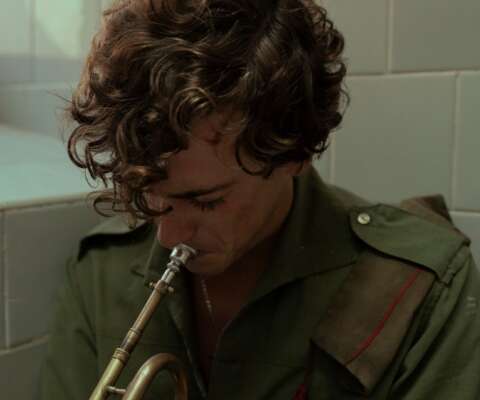
Macchia gives a brooding an introspective performance as Pierre finds himself at a crossroads. It’s a remarkably confident screen debut that uses restraint to straddle the internalised codes that have Pierre bursting. He knows his reprieve with the outsiders is temporary. Soldiers return to the front once they’re on the mend. But there’s no way he’ll survive if it means being apart from Francis. He weighs his options, having seen the fatal charges that desertion brings. However, he begs Francis to run away with him. They’ll create an idyllic safe-haven, although Francis gently reminds him that spaces like the company don’t exist back home.
Meanwhile, Campagne proves a nature screen performer. He commands space whereas Macchia seemingly knows how to let Pierre withdraw and camouflage. Dhont invites the actors to life through distinct survival mechanisms, and it’s a case where opposites attract. Anytime they’re both onscreen, one feels the fusing of two parts becoming whole.
As the soldiers wage their own battle about what it means to fight for others’ freedom while denying their own, they confront the societal and personal distinctions between cowardice and bravery. These intimate, personal battles offer another remarkable step forward in Dhont’s work as he crafts his most overtly queer film yet while reimagining spaces almost exclusively defined through a heteronormative lens in both recorded and cinematic history. Drawing upon contemporary fandom for drag culture, but also a determination to bring into the light what was previously relegated to shadows, the film offers both a revisionist and corrective history. These stories have always existed—they just haven’t been seen outside of fleeting frames like the snapshot of the lone soldier who inspired Dhont. Coward defines itself by its courage.
Coward premieres at TIFF 2026 on September 13, and screens again Sept. 14.
Head here for all our That Shelf TIFF 2026 coverage .
Coward opens in theatres later this year and is coming soon to MUBI.