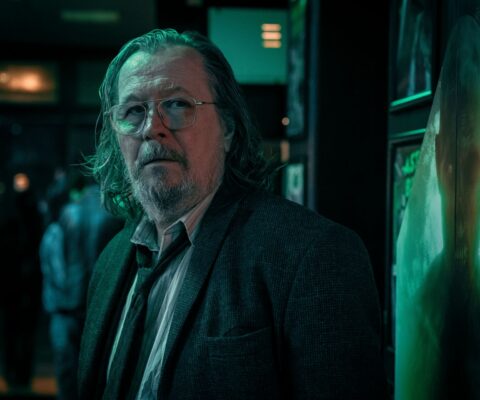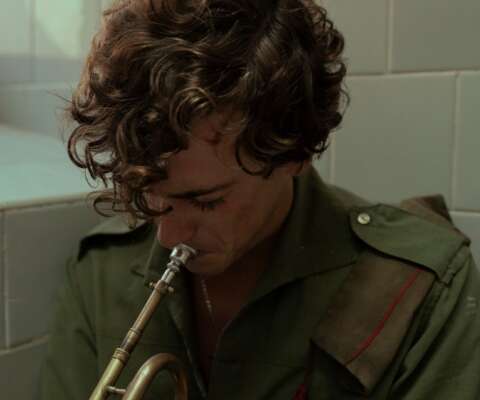


From scripts to performances, cinematic biopics–particularly around actors–can be a tough prospect in every respect. How do you distill one person’s character and story into a manageable runtime, and make it engaging and informative all at once? The stars must align to make a truly standout entry in the genre, or a film can feel more like a paint-by-numbers rote retelling of a life lived. Luckily, Simon Stone’s Elsinore is very much the former. With a career-best performance from the always-excellent Andrew Scott, the film both mourns the loss of a singular performer and pays tribute to his unique bravery, drive, and ability. It also perfectly captures the importance and joy of live theatre–and of Hamlet, in particular–and other performance arts that are so essential to our understanding of the world around us.
Scott stars as Scottish actor Ian Charleson, who was diagnosed with HIV and then AIDS in 1989 and pushed through his final months to play Hamlet at London’s prestigious National Theatre. Charleson may not be a household name to most modern film audiences, but within the British stage community, he is a legend. And for good reason. The thespian was a talent beloved by cast and crew alike, praised by generational icons like Alan Bates and Ian McKellen for his natural style and unmannered performances. He found consistent–though not necessarily starring–roles after his standout parts in Chariots of Fire and Gandhi , but found more success on the stage. Better, more layered characters came his way there, allowing for more opportunities to stretch his wings and, in some ways, fulfill his calling as an actor.
The film smartly avoids chronicling the actor’s entire life and concentrates on the time period between a late-decade career drought and the once-in-a-lifetime opportunity to take on the melancholy Dane after Daniel Day-Lewis drops out of director Richard Eyre’s highly anticipated production. In just a few important scenes, Stephen Beresford’s tight script gives us all the background we need to become invested in both Charleson and his world. We get the desperation of a jobbing actor, with lesser parts taken just to keep moving forward. The inertia of not being able to fulfill your potential, and the elation that comes with the opportunity to truly excel. Scott embodies those ups and downs perfectly, with subtle emotional shifts that build to a phenomenal on-screen catharsis both in Charleson’s life and as Hamlet.
It’s hard to convey just how good Scott is here. He clearly connects with the part, and it gives him the chance to return to Shakespeare and reimagine Hamlet–which he played in London himself in 2018– through the eyes of a man deeply feeling his own mortality. His passion for the stage shines through most of all, and it’s clearly a trait he shares with Charleson and many of his contemporaries. Most importantly, he delivers the real lesson here with sensitivity and conviction–that even when facing a death sentence, it’s the quality of the time you have left that truly matters, and not the quantity. And when, despite the odds, Charleson is able to take to the stage for his 24 performances at the National, the relief and accomplishment on Scott’s face is almost tangible. It’s a man who has determined his terms for leaving this world, and done it despite everything. The resulting juxtaposition of his prognosis and the famous words of Hamlet–from his famous soliloquies to conversations with Polonius, Ophelia and many more–is stark and incredibly effective.
Though there’s a universality to that simple but powerful theme, to be sure, there are few films that have been able to capture the essence of the theatre as well as Elsinore does. In Charleson and those he’s surrounded by, we see that the bug–once caught–is hard to ever shake. From the camaraderie backstage to the love of interpreting language to audiences to the clear emotional resonance of a 500-year-old text, it’s an art form like no other. What rolls out on screen here is just as relevant today as it was in 1989, because of that. If you’re a fan of the theatre simply as an audience member, there’s a similarity there, too. To the feeling that bubbles in the blood when experiencing art in real time, in a communal way that is never to be duplicated. It’s a shared, humane conversation between stage and stalls (as the British call the main theatre seating), and it goes a long way to helping us all process the world at large.
Like most queer actors of his time, Charleson was not out publicly. So his diagnosis was a secret, except to those close to him. Stone and screenwriter Beresford do a fine job of conveying the attitudes towards the AIDS pandemic and those affected. We hear and see the devastation to London’s community of gay men, the othering of their suffering and the ignorance they faced in treatment and understanding. It’s infuriating to see, but just as important to remember. Charleson’s doctor, Margaret Johnson (Olivia Colman), is one of the few looking to prolong the lives of those with the disease, and she faces uphill battles along the way. Elsinore also shows the different tactics of queer activists at the time, with filmmaker Derek Jarman (David Dawson) pressuring Charleson to go public and give the disease a famous face. His reasons for staying quiet are just as valid, and well expressed. The potential to change opinions was huge, and the actor still managed to do so, requesting that his cause of death be made public after he passed. The effect that had in Britain is hard to overstate.
Colman and Dawson are just two of an extremely impressive supporting cast. Johnny Flynn turns in an excellent empathetic performance as Eyre, and there’s equally effective work from Billie Piper as Charleson’s best friend Patsy Pollock, Monica Dolan as Stage Door Manager Linda Tolhurst, Luke Thompson as a fellow AIDS patient and former flame, and Matthew Beard as great friend Sean Mathias. Juliet Stevenson, Danny Webb, and David Rintoul all nail their performances as Charleson’s fellow Hamlet cast members Sylvia Syms, Michael Bryant, and John Castle. In small but memorable roles, stalwart acting vets Georgie Glen and Peter Mullan appear as Ian’s parents. In just a few short scenes, they convey the full gamut of emotions as they both learn of their son’s sexuality, diagnosis and plan to go out in style. In fact, Elsinore ’s casting is a real family-and-friends effort, with cameos from Charleson’s real-life friends, including Rintoul, Hilton McRae, and Nigel Havers, and with Scott’s sister Hannah James-Scott.
Stone ably helms the production, seamlessly blending stage-on-screen with pure cinematic scenes. The film has forward momentum, and no moments or scenes are wasted; everything effectively builds toward the celebratory but inevitable conclusion. Stone and Beresford (and their cast) deliver moments of real pain and suffering, true to both the time and the people represented, but the overall takeaway is a feeling of hope and a belief in human resilience.
If there’s one thing that detracts slightly from the overall film, it’s a sometimes overwhelming score from composer Stefan Gregory. Though tonally on point, as the film progresses, it begins to overwhelm moments and underscore scenes too emphatically. With such a strong cast and script, that extra emotional push feels a little overbearing and unnecessary. The story is understandably melodramatic as it grapples with both life and death, but it refrains from tipping into the mawkish. The music threatens that careful balance. But it’s a small quibble in an otherwise extremely strong cinematic effort.
Scott presents Charleson as a man worth remembering for more than just the circumstances of his passing, but for how fully he lived and loved in his final months. But Elsinore is about more than that. Stone’s film celebrates art, empathy, and light even in the darkest times. And we could all use more of all three in 2026. It’s clear a lot has changed in the 36 years since Charleson’s Shakespearean triumph and his passing, but with the many threats to queer rights, the arts, and community, there’s perhaps no better time to reacquaint audiences with, or have them discover, his unique and touching story.
Elsinore screened at TIFF 2026 and has further screenings on September 14, 15, and 19.
Head here for all of That Shelf’s TIFF 2026 coverage .
Watch Editor-in-Chief Jason Gorber’s video review of Elsinore below now for another take: