

There’s a moment in It Was Just an Accident where a parking garage security guard wants a tip. He and his partner stumble upon the film’s motley crew of kidnappers as they debate what to do with the man locked in a box in their van. They want to kill him, beat him, or worse—if it’s even the right guy—and the moral quagmire unleashes an emotional pitch. It’s not the most discreet conversation in the history cinematic conspiracies to commit murder.
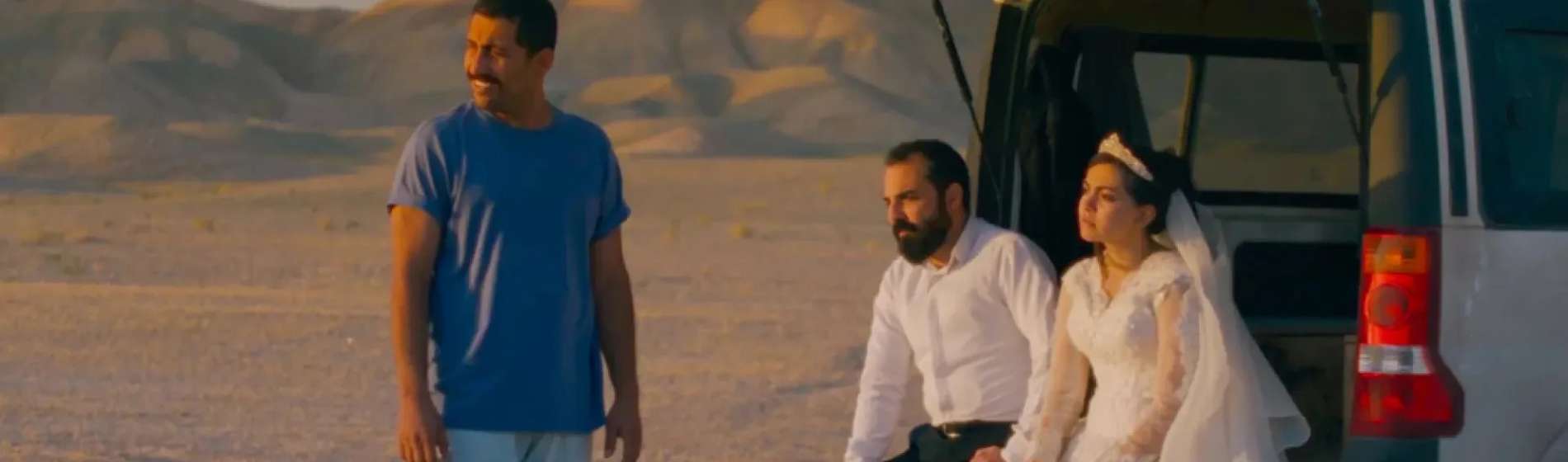
All the while, the security guards listen to the argument. They can’t’ help but be intrigued when the histrionic party includes a bride and groom. The bickering kidnappers create a diversion best they can, but the security guards don’t bite. They don’t see this crew as particularly threatening, either. They’ll let them escape through some greased palms. The kidnappers don’t have any cash, though, so one guard conveniently whips out his portable debit machine. And one party proceeds to swipe his card and deliver a tip—in the middle of a crime. And the parking garage isn’t the only time that folks in the conspiracy racket swipe their cards amid the kidnapping.
It Was Just an Accident somehow won the Palme d’Or at Cannes this year and it features some of the most ludicrously far-fetched feats of human behaviour ever committed to film. The questions the film asks are pointed and fair—namely, do the perpetrators of state-sanctioned crimes deserve mercy?—but Iranian director Jafar Panahi unfolds them in a ham-fisted morality play. This melodramatic potboiler simply strains credibility at every eye-rolling turn.
Twists and turns guide this tricky thriller that inadvertently plays like a comedy. When a simple accident brings a family to a garage, mechanic Vahid (Vahid Mobasseri) thinks he recognizes the father, Eghbal (Ebrahim Azizi). So, naturally, he kidnaps him in broad daylight, drives him out to the middle of the desert, digs a hole, and proceeds to bury him. There’s just one hiccup: as Vahid piles sand on the man he believes to be “Pegleg,” his torturer and captor from his years in prison, he realises that he might have the wrong guy.
In the great tradition of slapstick comedy, It Was Just an Accident piles on a cavalcade of characters as Vahid seeks confirmation of Pegleg’s identity. He recruits Shiva (Mariam Afshari) from a mutual friend, who may have encountered Pegleg during her own imprisonment. As luck would have it, she’s in the middle of shooting wedding photos for her comrade Golrokh (Hadis Pakbaten), who also survived Pegleg’s cruelty. Golrokh’s husband-to-be, Ali (Majid Panahi), carries no political past, but he’s game for playing the morality police, parroting Panahi’s niggling questions about goodness, vengeance, justice, and virtue.
The happy couple can’t confirm Pegleg’s identity either, though, so the motley crew squeezes into Vahid’s van and picks up Shiva’s brother-in-arms Hamid (Mohamad Ali Elyasmehr). The latter, like Shiva, still bears the emotional scars of imprisonment. His volatile bloodlust sends the crew into a frenzy, but they must ask themselves if taking the life of an innocent makes them as bad as, or worse than, their captors.
As Vahid’s crowded van tours the city, looking for allies and survivors to confirm the motley crew’s bloodlust, Panahi attempts to make the vehicle a powderkeg of explosive allegorical ammo. But it more aptly resembles a clown car as the passengers increasingly invite one exercise in stupidity after another. Panahi throws in everything but the kitchen sink. The clown car soon becomes an ambulance when the kidnappers make contact with Eghbal’s young daughter and perform a rescue mission on his pregnant wife when she faints and her water breaks. It seemingly leaks from her belly button, one of many continuity errors that veers Accident into The Room territory.
Panahi attempts to address the horrors of the Iranian regime in a roundabout way as the players discuss the past in coded language. The director, rightly famed for his own efforts to expose injustices of the Iranian regime, relies heavily on the paratextual elements surrounding his film—a trait in his filmography as facets of his films’ productions have become urban legends of their own.
The underground nature of the production, while admirable, lends a rushed, slipshod character to the proceedings. Slip-ups and gaffes break the suspension of disbelief required for such a convoluted moral fable. In another scene, for example, the crew exits the clown car when Eghbal defecates. Vahid pulls him out, cleans him off (under a bridge in the arid back corner of town), and returns him to the car with perfectly dry, clean pants. A few more official forms, debit swipes, tips, and pastry boxes later, and the gang seems further from its quest for truth. The performances are all of the map, too, with only Afshari and Mobasseri grounding the characters in a persuasive manner. The latter gets in on the joke when Accident veers into comedy by making Vahid sweat as he’s in over his head.
The moral quandary with It Was Just an Accident circles back to the question of forgiveness. Panahi is a talented filmmaker working in extraordinary conditions with undeniable fearlessness, but he holds a mirror up to a world that doesn’t feel real. Every person behaves like a total boob as they weigh the dual drives of guilt and vengeance. Is a bad film therefore redeemed by what it represents?
However, the final shot is so brilliant that one almost considers granting Panahi mercy for the convoluted melodrama that precedes it. But whether such compassion is warranted is a question that only individual viewers can answer.