

“For a child, the imagination has no limits. There’s no borders whatsoever,” says JR.
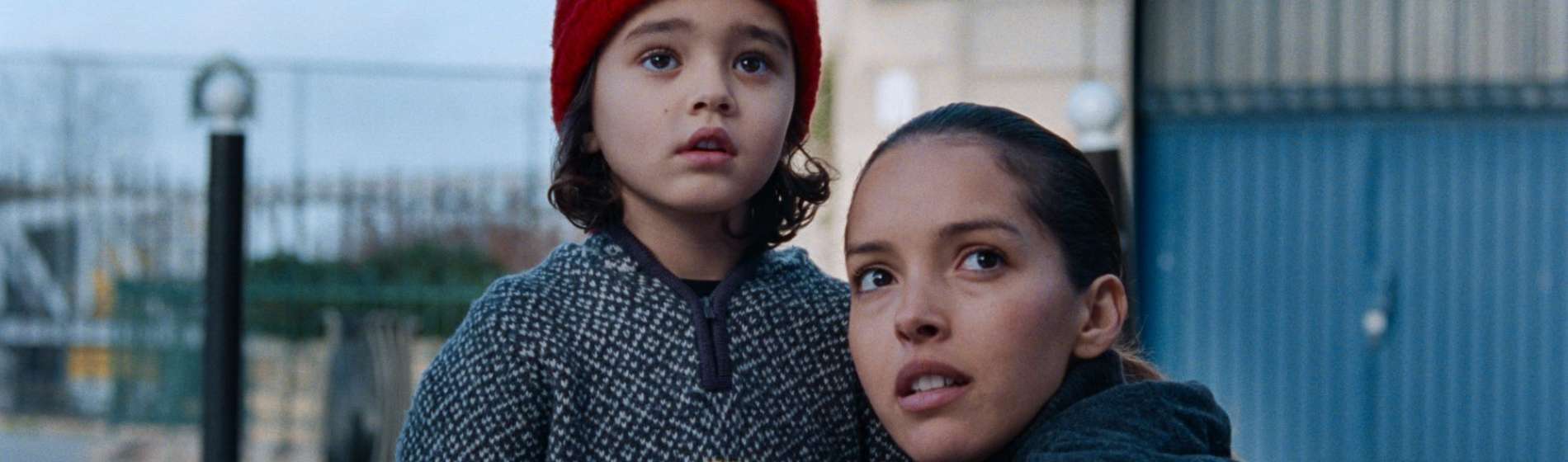
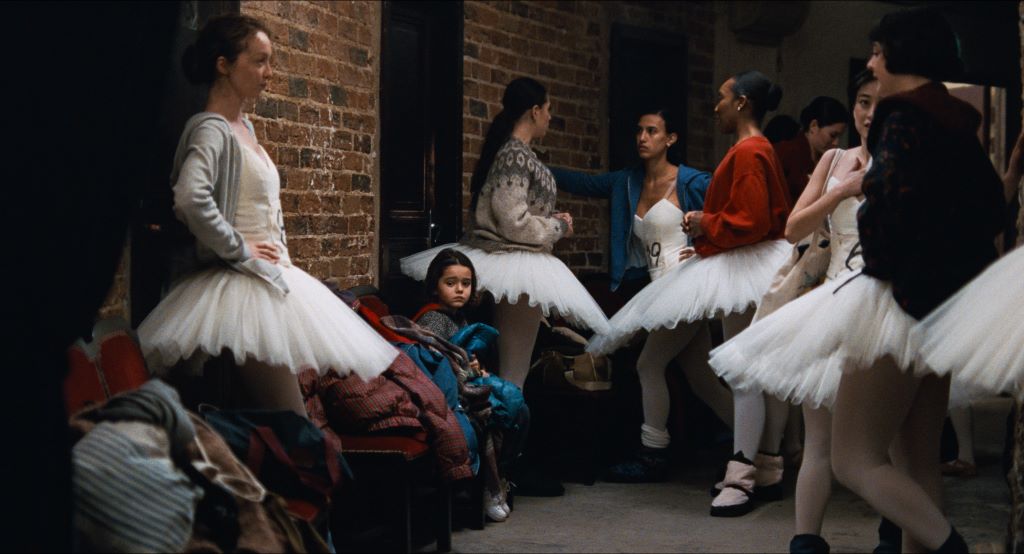
The French filmmaker and artist’s latest short film, An Urban Allegory , imagines Plato’s allegory anew through the eyes of a child. Directed with the great Alice Rohrwacher ( La Chimera ), An Urban Allegory follows seven-year-old Jay (Naïm El Kaldaoui) as he accompanies his mother (Lyna Khoudri) to a dance audition. As the boy observes his mother interact with the show’s director (Leos Carax), he years to see more. He wanders into the streets to see Paris anew.
“To do it through the perspective of a child was such a unique way because it’s the only time in our life that we are ready to constantly rethink. We don’t have inner walls,” explains JR, speaking with That Shelf and Rohrwacher via Zoom. “Today you’d be like, ‘No, there’s no walls. Those are buildings. They’re made up walls and concrete and there’s windows’ and everything is very hermetic.”
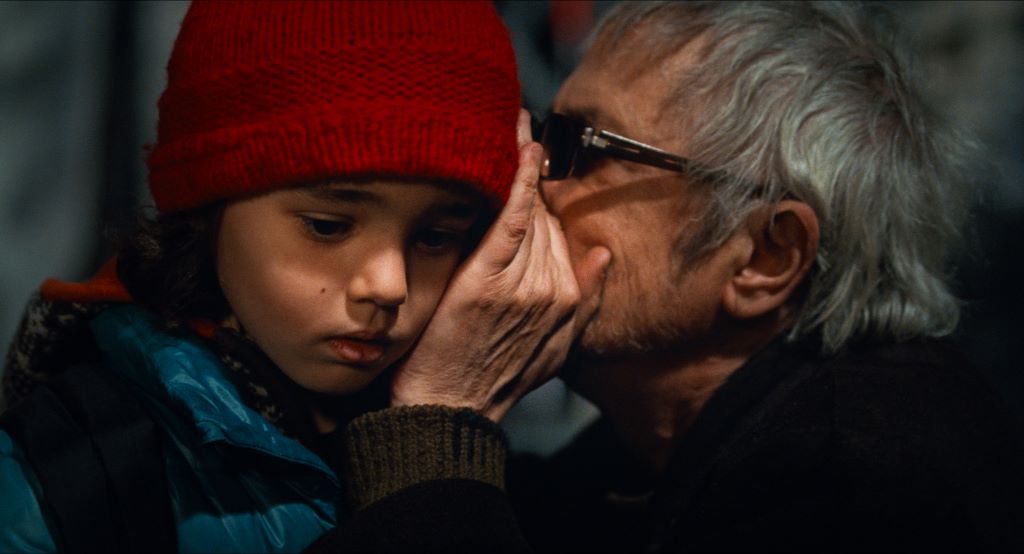
For Rohrwacher, the process of adapting the allegory of the cave became a question of location: Where is the cave? For her, it’s a matter of considering the layers of allegory in the myth. “Maybe it’s everywhere where humans can’t move their heads. In the allegory of the cave, [Plato] imagined humanity stuck in a cave with chains that made it impossible for them to move their heads, so they just look in front of themselves. They see shadows and they think this is reality. But the cave of Plato can be everywhere where there is a man who thinks, ‘I’m right: this is the only possibility. This is the reality. It’s just in front of me,’” says Rohrwacher.
An Urban Allegory sees Parisians peel back layers of the city as they find photographs of caves and tunnels beneath facsimiles of urban geography pasted overtop. For example, a street in An Urban Allegory might look like an ordinary street, but it’s actually a giant photo of a street pasted atop a photo of the cave, or images of the cave may be hiding behind photos of brick walls. Everyday people harness Jay’s childlike wonder as they find tiny tears that invite them to peel back the layers to reveal the cave.
The film gives the myth of the cave new resonance in an era when the idea of people living in their own alternate realities is increasingly the norm. The film strips back layers of reality as Jay finds a tear in the matrix, so to speak. “If the cave is, for example, in Paris, we should not see it. It’s hidden behind the images of the cities, hidden in some part,” continues Rohrwacher. “The art of JR is mostly about covering the reality with big pictures, big images. A big part of this work is to put something on the top of reality to change our perspective on that reality.”
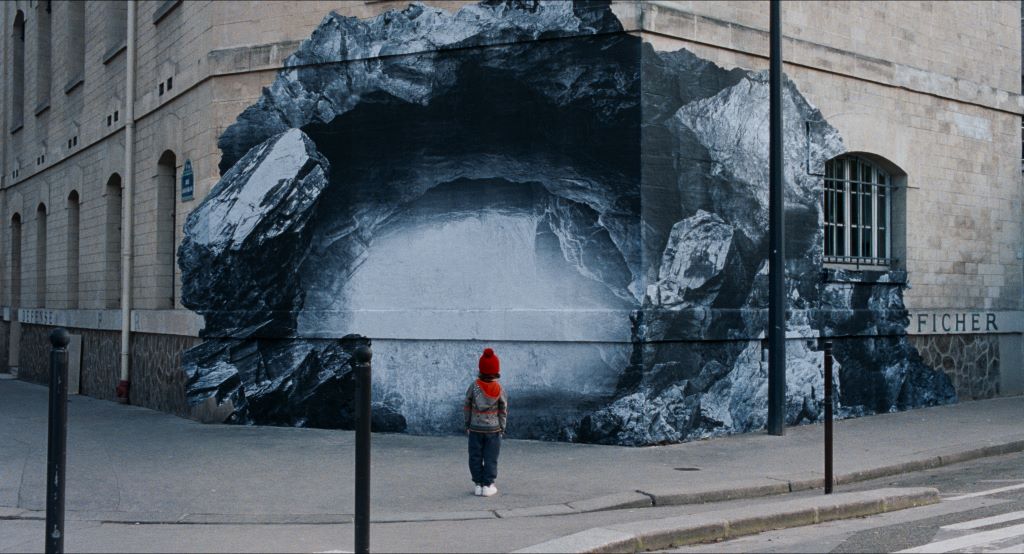
The conceit draws upon JR’s signature work in which he fashions oversized portraits of everyday people atop façades of their environment, most notably in his Oscar-nominated collaboration with Agnès Varda, Faces Places . JR says he’d never attempted his technique on this scale, nor with the layers of photography. “There was something magical, even for us, as we were [like] children on that set thinking, ‘It really looks like a special effect by hand,’” says JR.
The directors emphasize that they knew from the beginning they had to use JR’s handcrafted paper and glue approach even though visual effects and CGI could offer a similar feat. “We wanted the audience to feel the texture of the paper, the imperfections of things, and the fact that we are trying to tell a story from the perspective of a child, but it also comes from our inner child,” says JR.
The result is both a short and a public art display as the filmmakers were refashioning the streets of Paris to evoke Plato’s cave. Rohrwacher says it was a daunting effort to experiment with the layers of paper and glue in real time during shoots, but that waiting for the photos to adhere and then joining together in anticipation as Jay ripped the top layer back emphasized the value of the artisanal approach.
“When the little child went there and we were all [makes motion to convey anxiety], because if was not working, we would have to do everything again,” says Rohrwacher. “When he start to do like this [mimes peeling back the layers], it was really emotional for us because we did that together, not closed in a dark place in front of a computer. The emotion was a collective emotion because everybody was working to make this image possible.”
The directors hope that the sense of play in An Urban Allegory inspires audiences to have their own awakening and share the myth’s enduring parable about having an awareness of one’s environment. “When you look at the work of Christo and Jeanne-Claude , who were wrapping up bridges and buildings or the Arc de Triomphe, you look at it differently,” says JR, likening the cave feat to the large-scale installation work of the late French artists known for draping curtains across canyons or creating floating walkways. “Even when they remove their work, you never forget that, for a moment, they allowed you to relook at it from a different perspective. That shows you in a very beautiful and ambitious way that, you can do that with everything in life—a relationship or a city or context or community.”
“When you make a movie, you always have to give the possibility to see from another perspective,” adds Rohrwacher. “Our desire is for people to see the movie and then talk what are images are instruments of freedom and which are chains. It’s not sufficient to say images are illusions since chains are real.”