


The fabled cut of Quentin Tarantino ’s fourth film is here and available to non-Los Angelenos for the first time. Tarantino hosted screenings at his own New Beverly Cinema, but left everyone else holding the bag. The best you could do was watch Volumes One and Two back-to-back. Then, in an interview, the director seemingly put the kibosh on people seeing it on a large scale. “That’s not owned by a corporation, that’s owned by me. And the fact that you have to come to my theatre to see it, and it’s not just sitting on a stack of DVDs and Blu-rays that you get around to watching eventually.” Fortunately, fans of the film found out days later that a theatrical re-release would take place on December 5.
For the uninitiated, Kill Bill: The Whole Bloody Affair isn’t just Volume One and Two slapped together. It’s edited to flow in a thoroughly entertaining new way. Excised portions, such as the cliffhangers and the convertible-set recap, aren’t necessary in a unified cut, so they’re gone. Segments that were once in black-and-white are colourized, resulting in much more blood. The unrated cut means the MPAA no longer has to be appeased. The change it brings to the House of Blue Leaves fight sequence is significant.
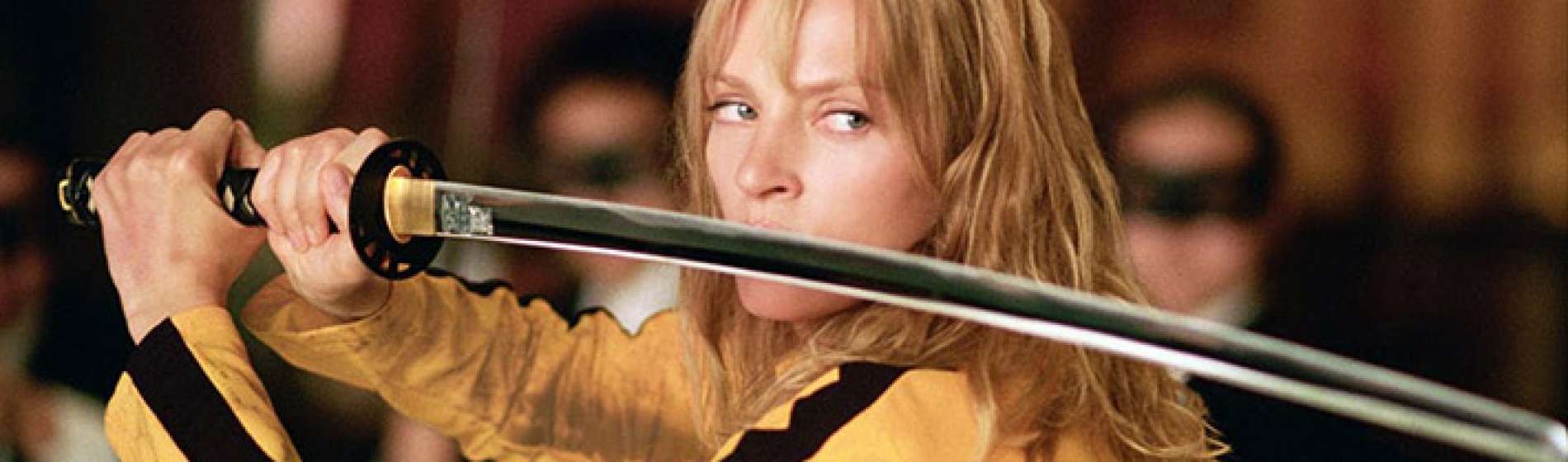
It’s easy to lose track of just how savage the battle with the Crazy 88s is when it’s in black and white. In colour, the blood adds a delirious tone to the proceedings. Beatrix ( Uma Thurman ), bloodied and exhausted, appears less sure of her ability to dispatch everyone to face her (temporary) final boss in the form of O-Ren Ishii ( Lucy Liu ). The wirework and fight choreography are top-notch. Watching the scene in a theatre, I could appreciate it in a way not possible on my television. The scale of that many fighters, and the skill each performer exhibits is required viewing for fans of martial arts films. In an age where every film is trying to mimic John Wick’s gun-fu, I missed Yuen Woo-Ping’s work ( Crouching Tiger, Hidden Dragon, The Matrix ).
Tarantino tweaks the already non-linear structure of Kill Bill to add moral ambiguity to Beatrix’s journey. She indulges in some bloodlust and mayhem prior to the inciting incident (still preserved in black and white). By structuring the film’s events in that particular order, it breaks up the catharsis audiences feel. Kill Bill is a film about revenge, unquestionably, but a doubt lingers as Beatrix kills her many foes. Is this chase going to make her more like them? Will she be able to walk away like Hattori Hanzo (Sonny Chiba)? As Hanzo says, “Revenge is never a straight line. It’s a forest, and like a forest it’s easy to lose your way… To forget where you came in.” Will this quest cost Beatrix her life?
Watching the new cut of Kill Bill , you get the feeling of how under-appreciated Uma Thurman’s performance was. For a woman whose career has spanned decades, she really deserved an Academy Award nomination for her work in this film. For every actress who learns piano, ballet, or sings, very few have convincingly portrayed a kung fu practitioner and slung a blade as well as Thurman does here. Her vengeance is fuelled by equal parts rage and vulnerability. Kill Bill is nothing without Thurman’s captivating performance. It deserves the same reverence as Meryl Streep’s or Cate Blanchett’s Oscar-winning work.
The new edit doesn’t really change much in terms of how the supporting cast registers, except for Lucy Liu. The extended animated sequences include more of Ishii’s quest to avenge her parents’ deaths. It may seem curious to keep these scenes since Tarantino isn’t building Ishii up as the end of the film, as it was in Volume One, but the animated sequences are a sight to behold. Rendered beautifully, they are a standout in form—a playful juxtaposition to the grainy Pai Mei scenes and Robert Richardson’s gorgeous lensing.
Watched as an epic, the difference between Beatrix and her antagonist, Bill (David Carridine), is more pronounced. Bill was raised by violent figures—Pai Mei, Hattori Hanzo, Estaban Vihaio. He, in turn, produced a flock of violent killers: Elle Driver (Daryl Hannah), O-Ren Ishii, Budd (Michael Madsen), and Vernita Green (Vivica A. Fox). A point of separation between Beatrix and Bill forms during Beatrix’s encounter with Vernita. Bill had no qualms about putting a bullet into a pregnant woman, while Beatrix gave pause to killing a woman in front of her child. When it unavoidably happens, Beatrix offers the daughter a chance to make it right down the road. It’s easy to imagine Bill simply killing Vernita’s daughter and walking away.
It’s clear from meeting the men who influenced Bill that the continued pursuit of violence rots the soul. Hanzo abandoned his practice and seems quite happy with his choice. Conversely, Esteban Vihaio is still at work, flaunting his sadism in front of Beatrix as she questions him about Bill’s whereabouts. The glint of malice in his eyes is palpable. Pai Mei met his unfortunate end because he never adjusted to a different life. He only became more cloistered and combative. The continued pursuit of revenge becomes a life sentence. No one escapes it. The cruelty is what men like Bill live for. It’s why Beatrix tried to escape, and why Bill couldn’t let that happen.
Most of the revisions that make The Whole Bloody Affair possible are for the better. Yet one qualm I have is choosing to come out of the intermission with Budd’s chapter. Budd is the saga’s weakest character. Jumping straight from a stretch break to Budd’s Podunk workplace is like slamming on the brakes. While Ishii’s animated backstory further illustrates the film’s reflections on revenge, Budd’s time at an El Paso strip club serves no purpose. Kill Bill is a mash-up of genres and influences, but no one needs the sleazy off-hour interactions between Budd and his manager. It grinds the narrative momentum to a halt; the only miscue for an edit that improves on an already great story.
The most significant difference between this cut and what came before it is the introduction of B.B. Volume One ended with the revelation that Beatrix’s baby survived, which set viewers up for a six-month cliffhanger between theatrical releases. It made sense as a studio decision. Keep people hooked until the sequel comes out. But it robs the weight of that information and what it means to the characters onscreen. Her daughter’s sudden appearance unmoors Beatrix. And while the audience remembers from previous viewings, it hits them much harder, too. Thurman spends the scene trying to balance the outpouring of emotion she feels for spending time with her newfound daughter, and the disdain she feels for the man who took B.B. from her.
Until the finale, we’ve only gleaned information about Bill. The climax allows us to watch him justify his actions to Beatrix. We’ve waited over four hours to see this final battle. But Tarantino doesn’t indulge the audience yet. Bill hits Beatrix with a truth-serum dart, and the former lovers exchange philosophies.
I used to chalk up Bill’s speech about Clark Kent/Superman as a misunderstanding on Quentin Tarantino’s part. With time and reflection, I realize that the speech is a peek into Bill’s worldview. Clark Kent isn’t Superman’s critique of humanity. Bill just couldn’t imagine why anyone would turn down power to live an ordinary life. An assassin with his gifts and influence, it’s no surprise that Bill thinks Superman must be mocking humanity with humility and empathy. It’s why he wouldn’t let Beatrix abandon her life.
Tarantino’s fourth film may not be his masterpiece, but this unified cut makes for a richer, more fulfilling experience. I’m honestly delighted that moviegoers get to experience it in theatres together. With Netflix’s acquisition of Warner Bros. fresh in everyone’s mind as the film started, it’s good to stop and appreciate these opportunities while they’re still available.
Kill Bill: The Whole Bloody Affair is in theatres for a limited engagement beginning December 5