


It’s no secret that nurses and other essential care workers are underpaid, overworked, and, most days, clinging to their sanity by a mere thread. They are harassed by patients, stretched thin by understaffing, forced to act as patient advocates when there are none, not to mention acting as counsellor, mentor, and more, all while trying to do one of the most important jobs on the planet. This is the complicated and overwhelming world that Petra Volpe’s exceptional new drama, Late Shift , immerses us in. What begins as a normal nursing shift turns into a race against time that is both engrossing, exhausting and heart-wrenching from beginning to end. It’s not hard to see why this film was Switzerland’s submission for the 2025 International Feature Oscar category.
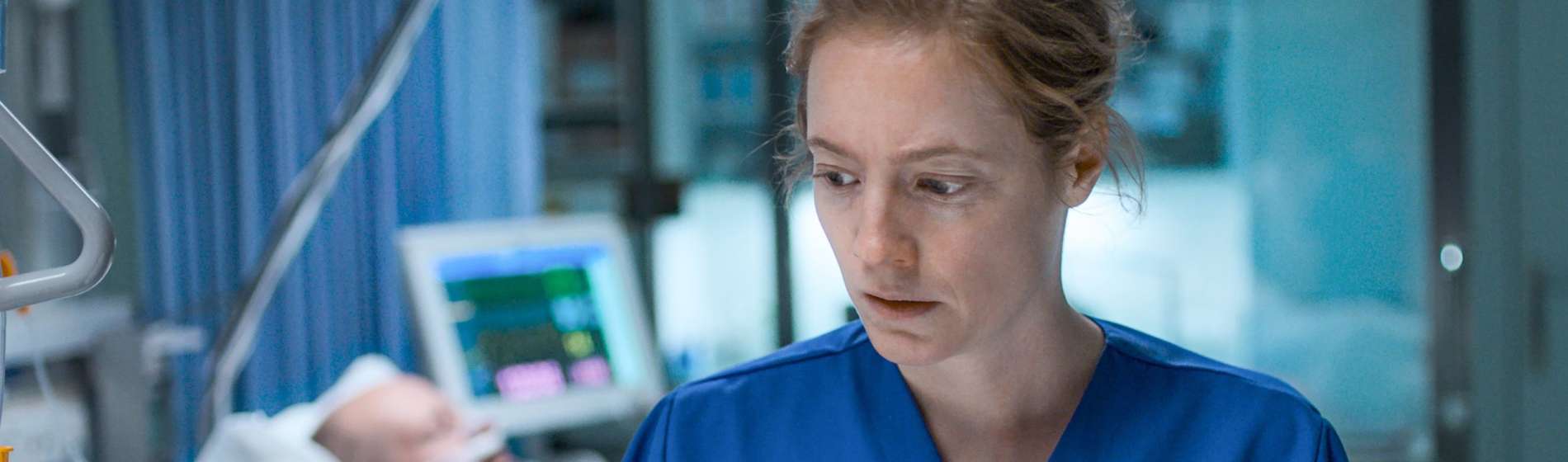
The camera follows dedicated nurse Floria ( Leonie Benesch) as she arrives for her evening nursing shift, and the routine of changing into her scrubs and new sneakers will be one of the few moments of calm she experiences throughout the film’s 92-minute runtime. Tonight her ward is understaffed, and as she deals with upset patients, families and other colleagues in the hospital, she is constantly having to explain and–at times–remind them all that, “there’s only two of us today”. She takes the west wing, while another nurse takes the east wing, and they share a nursing student, Amelie, who runs between them as best she can.
She is never able to complete even one full rotation around the ward due to the unexpected chaos around her, and it’s easy to picture this happening on many shifts. Floria races to get new patients settled, existing ones their meds, take some to their operations and procedures in other departments, confiscate contraband like cigarettes from a patient on oxygen, even find personal items a discharged patient has left behind. Despite being rushed off her feet, she takes the time to sit with patients to help calm them or to lend an ear, but the second the problem is solved, she’s off again. The pace is intense and unsustainable, and you know it’s leading to an emotional explosion or a costly mistake. As she gets pulled in a million directions at once, something’s got to give.
In fact, the pacing of Late Shift is key to the film’s success and director Volpe perfectly delivers there, ratcheting up the tension shot by shot, moment by moment. The unwavering pressure pressing down on Floria is almost palpable, and as it builds and builds, the uncertainty of when–and how–it will explode becomes almost unbearable. It’s a pace impossible to maintain, so when it does reach its climax, it’s both cathartic and shocking. The atmosphere’s intensity is heightened by Emilie Levienaise-Farrouch’s effective score and Benesch’s incredibly committed performance.
The award-winning German actress ( The Teachers’ Lounge ) features in almost every frame of the film, and her character is constantly on the move. There is no downtime, nor a moment of space or quiet. Her efforts to calm and care for patients, both physically and emotionally, drain her, but she doesn’t let that slow her down. She radiates competency and empathy, even with the more difficult and unruly patients. Benesch’s performance is so good that it’s easy to forget Late Shift is not a documentary uncovering the realities of modern-day nursing.
There are no one-dimensional characters to be found here–no matter how big or small the part. Each patient and each caring family member is a fully-realized person. That’s not to say we spend a lot of time with them, given how quickly Floria is required to move throughout her shift. But the slice of their lives we’re witnessing feels honest, and her interactions with them feel genuine.
There’s no specific antagonist, either. Not really. Not in the form of any of the characters. The problems Floria has to battle are time–there’s not enough of it–and understaffing, which is an issue in hospitals worldwide. A doctor ignores her pleas to attend to a patient who’s been waiting for a diagnosis for far too long, but that doctor is exhausted and overworked, too. There is a trio of sons rudely pushing for help for their sick mother, but they are understandably scared, and the understaffing means their matriarch isn’t getting the care she deserves fast enough. That’s true of everyone in the ward, but not for lack of trying on Floria’s part. But she is only one person, doing the job of ten. So their lashing out is understandable, even if it’s misdirected.
There is also an entitled wealthy patient who embodies the very worst qualities a patient can have. He’s demanding, sarcastic, and treats Floria as a personal servant, uncaring about other patients or the fact that the ward is down a nurse. He is one of two people Floria loses her temper with–in one of the film’s most memorable scenes–but even then, she begins to understand the dimensions of his situation. He has just been given a fatal diagnosis, and she realizes he is lashing out and seeking to control anything he can. It doesn’t excuse his behaviour, but it allows her to find some empathy, which in turn causes him to treat her differently.
When the shift finally ends, it’s hard not to heave a sigh of relief for both Floria and for ourselves as viewers. How she still has the energy to jog to the bus is hard to comprehend. The final shot of the film is one of the best you’ll see in any film this year. It’s a tableau that serves as an important reminder that healthcare workers are not machines that can be turned off when they’re done for the day. They take patient outcomes to heart and carry their stories home with them, whether they want to or not. Before the credits roll, the film tells us there is a severe shortage of care workers worldwide, and it’s only getting worse. And it’s not hard to understand why.
For anyone who has ever spent time in a hospital, Late Shift offers an essential behind-the-scenes glimpse of its internal workings . Theoretically, we know healthcare is in a perilous state right now, but it’s easy to lose sight of the human side of that crisis. Volpe’s film–and Benesch’s exceptional performance–shows us that the people at the heart of the system are just as vulnerable as the system itself. It costs them emotionally, too, as they care for us at our worst. They are often the face of the systemic problems and are unfairly derided daily by frustrated patients, even though the solutions are beyond their control. Late Shift skillfully asks us to remember their humanity and implores us to have a little patience as we navigate this broken system together.
Late Shift screened as part of the 2026 Blue Mountain Film Festival.