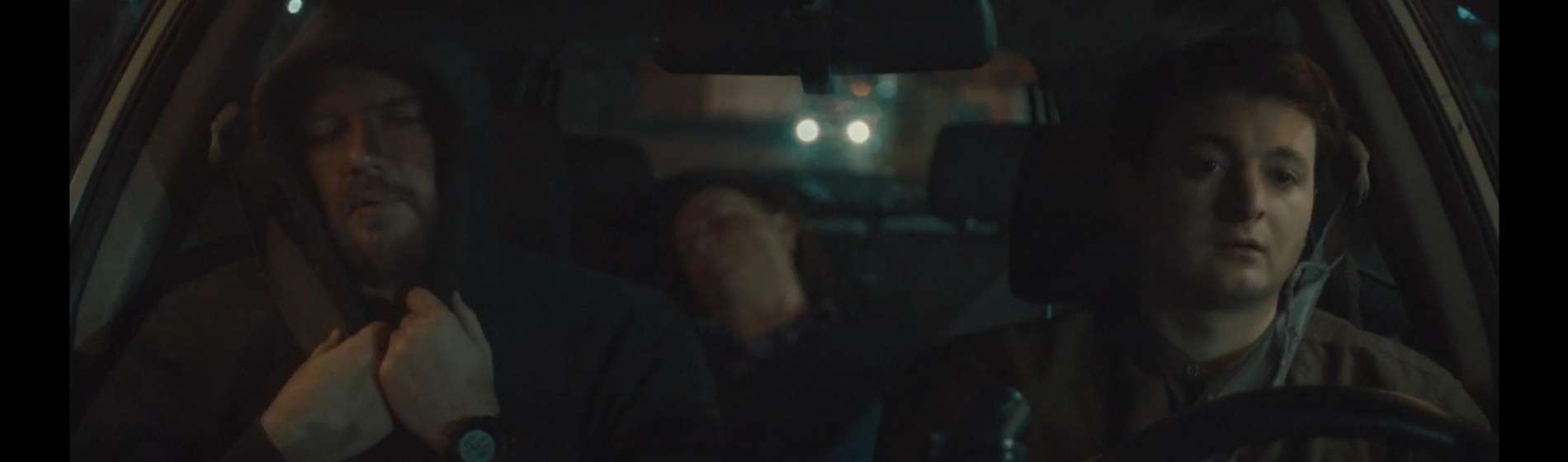



There is a scene early in Mihnea where the titular character, a neuroscience student and reluctant party bus driver, is forced behind the wheel after a night of drinking. Writer-director-star Mike Doaga does not frame this as a dramatic set piece with screeching tyres and near-misses. Instead, the camera shakes subtly, the score tightens like a vice, and the tension becomes almost unbearable through restraint alone. It is a sequence that captures exactly what makes this scrappy 72-minute indie so impressive: it understands anxiety not as spectacle, but as suffocation.
Doaga plays Mike, a soft-spoken, deeply sensitive university student in his final term. He’s fighting a losing battle to juggle his neuroscience degree and a party bus gig run by his domineering father, Dan (Raresh DiMofte). The dynamic between father and son is established with the kind of lived-in shorthand that only comes from real experience. Dan speaks in Romanian, while Mike responds in English — a bilingual friction common among first-generation immigrant families that the film subtly captures.
Mike’s relationship with his mother, Elena (Sabina Doaga), is warmer and more tender. She is the only person who calls him by his real name, Mihnea, and their scenes together carry a quiet sweetness that grounds the film emotionally. The contrast between his parents — one demanding, the other nurturing — forms the central axis around which everything else orbits.
The film opens with Mike’s high school friend Joe (Sean Depner) setting him up with Casey (June Laporte), a non-binary classmate whom Mike awkwardly misgenders. The dialogue is stilted and uncomfortable in exactly the right ways, zeroing in on the painful rhythm of two people forced into conversation by a well-meaning third party. When Mike tries to lean his head on Casey’s shoulder and immediately gets rebuffed, the moment lands as both funny and painfully relatable.
That same inability to assert himself follows Mike everywhere. When Umer (Harnoor Gill), the head of the university debate team, corners him in a hallway, Mike agrees to attend a meeting because he simply cannot bring himself to say no. The film smartly cuts to the next person Umer approaches, who tells him to shut up — a quick, effective illustration of the space between who Mike is and who he wishes he could be.
It is at the debate club where Mike meets Jocelyn (Anna Christine Toth), and their tentative connection provides the film with a welcome undercurrent of romantic possibility. In a detail that feels achingly real, Mike abandons his exam studying to read Wuthering Heights after spotting an Emily Brontë quote in Jocelyn’s Instagram caption. It is the kind of small, irrational, deeply human choice that Doaga’s script excels at.
Where Mihnea truly distinguishes itself is in its depiction of panic attacks. The drunk driving sequence is harrowing, but the attacks that follow, one during an exam, another mid-debate speech that ends with Mike vomiting into a garbage can, are rendered with a visceral authenticity that feels less like performance and more like a documentary. Credit belongs both to Doaga’s committed lead turn and to the film’s subtly shaky, handheld camerawork, which keeps the audience locked inside Mike’s spiralling perspective.
Sabina Doaga, in particular, deserves recognition for her portrayal of Elena. The scenes where she comforts her son after his worst moments are understated and deeply affecting. A mother who sees everything, even when her child tries to hide it.
Not everything works as seamlessly. Some of the supporting performances run a touch hot, occasionally tipping into over-emoting that contrasts with Doaga’s naturalistic lead work. And the ending, still emotionally affecting, feels rushed. There are too many threads resolving in too little time. At 72 minutes, Mihnea is clearly working within the constraints of a modest indie budget, and the final stretch is where those constraints show most.
Even so, Mihnea leaves a lasting impression. Doaga’s script nails the rhythms of real conversation: people cutting each other off, trailing into half-thoughts, never presenting themselves in the polished sentences most films rely on. Combined with the documentary-style camerawork and a score that knows when to pull back and when to press in, the result is a film that feels startlingly real. As a triple-threat debut, it is a remarkably assured piece of work; a thoughtful, textured portrait of immigrant family dynamics and the quiet crisis of early adulthood that gets under the skin and stays there.
Mihnea premiered at the Canadian Film Fest on Tuesday, March 25.