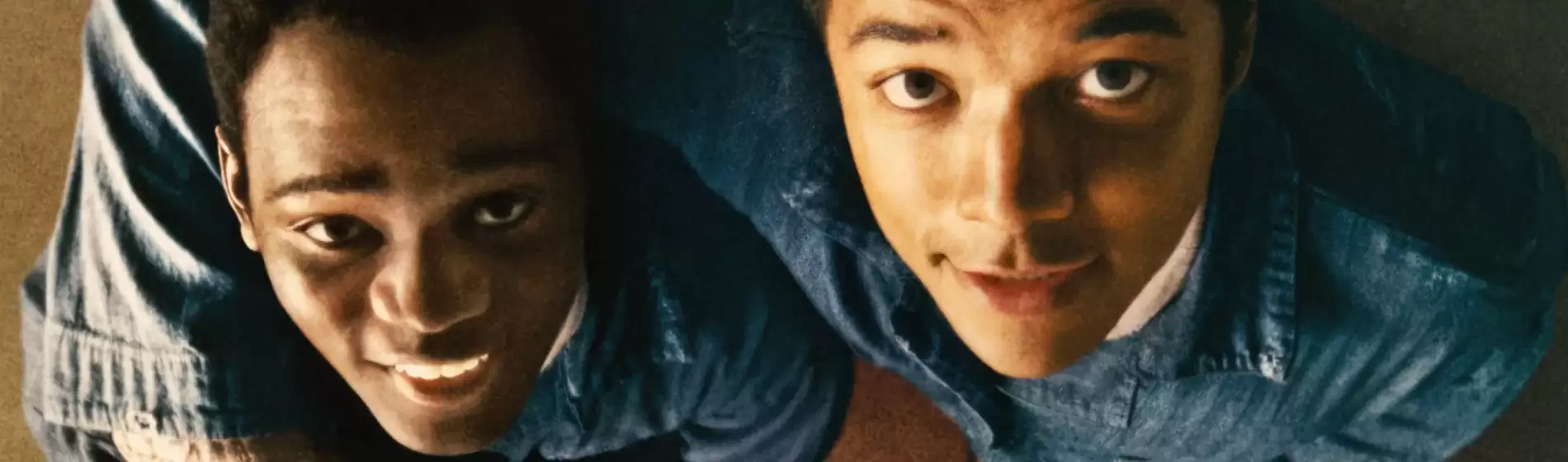


Near the end of RaMell Ross’s ( Hale County This Morning, This Evening ) feature-length, narrative debut, Nickel Boys , Elwood (Ethan Herisse) and Turner (Brandon Wilson)—teens sentenced to an abusive, racist reform school in 1960s’ Florida—share a seemingly casual discussion about their pasts, present, and futures under a mirrored ceiling. Echoing the cover of Whitehead’s novel, their points of view—until now divided, split, and halved by Ross’s radically unconventional approach—visually share a space that blurs the psychological lines between them, their split consciousnesses briefly united. It’s a brilliant moment in an audacious, masterful adaptation of Colson Whitehead’s Pulitzer Prize-winning 2019 novel.
That incredibly powerful, deeply moving scene is also filled with a poignancy derived from shared circumstances and an unshakable foreboding of what the next few days might hold for them, both individually and collectively. Elwood is an idealist nurtured on the promise of the Civil Rights Movement and Martin Luther King Jr.’s exhortations of a better, brighter future; the other (Turner), a cynic all-too-familiar with the daily humiliations, abuses, and injustices of Jim Crow America, find common ground—and common cause—in survival. They stand little chance of surviving the Nickel Academy, a century-old institution ostensibly created for the reform of young men. In reality, the word “reform” has no meaning except as a catch-all for the never-ending abuses inflicted on the underage inmates by the unaccountable white staff.
Freely adapting Whitehead’s densely textured, heavily researched novel, Ross and co-writer Joslyn Barnes decided to take an impressionistic, expressionistic approach to the material. They focus on lived-in, everyday details fixed to a first-person point-of-view—Elwood’s for roughly the first hour, then alternating between Elwood and Turner’s for the remainder of Nickel Boys’s r unning time. In effect, Ross replaces the typical, third-person point-of-view of mainstream cinema with an embodied point-of-view. We’re not just seeing the world from Elwood and Turner’s eyes, but experiencing it on a fundamental level as well. Sense memories—and with them a deeply felt emotional connection—take precedence over the usual succession of plot points and narrative turns.
An early, flawlessly conceived and executed scene centred on a preteen Elwood functions as a macrocosm for practically everything that follows. Disorienting at first, we see and hear what young Elwood sees and hears, hiding under a table as adults, including his soon-to-be-absent mother, practically ignore him, playing cards, drinking alcohol, and enjoying each other’s company. Still too young to participate, Elwood simply observes. Even as he observes the adults around him, a lingering sense of isolation, of longing envelopes him, assuaged only later by the presence of his loving, open-hearted grandmother, Hattie (Aunjanue Ellis-Taylor).
Pegged by a thoughtful, politically engaged high-school school teacher, Mr. Hill (Jimmie Fails), as a gifted student with potential, Elwood’s fate takes a turn for the better, before taking a decided turn for the worse, as Elwood finds himself wrongly implicated as an accomplice in a car theft. This leaves him with a one-stop future, the Nickel Academy, awaiting him on the other side. There, Elwood—shy, introverted, and socially awkward—meets Turner, his almost exact opposite in every way. Their bonding—driven initially by instinctual need and followed by a friendship that ultimately defines them—serves as Nickel Boys’ emotional through-line .
Ross periodically integrates archival footage, including national news of the time (e.g., NASA’s moon missions, the Civil Rights Era headlines) along with real-life photos derived from the Nickel Academy’s real-world analog, the Dozier Academy, into the alternative points-of-view. While a potentially divisive decision, the integration of archival footage provides much-needed historical context for members of the audience unfamiliar with the time period. It also reflects both the media consumption typical of the era, including what Elwood, Turner, and the other boys might have personally encountered, and functions as an ironic counterpoint (the boys effectively locked into a racist, institutional system vs. the soaring accomplishments of the NASA space program).
In addition to shifting points of view and archival footage, Ross unmoors the narrative from linear time. Flash-forwards gain meaning with repetition, and glimpses of a post-Nickel Academy Elwood from behind—Ross equipped future Elwood (Daveed Diggs) with a harnessed camera—foregrounds the trauma Elwood and the other survivors carry with them, unseen by everyone around them, but keenly felt. It also adds a layer of mystery that, at least for some, might feel like a bait-and-switch, but like everything else in Ross’s impressive debut, it serves a purpose that goes beyond narrative, expressing hard, incontrovertible truths about not just American history, but us as well.
Nickel Boys opens in limited release on December 13, and expands to additional markets and theatres in subsequent weeks.