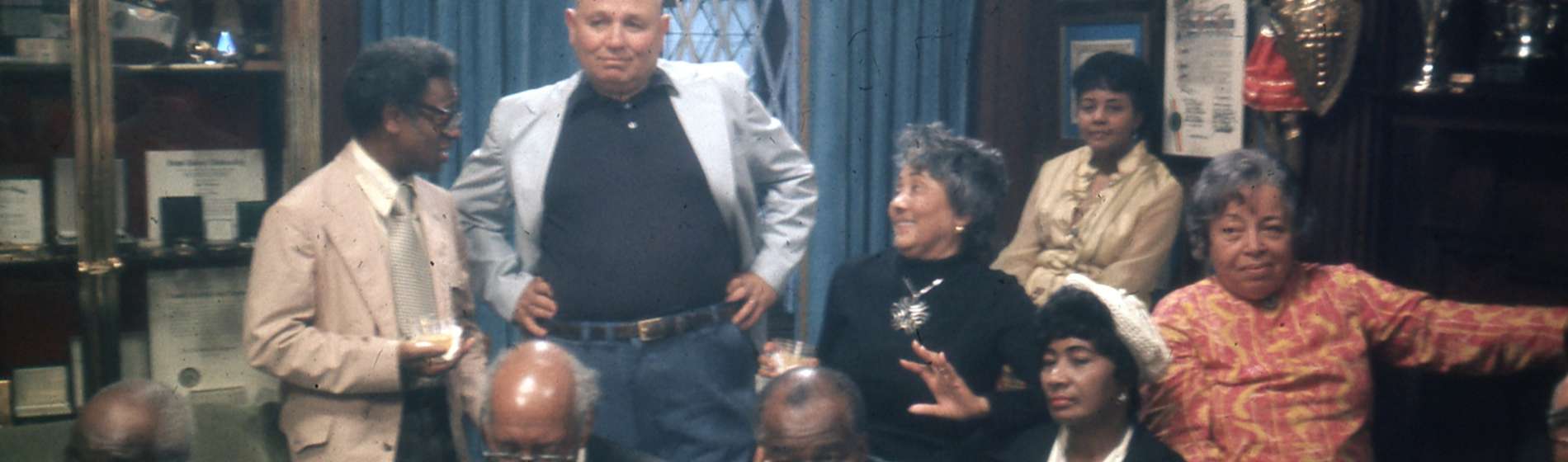



Picture assembling a who’s-who of the brilliant minds and talents that shaped culture as they sit assembled in one place while ruminating on the impact they have had. Artist, poets, musicians, philosophers, librarians, journalists, actors, teachers, critics, photographers, and more all gather in one place sharing ideas, engaging in debates, and discussing their respective crafts. One would think that it would be impossible to capture the magnitude such an occurrence, but that is exactly what legendary filmmaker William Greaves did in 1972.
Planning to make a film about the Harlem Renaissance, Greaves orchestrated a party at the home of Duke Ellington and invited many of the key figures of that movement who were still alive. Filming the event, with his son David serving as one of the cameramen, the documentarian recorded a wealth of conversations and solo interviews with those who helped to redefine a generation, but also what it meant to be Black in America.
Although Greaves would eventually make the fascinating documentary short film From These Roots in 1974, which was all about the Harlem Renaissance and only used archival photos, he never forgot about the footage he had captured. As powerful as that film was, the genre-defying filmmaker kept tinkering with footage from the party on and off until his death in 2014. Years later, David Greaves has completed his father’s opus with Once Upon a Time in Harlem . The result is a mesmerizing tapestry of history and the ideas that shaped it.
Like a guest mingling at a cocktail party, Greaves’ film effortlessly moves from conversation to conversation giving the viewer insight into the various people in the room. Never feeling disjointed or stilted, the discourse gets livelier as the event goes on and the distinct personalities come into focus. It quickly becomes clear that, as with all movements, there were vastly different, and at times competing, views not only the on approaches to elevating the Black community, but also on who deserved credit for the renaissance.
While some individuals, like Ida Mae Cullen, the wife of the late poet Countee Cullen, champion for more recognition for their loved ones’ contributions, others point to unlikely individuals as unsung participants, like gangster and philanthropist Casper Holstein who helped to put more than 40 Black people through college.
Regardless of who did or did not get praise, Once Upon a Time in Harlem captures how it truly took a community to evoke change. As one person notes in the documentary, “If I can’t do something to help [Blacks in Harlem] I don’t want to do it.” That sentiment is reverberated throughout the various conversations. Everyone may not have known the impact they were making, but they knew it was important to revive the sense of greatness that others attempted to strip from them.
It is why on the scale of achievements, local librarians offering a hub for writers were given equal weight as the artist who taught others to paint in a cramped cellar. In listening to the wealth of stories and insights, one not only gets a vibrant picture of Harlem in the 1920s, but also of the numerous accomplishments that were made despite the entrenched racism that Black people consistently faced. Even in 1972, the members of the renaissance still found themselves engaged in fierce debates regarding the best ways to fight against an unjust system.
Blending these discussions with individual interviews and archival footage, William and David Greaves create a work that feels timeless. As if uncovering buried treasure that itself is a map to future prosperity, Once Upon a Time in Harlem offers a new way to consider the Harlem Renaissance and those involved with it. The film provides younger generations with insight into the various paths cultural movements travel down, and the important roles that so many different individuals in a community can play.
A masterful piece of cinema, Once Upon a Time in Harlem vividly brings a rich history to life. It is a work that forces viewers to recontextualize the past and study how we can reshape the future for the better.