

Genre specialist André Øvredal’s (The Last Voyage of the Demeter, Scary Stories to Tell in the Dark) latest film, Passenger, opens with an excerpt from the Prayer of the patron saint of travellers, mariners, and, in some accounts, transportation, Saint Christopher: “Saint Christopher, protect me today, in all my travels. Give us your warning sign if danger is near.”
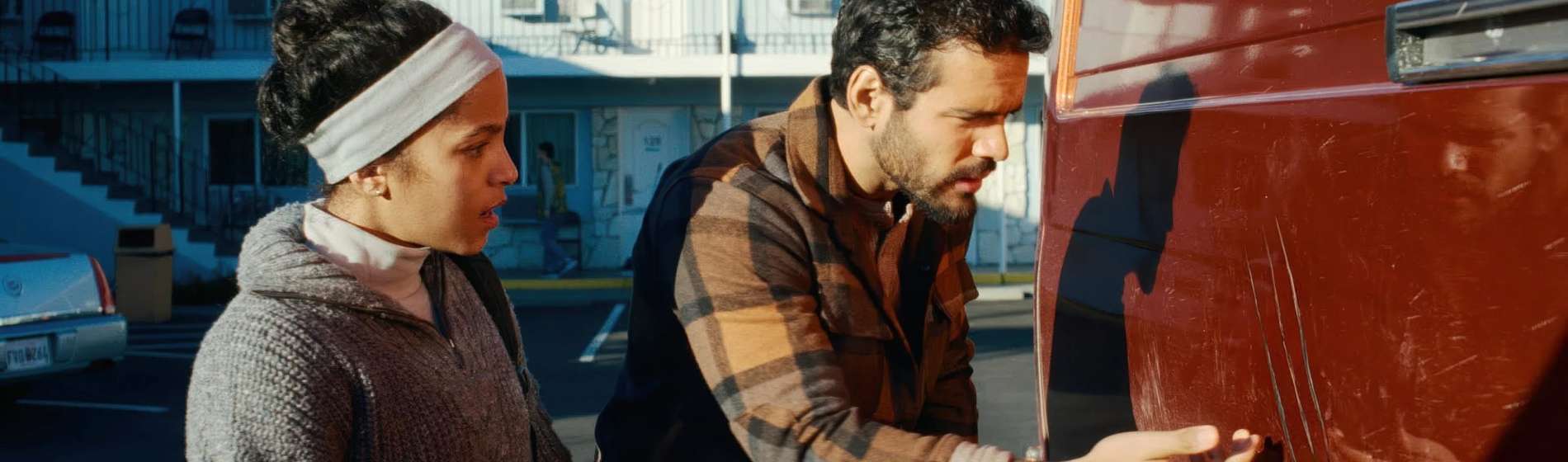
Before long, Maddie Brecker (Lou Llobell) and Tyler Genocchio (Jacob Scipio), the thirty-something couple at the centre of the Passenger, will be on their hands and knees in prayer, Saint Christopher’s medals around their necks, hoping for the intercession of a long-dead, possibly (likely) fictional, holy man. They’re less interested in soul salvation than in their safety from physical harm from the title character, a parasitic demon with poor hygiene, arthritic joints, and nicotine-stained teeth.
Well before Tyler and Maddie encounter the “Passenger” of the title, the couple has quit their day jobs, sold all of their possessions, and adopted the rambling, nomadic “van life,” leaving everything else, presumably including friends, family, and acquaintances, behind. Not fully ready to give up all the comforts of their tech-driven life, they’ve purchased a state-of-the-art Mercedes-Benz van, complete with all the bells and whistles typical of our age. It includes multiple cameras positioned around the high-end van’s exterior. (Note: These same cameras will play a key role in one of the film’s better set pieces around the halfway mark.)
Co-screenwriters Zachary Donohue (The Unknowable, The Den) and T.W. Burgess set up the central conflict, not between Tyler, Maddie, and the Passenger, but between Tyler and Maddie. He sees living out of a van as a permanent — or, at least, an open-ended — decision while she sees it as temporary, a way to shake off the financial pressures, background noise, and never-ending distractions to focus on stripped-down, rebalanced living. Maddie also sees living out of a van as a demonstration of her unconditional love for Tyler.
Story-wise, it’s not particularly deep or broad, but the Tyler-Maddie conflict serves as a solid foundation to develop the larger conflict between Tyler and Maddie on one side of the divide and the Passenger on the other. The stalking demon takes a page from The Twilight Zone and the Rod Serling-scripted S1E16 episode, “The Hitch-Hiker,” and always has a way of finding the couple, often appearing on the road in front of them or even inside the van.
Once they’re marked by the Passenger for breaking the unspoken rules of the road (“Don’t drive at night, don’t stop, and don’t try to help stranded or injured passengers”), there’s nowhere they can go, at least not for long. He can appear anywhere, and everywhere there’s a road. As neophytes to living on the road, Tyler and Maddie don’t learn the rules until it’s almost too late, suggesting, inadvertently or not, that a basic act of altruism can come at an unexpected price. Yet, the Passenger also suggests there’s not just a need, but a place for community among roaming nomads.
Gifted with a keen eye for visual composition, shot selection, and scene construction, Øvredal delivers several study-worthy set pieces, beginning with a tone-setting prologue involving an ill-fated, road-tripping duo, Lucas (Miles Fowler) and Daniel (Alan Trong), who make one bladder-emptying stop too many. Besides the Passenger’s superhuman speed, seeming omnipresence, and the vast, enveloping darkness, Øvredal and his cinematographer, Federico Verardi, nimbly mix variable-length shots with perfectly timed one-shots, including one where the camera follows a freaked-out Lucas in and out of a parked car after Daniel’s off-screen disappearance.
At least two other set pieces in the Passenger demonstrate Øvredal’s under-appreciated genre skills, one involving a nighttime walk to their van across a semi-deserted parking lot outside a 24-hour gym (a fiendishly clever twist on the old “1-2-3-Red Light” children’s game). The other set piece involves Tyler and Maddie, chilling after a long day on the road, watching the Gregory Peck and Audrey Hepburn-starring Roman Holiday via a portable projector and a makeshift screen. As the twig-breaking Passenger relentlessly circles their camp, Maddie turns the projector into a secondary flashlight, and distorted images from the film fall onto the trees and foliage, forcing the audience into a form of hyperactive viewing.
While the script all too often feels thin and underdeveloped, especially when the inevitable reveal behind the Passenger’s identity, his dubious connection to Christian folklore, and how to stop him becomes essential to moving the narrative forward, it’s elevated by Øvredal’s skillful direction and grounded, persuasive turns by Scipio and Llobell. They not only sell the in-film reality of their background as romantic partners, but everything else, too–from Tyler’s willful blindness to Maddie’s attempts at accommodation, Maddie’s increasing distress, and Tyler’s slowly growing realization that Maddie’s distress isn’t psychological, it’s supernatural in nature. All the way through the long and winding road that leads to the resolution of their internal (each other) and external (the parasitic demon) conflicts over the course of the Passenger’s 94-minute running time.