

Singer-songwriter Neil Diamond retired from performing onstage almost a decade ago, but well before he did, tribute groups, individually and collectively, numbered in the hundreds, if not the thousands. Diamond’s sparkling pop melodies, deep, sonorous voice, and unerring sincerity defined uncoolness during successive decades when various forms of rock, hard rock, indie, and/or alternative dominated the airwaves. That unironic sincerity, however, always had its fans, and for some, simply listening to Diamond on vinyl or watching him perform live wasn’t enough.
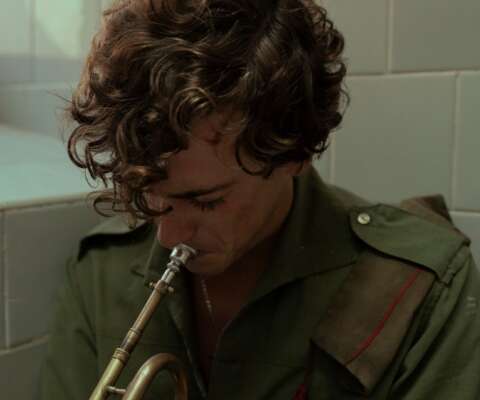
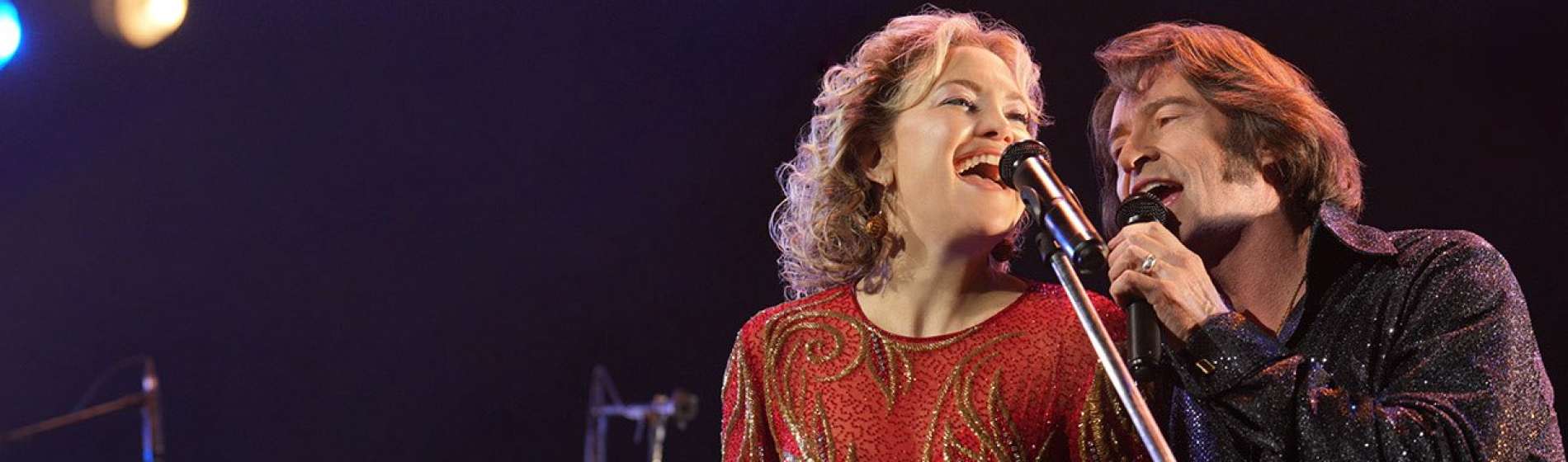
Some, like Mike Sardina (Hugh Jackman) and Claire Stengl (Kate Hudson), in writer-director Craig Brewer’s (Dolemite is My Name, Hustle & Flow) latest film, Song Sung Blue, find a modicum of modest fame from performing as a Neil Diamond duo, Thunder and Lightning, in ’80s and ’90s Wisconsin. For Mike—a divorced Vietnam veteran, sometime auto mechanic, and recovering alcoholic—performing as one-half of Thunder and Lightning gives his life both joy and meaning that seems all but missing from the daily grind of his working-class life.
When we first meet Mike, he’s moments away from performing as a Don Ho impersonator at the Wisconsin State Fair. Frustrated, he walks away at the last moment, but not before catching Claire’s deeply felt performance as Patsy Cline. Almost immediately, a partnership is born when Claire encourages Mike to reinvent himself as a Neil Diamond “Interpreter” and not simply an “impersonator,” adding his own vocal inflections, turns of phrase, and energy to the by-then standard Diamond repertoire.
In turn, Mike encourages Claire to join him as one-half of a Neil Diamond duo, both as vocal support and co-equal singing- and performing-wise. When love inevitably blooms between them, they marry and blend families. Narratively, Song Sung Blue alternates between occasional triumphs (e.g., growing success on the performance circuit, recognition for their efforts, etc.) and setbacks teetering on tragedy, including one involving an out-of-control car and Claire, that would be rightly perceived as borderline absurd or even worse, a desperate attempt at gaining and/or manipulating audience sympathy, if it hadn’t occurred in real life.
From that tragedy, Song Sung Blues turns toward a more grounded drama of recuperation (Claire’s) and reconciliation (Mike’s) as both fitfully move toward individual self-realization of their importance to each other, and given the central theme of communing with a higher power (not Diamond specifically) through performing as a duo. The music in general matters, Neil Diamond’s songs in particular matter, but for Mike and Claire, beset by economic problems (i.e., poverty, gigging, lack of medical care) and physical ones (Claire’s soul-shattering injury and subsequent start-stop rehabilitation), there’s more here than that.
Buoyed by strong, persuasive turns from Jackman as Mike, by turn repeatedly humbled by life-altering circumstances and elevated into a near transcendental stage by performing onstage, and Hudson as a hairdresser-turned-performer facing imaginable and unimaginable loss related to Mike and her extended family, Song Sung Blue skirts, but never crosses, the line between melodrama and drama, camp and non-camp, and excess and restraint.
At a little over two hours long, Song Sung Blue only really stumbles when it shifts focus from Mike and Claire to various subplots involving their respective children and the issues they’re facing. But that’s a minor quibble relative to an otherwise deeply moving, poignant film about dreams, dreamers, and finding meaningful expression in the seemingly least likely of ways, not just in the music of Neil Diamond, but in the communal experience of singing and performing his songs.
Song Sung Blue opened theatrically on December 25.