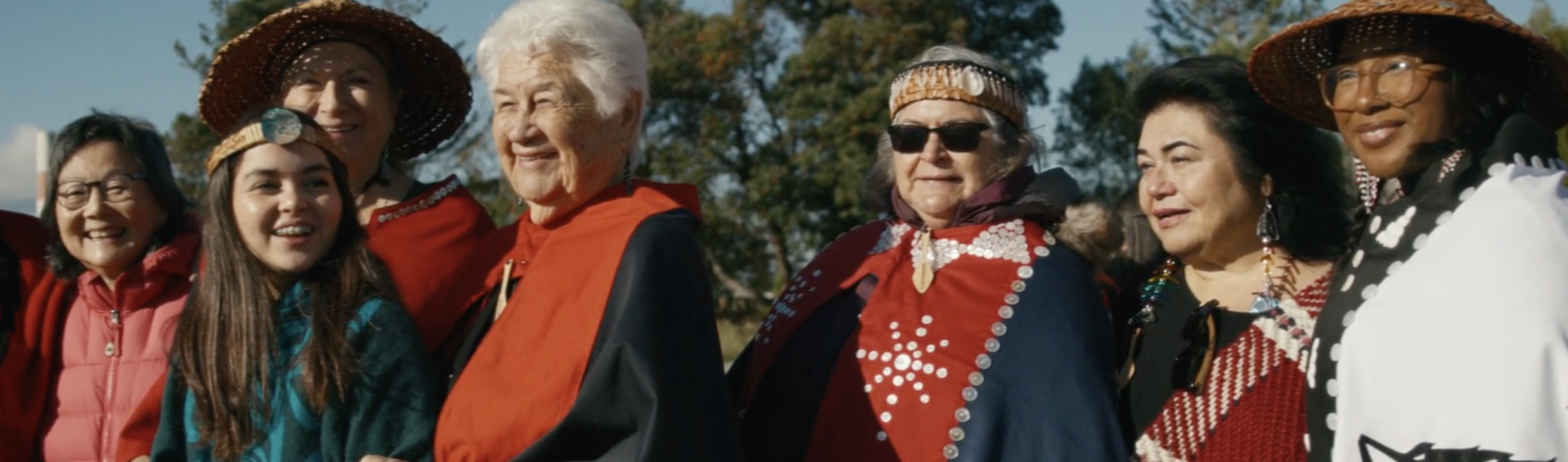


No matter if it’s an object, a person, or a place, humanity puts a lot of effort into naming things. In just a word or two, that label must be able to convey a people’s history, traditions, and stories. It must stand for a group’s indescribable lived experiences and identities. In short, a name is never just a name. Yet, humans aren’t a cohesive collective. Different cultures use different names. And when dissimilar groups share a space, tension can grow around something as seemingly trivial as these assigned words. This is what the new documentary tÉ™m kÊ·aθ nan Namesake tackles.
The captivating film chronicles the Tla’amin Nation’s efforts to change the name of a coastal community, now called Powell River, back to its original Indigenous name: Qathet. This name reflects their long-standing connection to the region and its land. Throughout their legal and social undertakings, the Tla’amin face constant pushback from the local government and residents alike.
The film manages to cover a great deal in its short 75-minute runtime. Immediately, though, it’s made clear that creating such a change in a multicultural community—one with starkly different identities—is beyond difficult. Especially so when the history behind their relationship is as dark and disturbing as it is here.
tÉ™m kÊ·aθ nan Namesake opens by describing the Tla’amin Nation’s given names for the four seasons, ones that date back millenia. There are steady and still close ups of flora and fauna, which the film pairs nicely with scenic shots of the Canadian landscape–nature that is mountainous, river-ridden, and rocky. Over that is a narrator, soft-spoken and comforting.
It’s a beautiful opening, both in its visual and scripted storytelling elements, as directors tÌ“agÉ™m Eileen Francis and ƛɛsla Dr. Evan Adams fully lean into the deep connection that the Tla’amin have with the land. Then, the disheartening history of the Canadian settlers’ treatment of the Tla’amin shifts into focus. The naturalistic beauty disappears, replaced by the industrial mills and factories that came to occupy on the land, instantly correlating the town’s poisoning of nature with the birth of its newer name, Powell River.
The audience hears primarily from the Tla’amin Nation, but also with an historian and a professor providing context. The former is more gripping, the latter feels more disjointed. Many of the academics featured are not a part of the Nation, and their statements recounting past atrocities simply echo the more impactful recollections of the Indigenous community itself.
Later on, as the documentary centres more and more on the contemporary renaming battle, those same voices manage to add further depth to the conversation, providing useful and productive insight into the local opposition to the name change. Rather than framing those opposed to the renaming effort as simply villainous, they are shown as individuals struggling to accept the ugly truth about their own histories and identities.
Even with that focus, there’s substantial content and time dedicated to the Tla’amin’s past and many traditions. These personal accounts greatly help to bridge the cultural gaps that may exist for some members of the audience, those less familiar with the Nation at the heart of the film, while adding depth to the main thread of the current conflict.
It’s a key piece of connection for both sides of the argument, too. Everybody holds value in traditions – in names and in ancestral roots. The main difference – and what makes the Tla’amin’s story so meaningful – is that people of a dominant culture often struggle to imagine what it’s like to lose their own history, stories, and words. tÉ™m kÊ·aθ nan Namesake does well to document that heart-wrenching experience, and provides hope, too, for a greater understanding between us all.
təm kʷaθ nan Namesake has its world premiere at Hot Docs 2026 on April 27 and April 30 .