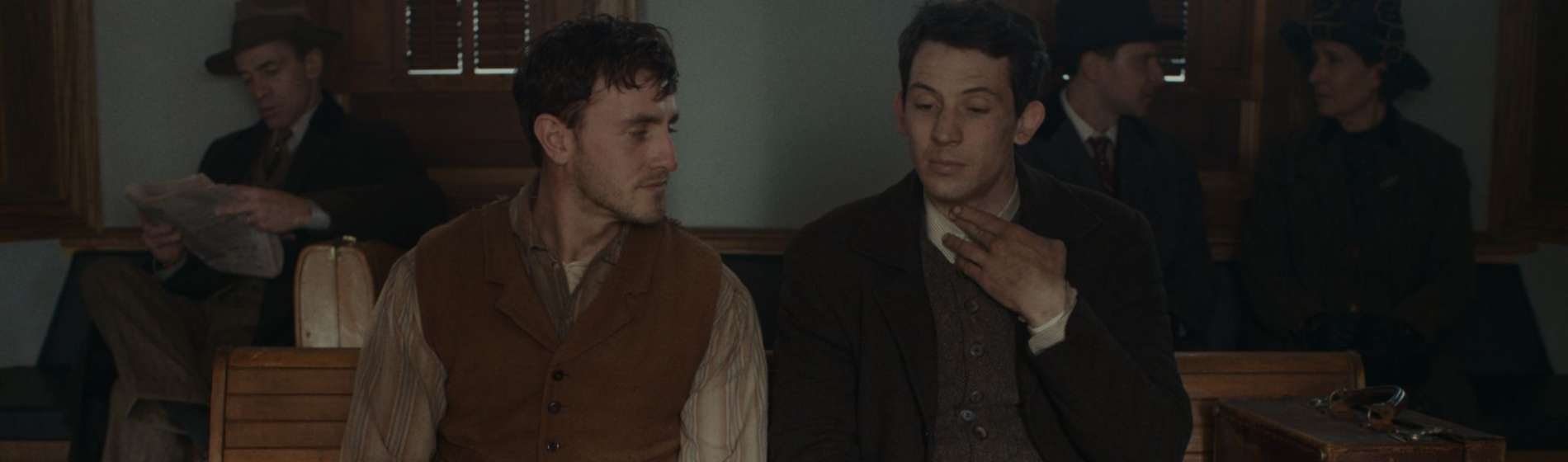


Is there any sound more intimate than a tune sung a cappella? The heart can’t help put swoon a little as Lionel ( Paul Mescal , Hamnet ) and David (Josh O’Connor, Challengers ) take turns feeling the vibrations of unaccompanied vocals. Put your hand on another’s throat or chest as he voices a sweet tune, or listen to the warmth of a raw, pure voice radiate from the grooves etched on a wax record, and one opens a window to the heart and soul. It’s an old school way of finding love, so to speak, but The History of Sound sweetly and tenderly envelops a viewer. This understated romance from director Oliver Hermanus ( Moffie , Living ) poignantly reminds us of the enduring power of love.
An old folk song brings Lionel and David together one night at the pub while they’re both studying at the Boston Conservatory. It’s 1917 and young Americans try best not to occupy themselves with thoughts of war. But as David tinkers away on the piano, Lionel can’t help but burst into song. Mescal, who sings surprisingly well, croons a tune that gradually works its power on the smoky pub. The chatter fades and students put down their drinks, awed by the golden boy’s rendition of the traditional folktune. It’s a stirring reminder of the freedom that many of their friends defend overseas.
The song immediately works its power on David, too. He can’t help put pause his handle on the ivories to savour the sweet, slightly raw voice before him. Soon thereafter, David invites Lionel back to his dorm where they make good on their instant connection—quite hotly with David spitting water into Lionel’s mouth. (1917 certainly has its ways!)
A few tender trysts let Lionel and David write their own story, but writer Ben Shattuck, adapting his own short story, instead favours the moments before and after. For a film with music at its centre, The History of Sound finds great power in shared silence. The History of Sound finds its stars’ harmony in the afterglow or the early morning discussions about music over coffee. Their connection seems well matched both intellectually and emotionally. But discord interrupts the ballad that’s just beginning as wartime forces the school’s closure. David ships off to war and Lionel returns home to Kentucky and works on the modest family farm.
Cut to the post-war years, though, and they reunite without missing a beat. David, now back on the trail as an ethnomusicologist, invites Lionel to accompany him to Maine. He wants to collect American folk songs like the one with which Lionel first serenaded him. It’s welcome retreat from the trauma of wartime, too, as tranquil life in the Appalachian Mountains, accompanied by soulful tunes crooned by salt-of-the-earth folks, offers just the balm the war vet needs. And a little extra warmth in the tent does hurt, although The History of Sound instead observes the romantic refrain in the moments shared listening to music, rather than time spent between the sheets. Equally awed by the sense of intimacy and presence that recording voices on wax cylinders demands, they find a gentle rhythm to their pairing.
The first act of The History of Sound serves a thing of beauty as Hermanus delicately observes the cadence of working class life and the gradual development of romance. The film finds a laudably progressive depiction of a queer love story, especially one set in 1917, with no whispers or speculation. It’s a courtship treated like any other. The idyllic Appalachian setting offers a refreshingly masculine twist. There’s a rugged tenderness to the story that develops. Hermanus also avoids melodrama, eschewing any romantic crescendos. This love story favours a mellow tune, confidently and comfortably told with restraint. Natural light adds to the mannered, politely reserved way of American life in which Lionel and David find themselves. It’s a story of self-possessed, unemotional verve that quietly catches a viewer in its undertow.
The emotion instead bides its time for later. O’Connor exits the picture when David completes his research and Lionel leaves for work in Europe. But Mescal and O’Connor have such captivating chemistry that The History of Sound feels the latter’s absence.
The film’s second act, unfortunately, suffers from the change in tune. Shattuck’s expansion of the story might have been better served by spending more time in Appalachian country, as many scenes of Lionel and David sitting around candle-lit tables evoke note-perfect serenity. Lionel’s days in Europe, restlessly trying to find a rhythm for his new life, are slow and meandering. There’s obviously intention behind the shift in tempo, but there’s an alienating and jarring coldness to the film’s second half.
The finale also comes as a surprisingly, if ambitiously, muted one. Lionel, now played by Chris Cooper as the character turns 80, revisits that fateful research trip anew. Cooper’s a wonderful actor, but one of brooding intensity and sharp humour. The elder Lionel feels spiritually disconnected from Mescal’s younger romantic. The emotional payoff just isn’t there at the end without either Mescal or O’Connor to express it.
But the song that Mescal and O’Connor create beforehand is something kind-hearted and real. They warmth with which they caress the film’s first half speaks to the spiritual connection Lionel and David forge while connected through song. The film aches when they’re ripped apart.