

Quietly nestled in the foothills of San Jose, San Francisco’s sister city to the south, the Winchester Mystery House and its labyrinthine design have been a tourist attraction for more than a century. Built and rebuilt, designed and redesigned by Sarah Winchester, heir to the Winchester firearms company, the mansion reflected her intense interest in architecture. If popular culture actually reflected the historical record, the manor was haunted by the guilt associated with the family business and the chaotically laid-out mansion reflected her psychological instability, physical deterioration, and ultimately, a lonely, isolated life.
Similarly, the fictional Winchester mansion at the centre The Housemaid , Paul Feig’s second film in 2025 ( Another Simple Favor being the first), reflects the neuroses of its tightly-wound owner, Andrew Winchester (Brandon Sklenar), heir to a multi-million dollar family fortune and he carries a thousand-watt smile that makes most women melt. The mansion contains all manner of oversized rooms, winding staircases, and hidden alcoves, which suggests something vaguely sinister both in the home’s design and in Andrew himself.
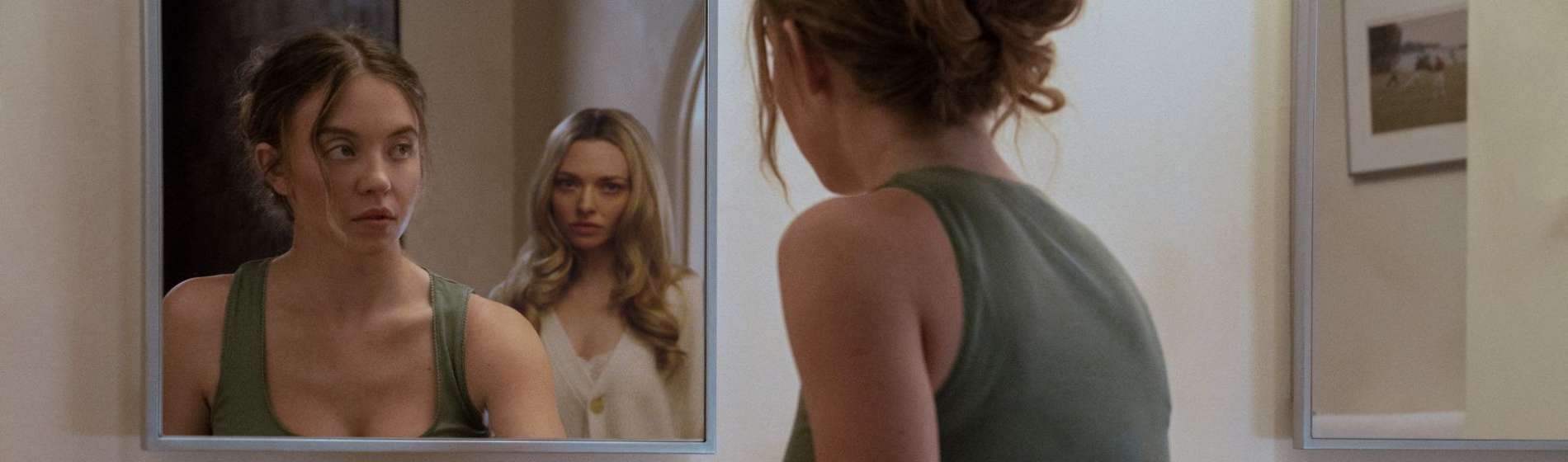
From the outside looking in, Andrew signifies wealth, power, and privilege, a “catch” as defined by the tropes of romance fiction. (He’s also tall, broad-shouldered, and always well-dressed.) At least initially, though, Andrew serves as an appendage, an afterthought to the intense, twisty psychological duel that emerges between his wife Nina (Amanda Seyfried) and Millie Calloway (Sydney Sweeney), the newly hired, live-in “housemaid” of the title.
An artifact of Rebecca Sonnenshine’s adaptation of Freida McFadden’s bestselling novel, The Housemaid shifts its focus and thus, its point of view from Millie to Nina. Initially, The Housemaid gives Millie, a homeless ex-con hoping for a second chance at life, a semblance of agency through voice over shared exclusively with the off-screen audience. These diary entries in turn invite viewers to become co-conspirators of sorts. We learn bits and pieces of Millie’s tale of woe, including her lengthy incarceration and the small lies she tells Nina to obtain employment. Shockingly, Nina seemingly doesn’t check her references.
More than halfway through The Housemaid , the point of view switches from Millie to Nina. She has a story to tell, too, although the particulars venture into spoiler territory. Nina reveals all, however, in a long, meandering expository letter she writes to a future version of her preteen daughter, Cecelia (Indiana Elle). It ties into Andrew and not just what he represents, but also what he offered Nina at a vulnerable point in her life.
Along with practically everything that precedes Nina’s letter, that explanation bears little resemblance to “reality,” at least not the reality as lived on the other side of the screen. However, given The Housemaid’s unironic embrace of pulp, camp, and melodrama, it’s far from surprising. As gaslighting turns to confusion, which spirals into open conflict between Millie and Nina, with Andrew as the dubious “prize,” The Housemaid goes off the proverbial rails.
While there’s no denying that The Housemaid offers its share of narrative and visual pleasures, like Seyfried as Nina and Sweeney as Millie in combat mode, Elizabeth Jones’ cavernous production design, and Renee Ehrlich Kalfus’s on-point costumes, it’s also fair to say that they’re purely superficial. This film, like the book that inspires it, is meant for easy consumption and even easier digestion.