


Movie history lists 1939 as the Golden Year of American moviemaking, when a convergence of exceptional storytelling and new heights in photographic technology saw Hollywood studios reach a pinnacle of cultural output. Many films released that year are still on the minds of today’s film lovers: The Wizard of Oz, Mr. Smith Goes to Washington, Stagecoach and, for better or worse, Gone with the Wind, among many others. The achievements of that year turned out to be the gateway to a decade of incredible filmmaking.
Movie studios became one of the USA’s biggest industries in the thirties thanks to the Depression, and by the forties were enlisted by the government to churn out products that would boost morale during the war. Brimming with noirs, war movies, musicals, and exceptionally good dramas, the 1940s are a decade of wall-to-wall classics, although I will add two caveats about what is probably my favourite era of American filmmaking: very few movies made in America at this time were concerned with anything other than straight, white people, and, more specific to my roundup here, it was a huge period for musicals and I don’t include any on my list below, outside of a Disney film. Get mad at me if you need to, but I prefer musicals of the previous decade, or the bombastic nonsense of the fifties.
Here are the Classics Shelf’s picks for the top ten Hollywood movies of the 1940s:
10. Fantasia
Samuel Armstrong, James Algar, Bill Roberts, Paul Satterfield, Ben Sharpsteen, David D. Hand, Hamilton Luske, Jim Handley, Ford Beebe, Jr., T. Hee, Norman Ferguson, Wilfred Jackson, 1940
After producing a series of ‘Silly Symphonies’ that involved short pieces of pre-existing music set to a fun, animated story, Walt Disney finally realized his dream to create a feature-length film that incorporated famous classical pieces set to varying styles of abstract or narrative animation. The result was a financial and critical failure, but years later stands as a masterpiece of artistic success that is unparalleled in the animation world (even including its sequel in 2000). The original was re-released by the studio many times over the last eighty-six years, including a version in the early 1980s that was produced with a brand new score conducted by Irwin Kostal. (The original soundtrack has since been replaced on more recent issues.) The technology for animation has improved exponentially over the decades, but has the Mouse House done anything this daring ever since?
9. Laura
Otto Preminger, 1944
Detective Mark McPherson (the underrated Dana Andrews) is assigned to a murder case but becomes obsessed with the victim after getting a look at her portrait. A wealthy socialite who dazzled everyone around her, Laura (played in flashbacks by Gene Tierney) becomes known to McPherson through others’ testimony, and alongside his genuine desire to solve her murder is undeniable, almost necrophiliac obsession that makes for one of the most sensual and complex of forties’ noirs.
8. The Search
Fred Zinnemann, 1948
The Second World War was covered ubiquitously on cinema screens in the 1940s (and beyond), but rarely with a level of realism so close to the events that occured, as we see here. A young boy (played with deeply affecting sincerity by Ivan Jandl) who has survived the Nazi concentration camps is being transported by the Red Cross when he and the other children mistake car noises for a gas attack and break out of the truck. He eventually encounters a plucky G.I. (Montgomery Clift) who takes him in, feeds and clothes him and comes to love the boy as his own. Zinnemann somehow manages to make the more melodramatic aspects of the story feel real thanks to his never softening the devastation that the war has wrought. Unsuccessfully remade and set in the Second Chechen War by Michel Hazanavicius in 2014.
7. Rebecca
Alfred Hitchcock, 1940
The 1940s rivals the fifties for being Hitchcock’s best decade, and while Notorious and Shadow of a Doubt are probably better films (and better representations of his brand), his adaptation of Daphne Du Maurier’s masterpiece novel, the second of three films he would make from her works, is the one I return to most often. Joan Fontaine is scintillating as a humble young woman, as in the novel nameless, who falls in love with moody aristocrat Max deWinter (Laurence Olivier) while working as a lady’s paid companion on the Riviera. Upon going home to her new mansion abode after her honeymoon, she discovers that Max’s late first wife, Rebecca, died under mysterious circumstances and her memory looms large enough to feel like a ghostly presence that haunts the place. Atmospheric and exciting, a soapy melodrama with dangerous, Gothic touches that are still a thrill to behold.
6. The Lady Eve
Preston Sturges, 1941
The forties was a highly profitable and prolific decade for Sturges, and I’m sure many people would prefer I put Sullivan’s Travels or The Palm Beach Story on this list, but Eve is the film of his I return to most often, a movie that is as funny as it is sexy and represents the great Barbara Stanwyck at the height of her powers. Henry Fonda plays a wallflower millionaire and snake enthusiast who falls in love with bombshell Stanwyck on a cruise from South America to New York, completely unaware that she’s actually a cardsharp who is out to take him for his cash. When she reveals who she is and he rejects her, she goes on a quest for revenge that is actually more passionate than when she was genuine in her affection for him, and Sturges’ understanding of love, that we save our hatred for the people we care about the most, is just one of his many sharp observations in this dense and delightful film.
5. The Grapes of Wrath
John Ford, 1940
Few films were as sociologically honest as this compelling adaptation of John Steinbeck’s novel, which has aged better than most of Ford’s films. Had he made it a decade later and not followed it with a series of popular westerns, he definitely would have been investigated by the HUAC for making so excoriating a criticism of the failure of American capitalism, the tale of a family, headed up by Henry Fonda, who have left the poverty of Oklahoma in search of subsistence as land labourers. Going from town to town, they end up in even worse conditions than what came before, in an orange grove field in California, where they must stay until they can gather their resources well enough to escape.
4. The Heiress
William Wyler, 1949
Olivia de Havilland gives the performance that set a new bar for unmannered acting on screen, scoring her best triumph and an Academy Award before her legal success against the studio system saw her pushed out of her Hollywood career for good. She plays Catherine Sloper, the plain and painfully shy young woman who attracts the attentions of handsome Morris Townsend (Montgomery Clift). She wishes to marry him, but her father (Ralph Richardson) objects, insisting that Townsend is a fortune hunter or else why would such a fantastic catch want such a homely woman for a wife? Much of the narrative and dialogue from Henry James’ novel Washington Square, upon which the play by Augustus and Ruth Goetz and this film were based, have been changed to allow for more outwardly-directed drama as opposed to the novel’s inner subtlety and perception, but it retains James’s rich characterization and features some of the best direction of Wyler’s career.
3. Leave Her to Heaven
John M. Stahl, 1945
In the world of noirs in colour, this one ranks supreme, a dark romance that features one of the earliest examples I can find, in a major studio film, where a “bad” woman is given a pathology that explains, if not excuses, her destructive behaviour. Novelist Cornel Wilde meets gorgeous Gene Tierney (in her most finely calibrated performance) on a commuter train and they fall in love. She throws over her snooty lawyer fiancé (Vincent Price) and they get married, then is immediately overcome by depression, jealousy and anxiety, even honing in on his devoted relationship to his disabled brother (which culminates in one of the most intensely memorable scenes in film history) before turning her suspicions on his relationship with her adopted sister (a superb Jeanne Crain). It would easily be trashy soap opera in the vein of Kitty Foyle or a later Ross Hunter production if it were not for the talents involved; the direction is sharp as daggers and the performances really make it drip with sex and danger.
2. Mildred Pierce
Michael Curtiz, 1945
Noir was so popular a genre that Warner Bros. couldn’t adapt James M. Cain’s novel without adding a murder that’s not in the book. The invention actually tightens the structure of the story and fleshes out its protagonist’s ultimate moral lesson, the tale of a hardworking mother who sacrifices all for her daughter only to find that she has raised a raven who was born to peck out her eyes. Joan Crawford achieved an unforgettable career comeback with her finest screen performance, as a character who takes the lemons of poverty and divorce and reinvents herself as a restaurant tycoon in order to give her ungrateful brat Veda (Ann Blyth) the life she never had. A film that presents the definitive aspirational style of the era, much like Leave Her to Heaven folding the kind of melodrama that would dominate screens of the fifties into the folds of moody imagery.
1. Casablanca
Michael Curtiz, 1942
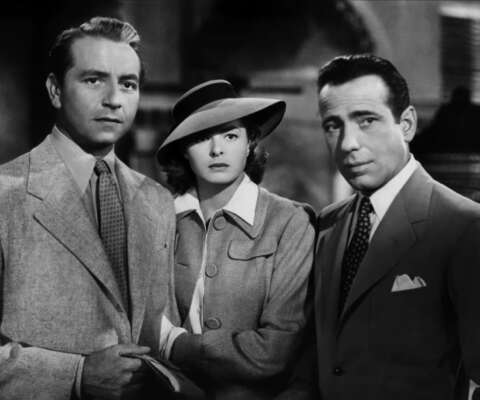
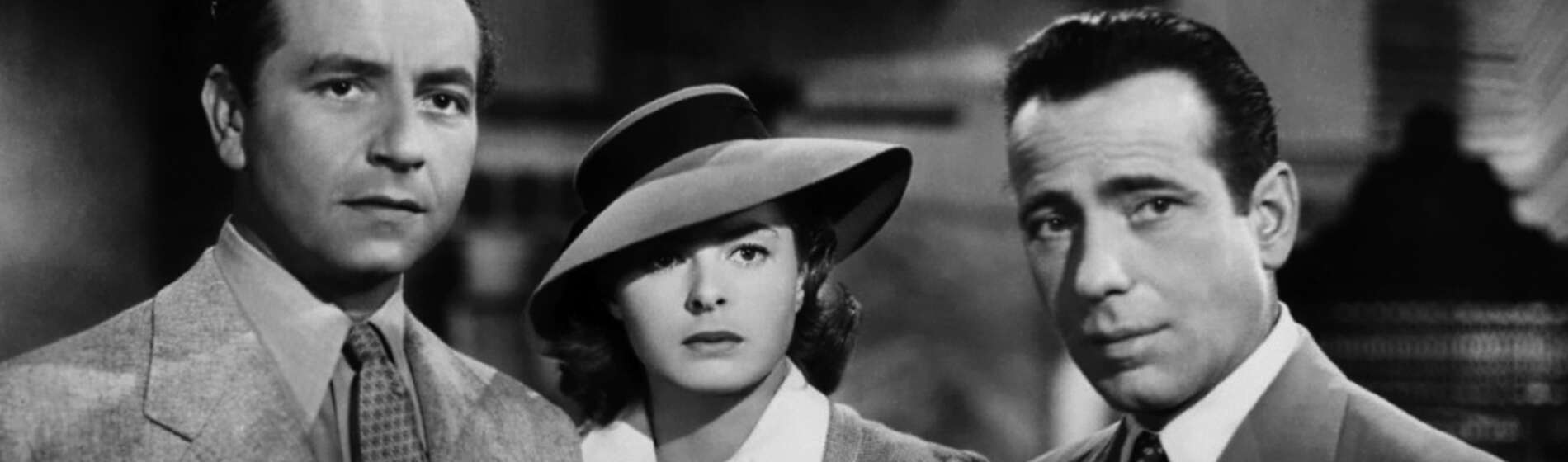
I’m sure it seems like such a basic choice, and eyebrows might rise at me giving Curtiz the top two slots, but the truth is that Casablanca is one of the few movies that truly is as good as you’ve heard. (Citizen Kane, on the other hand, is the movie that no one passionately loves but everyone can agree on.) Intrigue, romance and a remarkable cast (leads and supporting) all conspire to make one of the richest and most entertaining viewing experiences you’ve ever encountered, set in the Moroccan city of the title, where desperate Europeans wait for documents that will allow them to flee their war-torn continent and reach the safety of America. Of all the gin joints in all the world, Ilsa Lund (Ingrid Bergman) walks into Rick’s, the eponymously-named bar owned by the man she abandoned without explanation in Paris some time earlier, bringing along a new husband and the hope that Rick (Humphrey Bogart) will help her escape. Made on the studio backlot, as was common at the time, the exoticism of the location is impeccable, and the tone of its romance is groundbreaking. Bogart brings a cynical tonic to the idealized romantic leading men of the period, angry and bitter and in no need of a good woman to fix him, while Bergman destroys the legacy of cinema’s breathy heroines and underplays her character’s passion and regret (which, in reality, she said was because she wasn’t told during shooting which of the men she was actually in love with). Always imitated, often parodied, never duplicated, and it still looks like a million bucks.