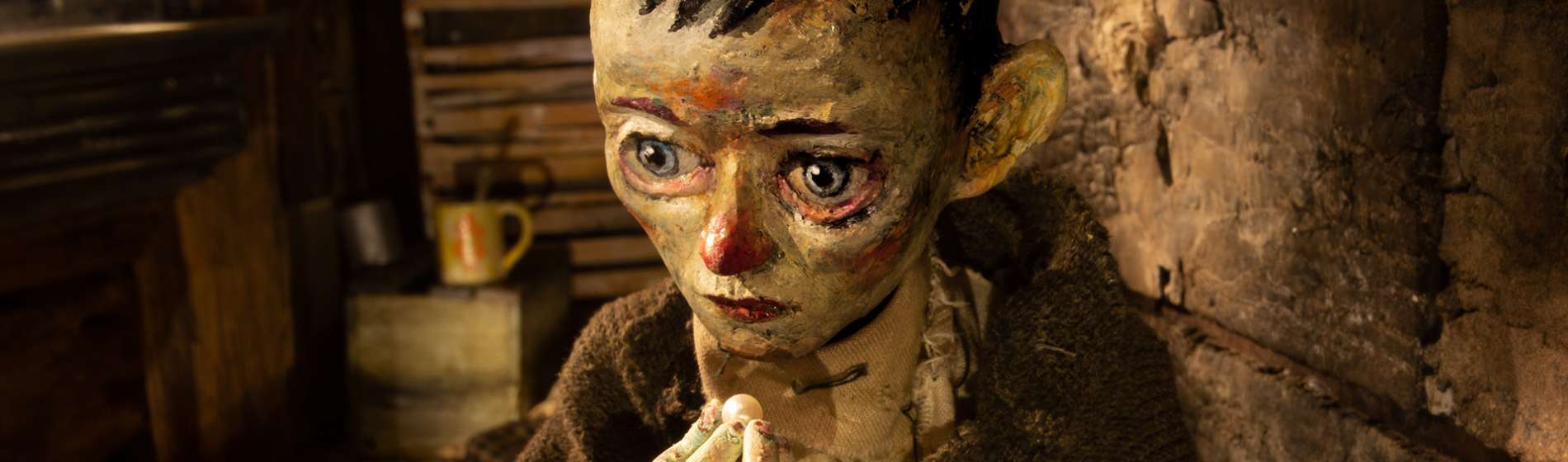


The National Film Board of Canada has a whopping twelve Oscars in its list of accolades and there’s a good chance it grow to a baker’s dozen this year. The NFB gem The Girl Who Cried Pearls easily marks the standout of the Oscar nominated animated short films. Directors Chris Lavis and Maciek Szczerbowski, the team behind the Oscar-nominated Madame Tutli-Putli, craft an inventive and enchanting tale. The film offers an ode to the power of storytelling as an old man (Colm Feore) tells his granddaughter a yarn about his boyhood in Montreal.
As the narrator sets the scene for the fable, The Girl Who Cried Pearls conjures the old city through exquisite stop-motion animation. The elderly storyteller speaks of being a boy on the streets and doing whatever he had to ensure his survival, including harvesting the riches of a very sad girl in the neighbouring apartment. It’s a tale of love and greed, but also the responsibility entailed in assigning value to things through the stories we create.
What easily sets The Girl Who Cried Pearls apart from the nominees is the overall finesse across each element of the production. This is elevated animation of the highest order. The colour palettes evoke the poverty that defines the young boy and the melancholy that enshrouds the girl with teardrop pearls. It’s a masterclass in world building with the unique sepia-toned old Montreal complementing the austere features of the characters. Moreover, Lavis and Szczerbowski ensure that the story itself proves as substantial and engaging as the craftsmanship. Feore’s rich vocal performance inspires a great sense of play to the unfolding of the tale, while the rich fable of the crying girl and the boy’s priceless stories offer a morale that will have any audience member smiling by the end. The complexity of the work simply stands a league above the rest. Bravo!
The strength of The Girl Who Cried Pearls especially asserts itself in a surprisingly weaker year otherwise with the animated shorts, which usually yield one of the strongest sets of contenders from the nominations overall. For example, nominee The Three Sisters inspires some good chuckles, but it’s fairly simple by design in terms of style and story. It’s a fun lark about three women who share a triplex on an isolated island and turn to renting one of their rooms out of financial necessity. The call inspires a tenancy from a burly sailor whose bad body odour quickly enchants the sisters like a magical man musk. However, any big laughs at the beginning of the film yield diminishing returns.
It’s amusing to watch them fall head over heels for the sailor, especially as the film’s colour palette becomes more vibrant with their awakening. But the short ultimately reveals itself as a surprisingly sexist escapade. In 2026, it feels a retrograde to celebrate a film about women undone by the arrival of a man and his sexual aura. There isn’t any growth or redemption, either, which is pretty surprising since director Konstantin Bronzit should have won the Oscar when he was nominated for 2014’s We Can’t Live without Cosmos, a heartfelt and hilarious tale of brotherhood. Maybe he should have stuck to men. This tale of three sisters frankly feels like the odd one out.
Similarly, there’s a great script at the heart of Retirement Plan, a favourite among the pundits. This buoyant ode to life by John Kelly features the voice of Domnhall Gleeson as Ray, a man who lays out his goals for the road ahead after he cashes in his pension. It’s a whipsmart and sprightly film with a great sense of humour and a touching ability to oscillate between emotions. However, the animation itself is relatively basic. The Sunday morning cartoon aesthetic serves the storytelling well, but artistically, it feels slight for a work competing to be the best of the year. Give the writing an Annie instead!
Stiffer competition may come in Nathan Engelhardt and Jeremy Spears’ Forevergreen, a film that’s so warm and fuzzy that it might inspire cinephiles to do a double take before recognizing that there isn’t a Pixar or Disney film in the mix this year. This beautifully realised film about generational wisdom and environmental care sees a young bear cub go under the wing of a wise old tree. The film harnesses the woodland setting to fashion its characters with block-cut designs and textures that evoke the grainy tactility of bark and branches. With nary a word, the film inspires a gripping emotional arc as the cub grows into unruly adolescence and defies the tree. He ultimately turns on his teacher and protector, but finds himself redeemed by the natural cycles of the Earth.
Much like The Girl Who Cried Pearls, Forvergreen offers an exceptionally crafted tale that matches animation style with storytelling. It’s like a bedtime book that springs to life, like an animated pop-out fable. It’s sure to be a favourite among families who catch the shorts, but it should inspire audiences of all ages.
Finally, there’s great heart to Butterfly (Papillion), director Florence Miailhe’s portrait of Olympic swimmer Alfred Nakache. The film charts his journey from the waters of North Africa to Olympic swimming pools, and then to Auschwitz as he becomes a prisoner of war. Stunning pastel compositions create a whirlwind of memories as trials from various stages of his life bleed into others. It’s an effective impressionistic work that favours still drawings brought to life with minimal movements throughout the frame. In an Olympic year, it might find its way to gold. But make no mistake: Pearl is the most precious gem on the ticket this year.
The Oscar-nominated animated shorts open in theatres including TIFF Lightbox on Feb. 20.
Stream The Girl Who Cried Pearls on NFB.ca, while YouTube has Butterfly, Forevergreen, and Retirement Plan.
Read about the live action Oscar shorts here.