

Sometimes, a film’s backstory turns out to be far more compelling than the final result. For YouTuber-turned-filmmaker Kane Parsons, that’s partially true. Over four years and 50 videos, the twenty-year-old Parsons grew his creepypasta-inspired horror series, “Backrooms,” from an obsessed, albeit talented, high schooler toiling in relative obscurity to 3M non-bot followers and 80M views. Those numbers practically guaranteed interest from horror-minded producers and production companies eager to discover the next generational horror filmmaker and, just as importantly, a profitable film or series/franchise. That interest culminated in the involvement of filmmakers James Wan, Osgood Perkins, and Shawn Levy (among others). Collectively, they produced Parsons’ feature-length debut, Backrooms.
While far from irrelevant, Parsons’ backstory isn’t the main attraction where Backrooms is concerned. Flawed in parts, hampered by an overindulgent running time, and self-conscious thematic and narrative opacity, Backrooms amply delivers what the web series and the subsequent announcement of the film adaptation promised: disturbing psychological horror, disorienting, discomforting liminality, and open-ended, interpretative ambiguity that practically invites post-screening conversation.
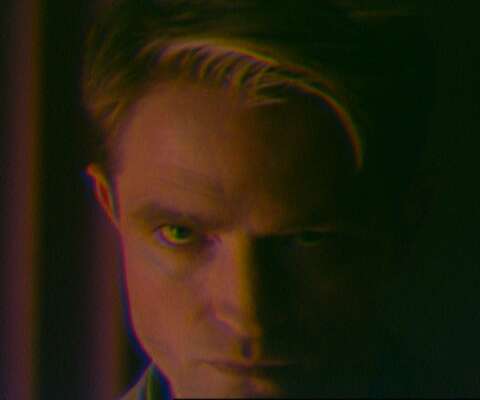
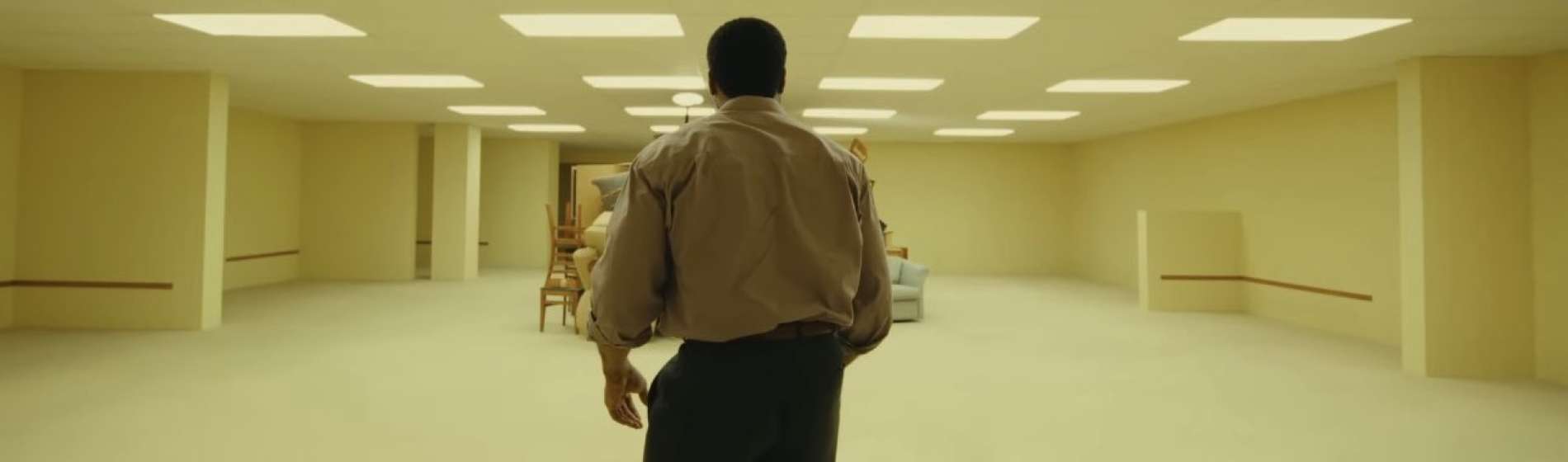
Set in an anti-nostalgic, pre-internet, mostly analog era (circa 1990), Backrooms opens in found-footage mode as a researcher for a super-secret institute, Naren Warne (Avan Jogia), a video camera in hand, loses his bearings inside the seemingly endless liminal space of the Backrooms. It’s a kind of psychic purgatory, a symbolic space populated by interlocking, yellow-walled rooms, scattered office furniture and doors, and doors of varying sizes that only lead deeper and deeper. Lost, bewildered, and overcome by fear and anxiety, a panic-stricken Naren encounters something, some heavy-footed, fast-moving, and impossibly large “thing” that haunts and stalks unwary wanderers in this Möbius strip-inspired extra-dimensional space.
With the tone-, mood-, and atmosphere-setting prologue completed, Backrooms switches focus to one of the central characters, Clark (Chiwetel Ejiofor). A heavy drinker who is newly divorced, bitter and resentful, he is a onetime architect who spends most of his waking life at his failing furniture store, Cap’n Clark’s Ottoman Empire in the Santa Clarita Valley. Sparsely decorated with low-quality, disposable furniture, and perpetually devoid of customers, Clark’s store seemingly reflects a larger economic recession impacting the region. Without his business, Clark has nothing and is nothing, literally and figuratively. Losing the business represents both a major hit on Clark’s self-worth and his masculine identity in a society that defines men not by the content of their character, but by their stock portfolios and, subsequently, their social standing.
Clark regularly vents his frustrations to his therapist, Mary Kline (Renate Reinsve), during their weekly sessions, usually to no avail. Despite therapy, Clark refuses to accept responsibility or accountability for his divorce or his business failures. A therapist who moonlights as a self-help guru with a well-publicized book and deep-seated family trauma of her own, Mary performs her trained role of neutral therapist impeccably, right up until a dishevelled, possibly drunk Clark appears at her office, ranting about the entrance to the Backrooms he’s discovered in the basement of his furniture store. Mary dismisses Clark’s far-fetched story as preposterous, leading to a possibly permanent rupture in their relationship.
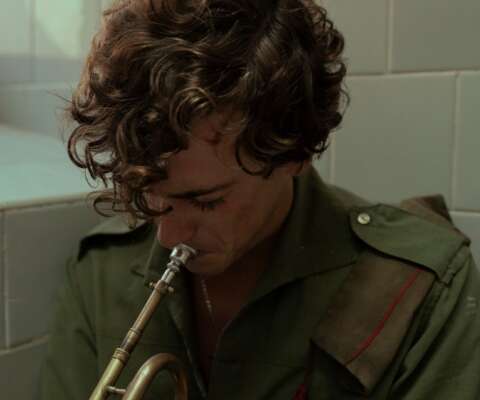
Backrooms repeatedly shifts from Clark to Mary and from Mary to Clark. Clark’s nightly, increasingly obsessive explorations of the backrooms lead first to the involvement of Clark’s unwitting, ill-fated employees, Bobby (Finn Bennett) and Kat (Lukita Maxwell), and later, Clark’s sudden, inexplicable disappearance. That, in turn, prompts Mary, miscalculating the risks involved and overcome by curiosity of the potentially fatal kind, to follow Clark into the backrooms, uncover whatever in-film “truths” exist there, and bring them back to the “real” world. Like Clark, Mary has a specific set of traumas (i.e., a mentally ill mother, parental neglect, and isolation) of her own to face, overcome, and reintegrate into her identity.
Working from a script written by Will Soodik, Parsons smartly leaves the central mystery (the what, the who, the how, if not the when) mostly unanswered, open to a variety of non-mutually exclusive interpretations. Do the Backrooms represent the discarded detritus of end-stage corporate capitalism, the external manifestation of an unwary visitor’s fractured inner life, the half-remembered, half-digested memories of a reality-spanning consciousness, or are the Backrooms a labyrinthine test concocted by a cruel, capricious god-like being, manipulating the users into psychological distress, deterioration, and eventually disintegration? All or none are possible.
Leaving the central mystery unresolved obviously leaves an opening for a sequel(s). On its own, it adds to the film’s overwhelming sense of existential dread, despair, and possibly doom, too. Are the backrooms an extra-dimensional reality alongside our own, or are they gradually encroaching on our reality until the backrooms devour our own in its entirety, leaving only existential meaninglessness behind?
Backrooms opens theatrically on Friday, May 29, via A24.