


This may sound like splitting hairs but asking people why they love video games is a different question than asking them what type of video games they love. Ask three people why they play Grand Theft Auto, and you get three different answers: the story, the sandbox mayhem, the online multiplayer. It’s a question you must ask yourself before firing up Days Gone, Bend Studio’s new PS4 exclusive open-world action game. Days Gone places you in the aftermath of a global apocalypse, and it’s hellbent on making players fight for their survival. Whether you find the game’s oppressive mechanics thrilling or tedious depends on what you consider fun.
In Days Gone, you play as a character with the very adult film industry sounding name, Deacon St. John (Sam Witwer). You may recognize Witwer from his role as Doomsday on Smallville and as Darth Vader’s secret apprentice in the Star Wars: The Force Unleashed series. The game takes place in the Pacific Northwest, a couple years after a pandemic kills off most of the world’s population. Those who aren’t killed transform into hideous creatures called Freakers. (And please don’t call them zombies or you risk offending the people behind this game).
The world as we know it is dead and gone. The global pandemic crippled society, and now people live in fortified encampments. There’ a strong The Walking Dead vibe to it all. Deacon has always been a rebel. In his old life, he belonged to an outlaw motorcycle club, the Mongrels MC. But now all that’s left from his past is his chapter bro Boozer. The two of them live together in a safe house, doing small-time jobs for the neighbouring encampments; hunting bounties and tracking down medical supplies. Their outlaw lifestyle and nimble motorcycles gave them the perfect skillsets to survive an apocalypse.
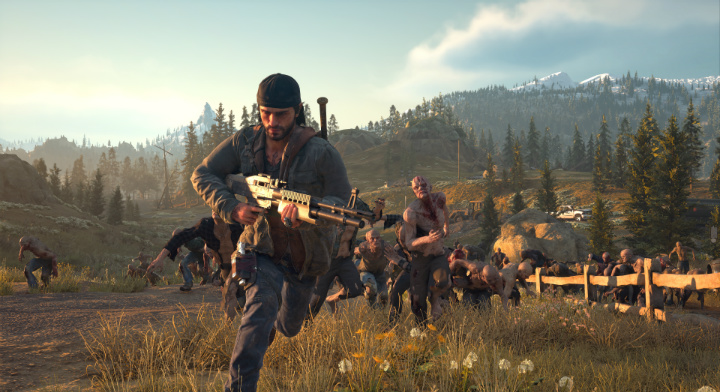
The biker bros’ harsh lifestyle has taken a toll on them, and Deacon thinks it’s time to for a change of location. But before he cuts ties, he must pull off a few more jobs because it wouldn’t be a video game if you didn’t have to level up and take part in fetch-quests. Deacon’s plans get derailed when Boozer falls ill, and some hooligans put his bike out of commission. Days Gone pits you and your gruff avatar against an unforgiving world, and tasks you with surviving long enough to repair your wheels, heal your friend, and maybe even uncover the pandemic’s secrets.
Days Gone is a brutal game. And I mean that as a compliment. There are brutally challenging games like Super Meat Boy that punish you with treacherous maps which demand hundreds of replays. And there are brutally tough games like the Dark Souls series; games so severe they taunt you into chucking your controller at the wall. Days Gone is brutal in the sense that you can never EVER let your guard down. You must think carefully about where you’re going and how you’re getting there. And something terrible can happen to you at any moment.
The game’s stress-inducing nature is why I ask what it is that attracts you to playing games. Sports games and RPGs let us escape from reality and live out our power fantasies. But in Days Gone you’re never safe and not very powerful. It nails the survival aspect of survival horror. And again, that’s not a knock. Some of my favourite moments in games like Skyrim and GTA happened when starting out and under-powered. I love those early moments when every bullet in my gun and each arrow in my quiver feels precious. Days Gone offers gamers 30-hours of a beautiful struggle.
The best aspect of this game is that ever-present sense of desperation. You get around the map on your motorcycle, but your bike runs on gas. And guess what? Gas isn’t easy to come by, and your tank doesn’t stay full very long. You discover gas stations along your travels, but they’re often out of the way. You can use your valuable resources to equip a bigger gas tank so that you may travel farther. If you’re brave, you may take risks by venturing to the far corners of the map on a half-empty tank. And when you run out, there’s no magic fast travel option to get you home. You must hoof it back to camp where they can haul your wheels back for you, at a price.
You can upgrade your precious bike in several ways. Upgrades range from cosmetic options like swapping out colours and decals, to nitrous boosts, saddlebags for extra storage, and tires which improve grip. Like everything else in the game, your bike is susceptible to wear and tear. And you must pull over and repair it with scrap parts before it breaks down completely – or your loud exhaust attracts predators that pick you off. Whichever comes first.
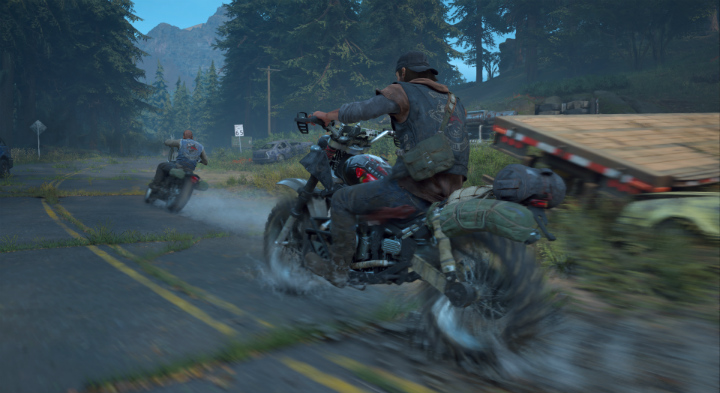
The most common foes are Freakers and Swarmers, miserable little pests that lurch along looking for prey until they detect you. Once they do, things turn deadly fast. They announce themselves with gurgles, snarls, and groans that beg for you to silence them with the pointy end of your weapon. One Freaker isn’t a problem, but they roam in packs, and they’re attracted to noise. Mess around for too long, and a Left 4 Dead style horde will rush your way and overwhelm you. Surviving in Days Gone means knowing when to fold’em and run for the hills. Even if it means leaving precious loot behind.
Don’t get too attached to items in your inventory either. Aside from Deacon’s trusty knife, weapons continuously deteriorate. It’s easy enough to find wooden planks, metal pipes, and baseball bats, so having them break amidst battle isn’t much of an issue. You can also modify these weak items into deadlier weaponry. Freakers don’t stand a chance against a baseball bat loaded with spikes. If you pace yourself (and repair them on the fly), these items can survive long for stretches. But it’s easy to lose track of your weapon’s durability status during a hectic brawl and have it break on you.
You can’t afford to leave your safehouse without packing some type of heat, because trouble can find you at any second. I can’t make this any clearer. Stumbling upon one Swarmer can be disastrous, as one of the asshole’s screams will bring a swarm of them on you. And the number of enemies in a swarm outnumber the bullets, arrows, and explosives in your arsenal.
So, let’s say you try and get slick, and provoke a swarm into chasing you and then hop on your bike and race off like a cool guy. Let’s say you don’t run out of gas, or spin out in the rain, or smash into a tree. Maybe you go full throttle into a tripwire laid down by some human scoundrels waiting to murder and rob you. Perhaps you find the road blocked and must get off your bike and push some cars out of the way, only to find that some scoundrels are hiding out, waiting to murder and rob you. Maybe you get shot off your bike by a sniper, by some… ah, you get the picture.
Days Gone dynamically generates treacherous obstacles that can throw you off your game plan at any moment. Will you enjoy it? Hell no. Will it come at the worst possible time? Most likely. But these random encounters don’t feel cheap either. If you leave your safehouse prepared and don’t let your guard down, you can survive these encounters and get back on the road.
[nextpage title=”Page 02″]
Humans and Freakers aren’t the only threats to Deacon’s survival. The pandemic crossed over into wildlife, and now animals behave in hyper-aggressive ways. Packs of wolves roam the countryside looking for chances to eat your guts. They’re fast enough to keep up with your bike, and they’ll come out of nowhere to attack. And massive, bullet-spongey bears will cross your path at the worst possible moments. The world has gone off the rails and Deacon hasn’t seen the worst of it, yet.
There are plenty of ways to lose yourself in Deacon’s world. The game has a Red Dead Redemption-type structure. Some missions advance the story, side-quests help you gain loot and build up your stats, and random events will happen out of the blue. You may set out to track down a bounty, change course to avoid a swarm, and then find an NPC trapped in a car at the side of the road, surrounded by Freakers.
The omnipresent sense of danger makes exploring every dark corner of the map feel like an adventure. I enjoyed Days Gone’s vibe more than I enjoyed its gameplay, and story. It’s like how I enjoy the atmosphere in Nicolas Winding Refn’s movies more than I like the characters and plot. He’s a vibe director who wows you with the way his work feels, but his films are flawed. Days Gone is fun as a vibe game, it’s tense and atmospheric but at times feels like a repetitive slog.

It takes about 30-hours to get through Days Gone’s main story, and the gameplay loop isn’t enticing enough to sustain the whole duration. Far Cry New Dawn takes about 16-hours to finish, features tighter gameplay mechanics, and more appealing visuals, and I began to burn out by hour ten. The combat in Days Gone isn’t satisfying; it lacks the crisp controls and challenging A.I. found in better shooters. The driving mechanics feel sluggish too. And the Pacific northwest’s muddy aesthetic didn’t compel me to explore every corner of the map.
A fully-realized map can make or break an open-world game. And with enough consideration by developers, a map practically becomes a character. I would often stop in Horizon Zero Dawn to stare at how the sunset shimmered off a river. Sometimes I enjoyed watching trees sway in the breeze. You want to soak up every inch of an immersive map but Days Gone lacks that awe-inspiring quality.
Moving from point-A to point-B in Days Gone often left me thinking, “Are we there yet.” The map, though massive, often feels bottlenecked, and much of the off-road terrain feels sparse and lifeless. You can enter most of the buildings you encounter, but I rarely wanted to. I often felt like I was moving around obstacles rather than exploring a world.
The game tries to get its hooks into you right away through its story. Days Gone wants to make a profound statement about loss, grief, and hope in the face of adversity. But the cinematics sputter out of the gate. The game begins right in the thick of the chaos, with a cut-scene, featuring the central characters during the early days of the pandemic. There is chaos in the streets, their town is on fire, and seem to be losing their minds. Things don’t go well for our heroes, and Deacon is left to make a tough decision. The people behind Days Gone are tired of The Last of Us comparisons, but I do have to contrast the two.

In The Last of Us, we spend time with the main character Joel in the moments leading to an outbreak. We move through his home to learn who he is and experience the bond between Joel and his family. When s#it hits the fan, there’s a weight to the story since we’re invested in the characters. And the tragic events that follow hits us like a punch to the gut because we already care. And this choice sets the harrowing tone for the rest of the game.
The setup to Days Gone’s story blows by you in a whiz-bang fashion. We’re thrown into the mayhem with no setup, no context, and no attachment to the characters. So, their interactions feel hokey and overwrought, and the game has a B-movie type of vibe. As if to prove that the opening moments are insufficient, we revisit the same cutscene again later in the game. But even with more context given to Deacon’s circumstances, the whole thing falls flat. The story’s first five minutes blows Deacon’s chance at making a strong first impression.
Days Gone is a solid all-around game that doesn’t excel in any one area aside from its joyfully oppressive atmosphere – which isn’t a selling point for everybody. The gameplay is solid enough to keep me grinding along for hours, but not enough fun to prevent burnout before completing the story. And even if we’re not calling Days Gone a zombie game, its generic zombie-adjacent plot has been done to death.
Although Days Gone didn’t blow me away, it still shows lots of promise, and I enjoyed my time experiencing Deacon’s world. Tune the combat a bit more, add some additional variety to the gameplay, and spice up the map a touch and Days Gone makes it onto critics’ year-end lists. But right now, Days Gone only teases the series massive potential.