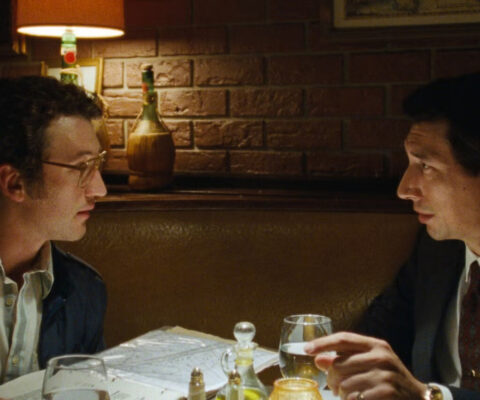
“Not everything is supposed to make you comfortable,” Alma (Julia Roberts) tells her student Maggie (Ayo Edebiri) in After the Hunt. This enigmatic morality tale from director Luca Guadagnino ( Challengers , Queer ) serves discomfort in spades as mentor and mentee face-off. This tense exchange comes when Alma finds herself at the centre of a cancellation that epitomizes contemporary culture wars. Her crime isn’t necessarily what she does to Maggie, but rather what she fails to do. This twisty and morally complicated film grabs the zeitgeist by the throat. After the Hunt should make audiences squirm. It’s a potent conversation-starter about notions of virtues and virtue-signalling, but also of the grey areas of right and wrong. Friendships could be made or broken by post-screening conversations.
Viewer can immediately engage with questions of morality when Guadagnino’s film hits the opening credits. Audiences may recognize the Windsor Light font of the title cards that list the main cast alphabetically, followed by the vertical stack of secondary players on the next card. It’s more commonly known as the “Woody Allen font.” This bold move makes a viewer—even a Woody Allen fan—shift in his, her, or their seat. ( After the Hunt remains very aware of the “they.” We’ll get to that later.)
But the engrossing moral fable, ingeniously scripted by Nora Garrett in a remarkable feature debut, brings audiences to the heady world of academia. Professor Alma Imhoff (Roberts) holds court in the philosophy department at Yale University. As she hosts an intimate soirée for colleagues and students, After the Hunt presents an environment where morals exist as theoretical volleys, rather than real-world stakes. The academics, including Alma’s colleague Hank (Andrew Garfield), her bestie Kim (Chloë Sevigny) from the psychology department, and star student Maggie, debate contemporary notions of virtue and privilege over wine and whisky. It’s a contentious issue, since morals are the subject of Maggie’s dissertation. Alma says Maggie’s work has promise. Hank, straight white male that he is, clearly feels otherwise.
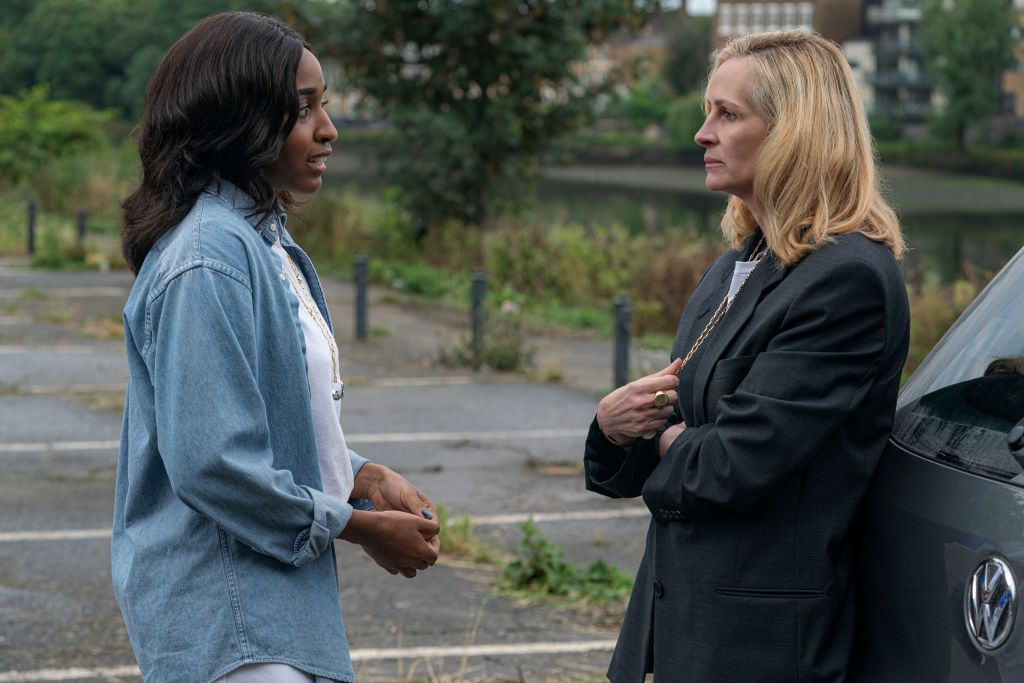
But Maggie, who also happens to be the only Black person in the room, sees theory and practice collide. She presents Alma with a new scenario the next day. Maggie charges Hank with taking advantage of her after leaving Alma’s party. It’s a gripping story. Alma directly asks, “What exactly did he do?” She seemingly juggles her responsibilities as Maggie’s mentor and Hank’s friend—it’s also worth noting that Alma and Hank are both vying for the same tenure position—to assess the charges. But Maggie dodges the question in her emotionally compelling if somewhat scattershot testimony.
After the Hunt leaves it to audiences whether Maggie’s story should be believed, whether its sketchiness just reflects her trauma, or whether she’s using colleagues as IRL research. Alma’s husband Frank (Michael Stuhlbarg) also thinks that Maggie has the hots for Alma, which makes the story extra juicy. Doubly so since Alma knows that Maggie is a happily partnered lesbian, or theysbian as Alma self-consciously misgenders Maggie’s trans partner (Lio Mehiel) with hints of generational contempt.
To further complicate things in a tale with many complications, Hank requests a lunch with Alma. He tells a different story and delivers it with equally compelling force. His tale speaks of a nightcap and mutually consensual intimate encounter. However, he also charges Maggie with plagiarizing her thesis, therefore offering Alma a seed of doubt. Maggie could be lying, but that runs counter to the #BelieveWomen ethos that informs the charged debates within the philosophy department. But Maggie knows that Alma knows that people sometimes lie—a juicy backstory that Garrett unfolds every now and then to shift perceptions and allegiances.
Guadagnino masterfully navigates the moral no person’s land of this material. He pushes the cinema of discomfort to unbearable degrees. Working with cinematographer Malik Hassan Sayeed (Beyoncé’s Lemonade ), the camera frequently shoots its players in direct close-up. He pushes the camera invasively near their faces and forces audiences to look into the actors’ eyes as character bare themselves or say heinously awful things. The proximity pays dividends in an age that devalues empathy’s currency. The camera forces the element of humanity that the philosophy department holds as an abstract notion. The off-kilter score by Trent Reznor and Atticus Ross further adds to the unease. It ratchets up the tension, sometimes with the direct ticking of a clock—or bomb—as the powder keg accumulates ammo.
It helps, too, that the actors embrace the slipperiness of these characters. For one, Roberts gamely plays against type. Alma defies the characters who helped make Roberts America’s sweetheart. She makes Lydia Tár seem warm. Whether one thinks Alma a bitch or a pragmatist says much about the perspective from which one approaches the story.
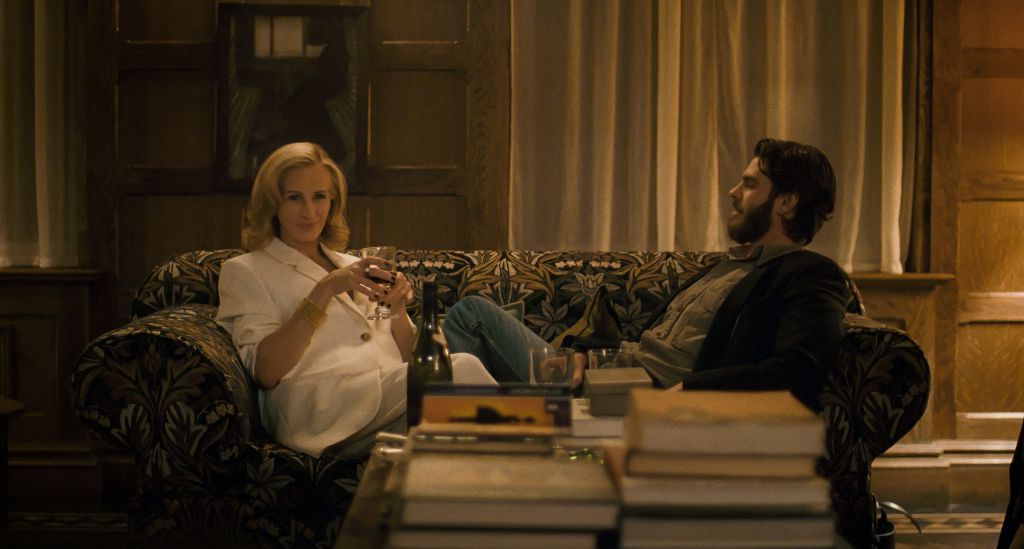
Much like her powerhouse turn in August: Osage County , Alma’s likability, or lack thereof, proves disarming. It’s another device to unsettle the viewer as Roberts delivers her best performance since her Oscar winning work in Erin Brockovich. Her acerbic zingers about political correctness and fragile young folks create a woman hardened by the toughness entailed in navigating a climate of sexism and glass ceilings. When Alma advises Maggie that her assault story risks defining her, her crime is her lack of empathy. She toughed it up, so Maggie should too.
In one especially dicey scene, Alma invites Maggie to dinner to help navigate the storm. Frank, clearly aligning with Hank’s side of the story, loudly leaves the dinner he has prepared for their guest. He sashays away through a butler door that seemingly soundproofs the kitchen. Frank retreats to an unseen man cave and cranks up some music, audibly expressing his disdain for the conversation being had by the women in the kitchen. As he stomps back and forth into the room to grab his plate and rattle some cutlery, the butler door obnoxiously lets Frank’s pointed take on Maggie’s situation destabilize the heart-to-heart she expects. All the while, Roberts winces, flinches, and side-eyes, masterfully using the art of the resting bitch face to complicate the affair.
For all the poison that Alma serves in her pointedly cadenced lectures and truth-telling, what she doesn’t say makes After the Hunt so explosive. Roberts reigns as the reaction shot queen. Her subtle expressions suggest that Alma finds the shitshow delicious even as it engulfs her. It’s the greatest challenge of the academic career, working out the philosophy of morality as it unfolds at the breakneck speed of social media algorithms.
Edebiri, meanwhile, juggles Maggie’s vulnerability and perceived sense of entitlement. Like Roberts, she gives audiences lots to suss out, especially as she amplifies Maggie’s defiance, switching from defense to offense as the character challenges her mentor with what it means to have agency circa 2025.
It’s tricky material. After the Hunt deftly navigates the fine line between having contempt and compassion for its characters. One might rightly feel both with equal measure. However, Garrett’s script doesn’t try to make a grand statement about cancel culture.
Instead, it invites audiences to take a seat in Alma’s seminar room. It challenges us to say something first in the age when any soundbite becomes a loaded gun. The thrill of After the Hunt comes in navigating the grey space of the she said/he said duel. It matters not if Hank did what Maggie says, in a way. The film flips the morality play back on a viewer, asking him/her/them why they’re inclined to believe one person over the other. How much one can rationalize, empathize, and intellectualize the story depends on the fascination contradictions that After the Hunt dares us to reconcile. There’s no comfortable answer here.