

If old enough, many film and television viewers will remember watching Barney & Friends or even The Wiggles . Fun characters, all dressed up in big animal costumes, taught kids important life lessons through song and dance. Nothing could possibly go wrong in these practically perfect worlds for kids. But then, what if it could? That is precisely the question writer-director Casper Kelly answers with his latest horror sensation, the scarily pleasing Buddy .
And just who is Buddy ( Keegan-Michael Key )? Well, he’s a classic 1990s TV show character who appears as a bright orange and friendly unicorn. Everyone remembers Buddy bringing life lessons from technicolour sets straight into their living rooms. Also in Buddy’s world — It’s Buddy — is a group of children who spend their time singing, dancing, and helping the unicorn spread happiness and joy.
Filmmaker Kelly fully immerses his audience in that comfortable, old-school world. The bright colours of the house they all play in, the catchy theme song, the regular cast members, and even the strange and alluring tone of the animal lead. It’s an all-too-perfect environment that, as a child, you don’t really register, but as an adult, you find off-putting and strange. It’s so far from reality that it’s unnerving. Kelly knows what will make us us nostalgic here, but he also knows what we’ve been secretly questioning about these shows since we sat rapt, watching them back in the day.
So it should be no surprise when Buddy flips the script entirely, when the film goes from cheery to creepy. Even going in knowing it’s a horror film, the juxtaposition of an ominous whirring sound and dark screen with the upbeat and animated It’s Buddy theme song is immediately unsettling. And then the children begin to question Buddy’s ethics and motives. When one child refuses to play with the rest, they end up setting off a chain of events that will change their curated and calm lives. Especially once Buddy’s disapproval begins to form cracks in their seemingly perfect universe.
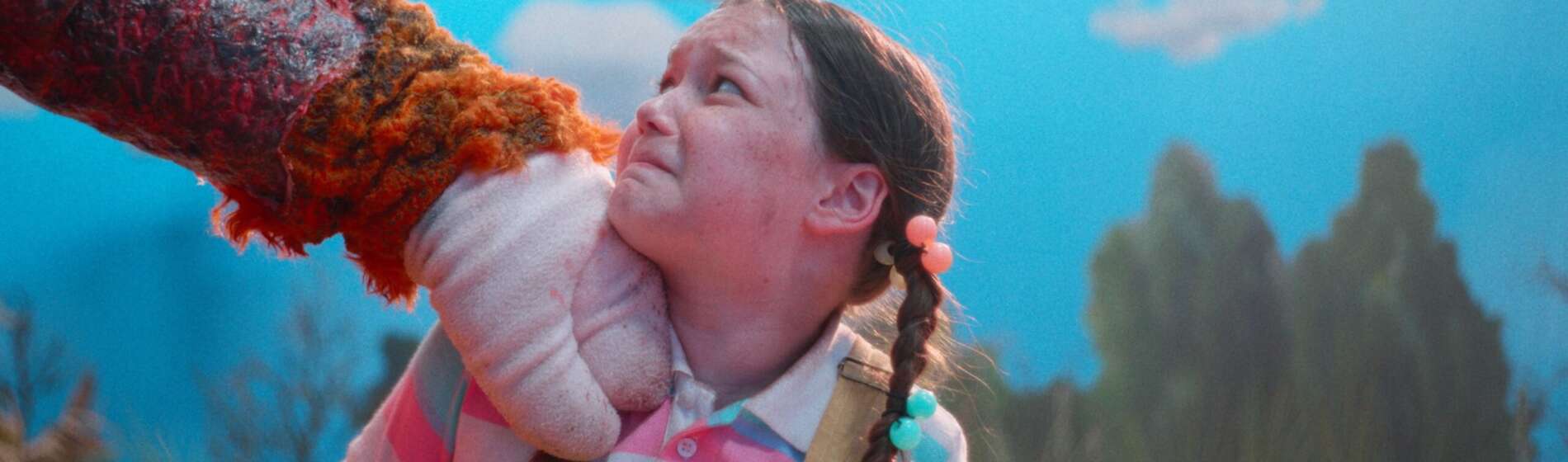
Freddy ( Delaney Quinn ) sets the ball rolling. After a conversation with several of the other animal friends in It’s Buddy , she begins to realize that things are just too perfect. After hearing a story about a kid who disappeared for refusing to play with Buddy, Freddy tests her luck. Refusing to play and opposing this practically perfect world, Freddy pushes Buddy off the edge. The world becomes dark, and Freddy and the kids find themselves on the outside of the yard. Lost in the dark and running from the monster chasing them, the kids must find their way home.
It’s Buddy , as originally shown, is a children’s television program made for families, and the film captures that atmosphere perfectly. From the clearly made-for-television set to the bright costumes Buddy and his friends wear, the film nails the aesthetic of 1990s children’s programming. But when the darkness comes, the landscape and mood change completely and the excellent costuming is a big part of that change in tone. It takes the bright and bubbly Buddy from his all-too-impeccable self and brings out the monster within. It’s something so simple, but it changes and conveys the change in direction, and signals a veer into the unknown for the children, and the viewer too. The drastic shift from that lighthearted, made-for-kids character to the horrifying terror we all feel in nightmares will grab and hold viewers’ attention until the credits roll.
That said, there is only so much a performer can do within that costume. So as much as the outfit’s temperature and tone change, it ultimately comes down to Key altering his voice and pitch to make the shift work. And he nails it. There is a fabulous supporting cast here, too, including Cristin Milioti , Topher Grace , Michael Shannon and Patton Oswalt , and a bright young cast in Quinn, Madison Polan, Bryson JonSteele, Seamus Flynn and Luke Speakman. Each does their part in bringing the viewer into this familiar and colourful world, but they also excel at reminding us of the darkness Kelly seeks to explore here, too.
Kelly explores both sides of the coin extremely well, using horror to capture the innocence lost as we shift from child to adult, not to mention the important lessons that come along with that. It comes up again and again in Buddy: in changed lyrics to Buddy’s theme song, in showcasing the need to question and rebel, and in wondering what is really out there in the less-than-perfect world. With that, Buddy becomes a piece of cinema that will surely attract audiences for years to come. So do yourself a favour and find out the truth behind “It’s Buddy!” and its unsettling orange unicorn.