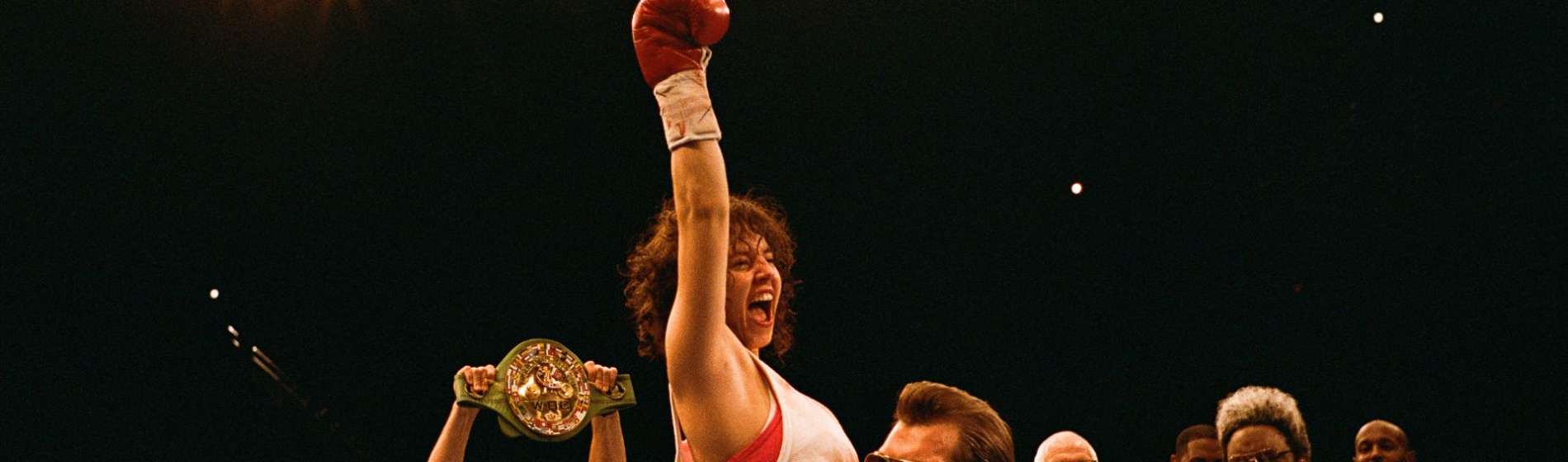


We all know that Sydney Sweeney has great jeans. But can she carry a movie? Even under a ratty 1990s’ hairdo and outfits seemingly borrowed from Clark Griswold’s neighbours in Christmas Vacation , Sweeney’s turn as boxer Christy Martin displays a full transformation. She’s everywhere these days and yet still manages to disappear in Christy . This certainly isn’t her first lead role, but it easily speaks to Sweeney’s strength as a dramatic actress. She single-handedly saves the movie.
Christy has a good story at its heart as it tells of Martin’s breakthrough when she began her professional boxing career in 1989. The 21-year-old fighter defies all the men at the gym. She proves she can throw just as hard a punch as anyone. Christy makes clear that the young woman from West Virginia has been fighting from an early age. She likes girls and doesn’t hide it, and life’s toughened her up. It’s instilled within her a refusal to let anything knock her down. That drive leads her to knockout after knockout in the ring.
The film unfortunately veers fairly quickly into biopic cliché, though, as it follows Christy’s path training with sleazebag coach and eventual husband Jim Martin (Ben Foster). Now and again, the script by Mirrah Foulkes rises above the template, and peppers Martin’s story with bits of personality, like her first meeting with fight promoter Don King—in which she puts up her dukes in a floral dress—or the tender relationship with her ex, Rosie (Jess Gabor), that offers a lifeline from her turbulent marriage to gym.
The same goes for an underdeveloped storyline with fellow boxer Lisa Holewyne (Katy O’Brien). The latter might have provided a refreshing final act given where their journey goes. The two women in Martin’s life invite the stronger material, yet the film shies away from them. Alternatively, as Christy feels compelled to distance herself from other women, often rejecting the label of feminist and saying that she isn’t fighting for equal pay for women, just herself, the film illustrates how she internalizes the toxic masculine culture that stifles her.
But for a story about a great “first,” Christy simply hits many beats that audiences have seen before. For example, it directly references Million Dollar Baby and the “girlie, tough ain’t enough” mindset from men that Christy continually needs to overcome. Giving a shout-out to a Best Picture Oscar winner always risks inviting a superior frame of reference.
However, Christy doubles that bold shout-two twofold. Besides name-checking Hilary Swan’s Oscar winning turn as boxer Maggie May, it indirectly puts Martin in the same breath as Sissy Spacek when boxing promoters dub her the “Coal Miner’s Daughter.” No Loretta Lynn songs pepper the soundtrack, though, since Christy’s more of a Stevie Nicks fan, but the name-check situates this turn into a league of memorable performances. Christy demonstrates that even the most familiar biopics can lend a star some golden gloves, and Sweeney meets the challenge with a committed performance that captures the fighter’s heart and spirit.
Somewhat ironically, Christy lands its strongest punches when the drama steps outside the ring and gym. The film frequently provides a harrowing window into the domestic violence and psychological warfare of the Martin household. Jim can’t handle his wife being the breadwinner, and being married to a tougher woman who openly prefers the company of other women emasculates him to no end. (Jim basically forces the marriage upon Christy for the sake of optics and control.)
Director David Michôd ( Animal Kingdom , The King ) thrusts audiences into Christy’s never-give-up spirit as Jim’s abuse overwhelms her. Scenes in the Martin household evoke the unflinching domestic violence of I, Tonya —although without the same comedic punch that makes the skating dramedy so jarring. But film editor Matt Villa cuts the latter acts of Christy with a meaner sting than anything Christy encounters in the ring. Christy’s struggle to escape Jim shows audiences how women can become trapped in cycles of violence by their own families who refuse to see beyond the façade of a happy marriage. The last act delivers an especially compelling gut-punch as Jim botches his attempt to take Christy’s life. The boxer somehow gets to her feet with a spirit that never quits.
Sweeney takes advantage of the depth of these scenes, too, injecting the biopic with far more than a confident makeover. Opposite Foster, who is surprisingly, almost unwatchably, bad here—his over-the-top performance suggest that he at least thinks they’re making I, Tonya —Sweeney conveys a morally and mentally grounded nature that keeps Christy sharp and nimble. She delivers a turn with layers and stamina, allowing Christy’s strength of spirit hits hardest. The star ensures that Martin’s story should inspire audiences to hold their own in whatever fight they might find themselves.