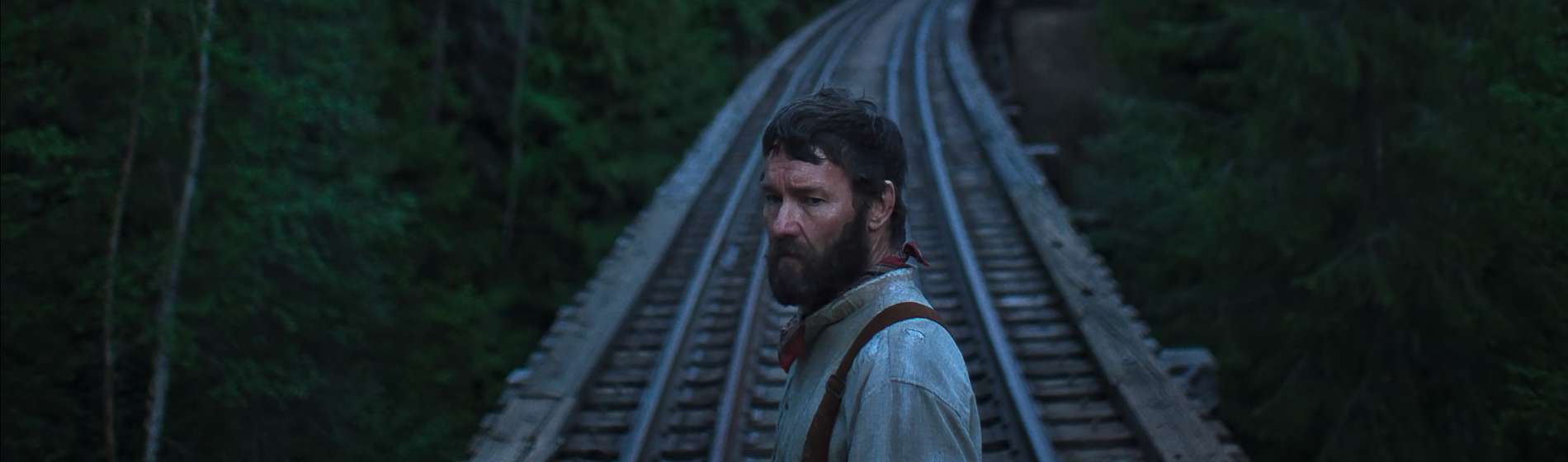


You can practically smell the pine trees while soaking up Train Dreams . This elegiac slice of Americana is a thing of beauty. Spanning many years and far many more miles, Train Dreams poetically observes the construction of contemporary America and destruction of a bygone way of life.
The film weaves through the daily grind of logger and railway worker Robert Grainier (Joel Edgerton) as he earns a modest living. Robert doesn’t say much. He observes the erection of a massive bridge with awe and horror. The feat of architecture of which he is apart makes America more connected for fellow travellers. But as he observes the violence that his fellow workers inflict upon their Asian colleagues, including arbitrarily tossing a co-worker to his death, seemingly just for sport, he witnesses divides that no marvel of engineering can heal.
Train Dreams asks about the price of civilization that comes with the violence of expansionism. As Robert watches his breath condense in the crisp morning air as he places his palm against one of old trees that stood tall long before settlers arrived, he finds harmony with the landscape whose development fuels his trade. While he perceives the irony of making one’s living by altering the beautiful untamed wilderness that drew people in the first place, he’s at heart a romantic. He’d rather bask in the shadow of the tall pines while slowly making his way through the forest instead of briskly moving through a clear cut path while the sun scorches down on him.
Throughout his travels for work, he encounters loggers, farmers, and jacks of all trades. Many colleagues share Richard’s affinity for silence. These men work hard sawing and hammering out in the bush. There’s no need to shoot the breeze when the wind cuts through the pines with such a soothing call.
Others, like explosives expert Arn Peeples (William H. Macy), fill the lonely silence of the railway life with nonstop nattering. The chatterbox proves a welcome companion to some, including Robert, as he makes up for the men of few words. His deeply philosophical ruminations give the workers much to ponder as they take the life from trees whose roots have been inextricably linked to the land for decades and, in some cases, centuries.
Macy’s brief performance is highlight in Train Dreams , but it illustrates an intermittently distracting cavalcade of cameos in the film. Train Dreams features numerous familiar faces in flyby appearances—Clifton Collins Jr.’s entire performance, for example, could be missed in the blink of an eye. Others, like Kerry Condon, make refreshing contributions with minimal screen time. Condon appears late in the film as a headstrong traveller who shares Robert’s affinity for the rugged rural life. As he accompanies her on a wagon ride, they trade pensive observations about the land and its power. It’s a stirring moment about the value of companionship and human contact in the isolated rural life.
Other brief appearances inject Train Dreams with melancholy that transforms the magic hour cinematography of Robert’s fading days. He finds great happiness with a marriage to Gladys (Felicity Jones) and works hard to provide for her and their baby daughter. But tragedy strikes during one of his trips away for work and their loss forever haunts him. Robert becomes bound to the violent power of the forest that can turn on a man. He seeks to rebuild and grow their homestead anew, holding out hope in the element of the unknown that shrouds their disappearance.
Edgerton’s weathered face provides a rugged landscape of its own with which to reflect the nature of the American heartland. His moody and introspective performance creates a man both comforted and tortured by silence. Robert is the strong and silent type, a sensitively brooding man who enjoys simple pleasures, like looking out a window at the rolling hillside or simply basking in the afterglow of a sunset with a trusty dog.
This slice of life portrait offers a bracingly cinematic adaptation of the novella by Denis Johnson. The team of Clint Bentley and Greg Kwedar ( Jockey , Sing Sing ) find a visual language with cinematographer Adolpho Veloso to perfectly match the cadence of Johnson’s lean but magnanimous prose. Their fleetingly Malickian view of the labourers engulfed by the beautiful landscape marks their most aesthetically gorgeous work yet.
Train Dreams and its star-studded ensemble marks a different pace from their previous dramas. Jockey and Sing Sing were anchored by lead performers supported non-traditional actors who lived the story brought to screen. However, for all the star-power on display here, Train Dreams retains that authentic salt-of-the-earth quality in the ensemble. Edgerton and company do find themselves surrounded by real players who can’t be portrayed by anyone else: those grand trees. The landscape proves the real star here. The lush greenery lends every frame of Train Dreams a lived-in, of-this-earth nature. Let’s hear it for the trees: every branch of the film resonates with their power.