

Families. Intentionally or not, they can seriously eff you up. The more toxic the family, the longer that toxicity metastasizes — unseen but ever present. It undermines, if not outright ruins, both biological and non-biological relationships. Add Deadites, the parasitic, flesh-invading, body-possessing demons created by Sam Raimi forty-five years ago in The Evil Dead, and the combustible mix sets the ill-fated, dysfunctional family at the centre of Sébastien VaniÄek’s ( Infested ) Evil Dead Burn on figurative, metaphorical, and literal fire.
For the French-born-and-raised Alice (Souheila Yacoub), the untimely death of her restaurateur husband, William (George Pullar), in the post-prologue opening scene leaves her in a state of ambiguity. Alice once loved the volatile William, but the tempestuous twosome were never meant to last, especially after their unhealthy, co-dependent relationship became violently abusive. Alice’s complicated, contradictory feelings only add to her emotionally fraught, fragile state of mind. Part of her may even have welcomed William’s abrupt exit due to an encounter with a Deadite and a subsequent fiery car crash.
Alice can’t move on, though, due in part to a bad case of survivor’s guilt and mostly to the crushing weight of social expectations. As William’s widow, she’s expected to publicly mourn his premature passing and make the obligatory appearance at his cremation service alongside the surviving Price family: William’s parents, Susan (Tandi Wright) and Edgar (Erroll Shand), their surviving son, Joseph (Hunter Doohan), his girlfriend, Thya (Luciane Buchanan), and William’s grandmother, Polly (Maude Davey). Later, the family expects Alice to join them at the family estate, miles from civilization, for an overnight get-together. The family estate is less a cabin in the woods and more a rundown mansion in the woods. Either way, it emphasizes both Alice’s loneliness and her isolation from the world-at-large.
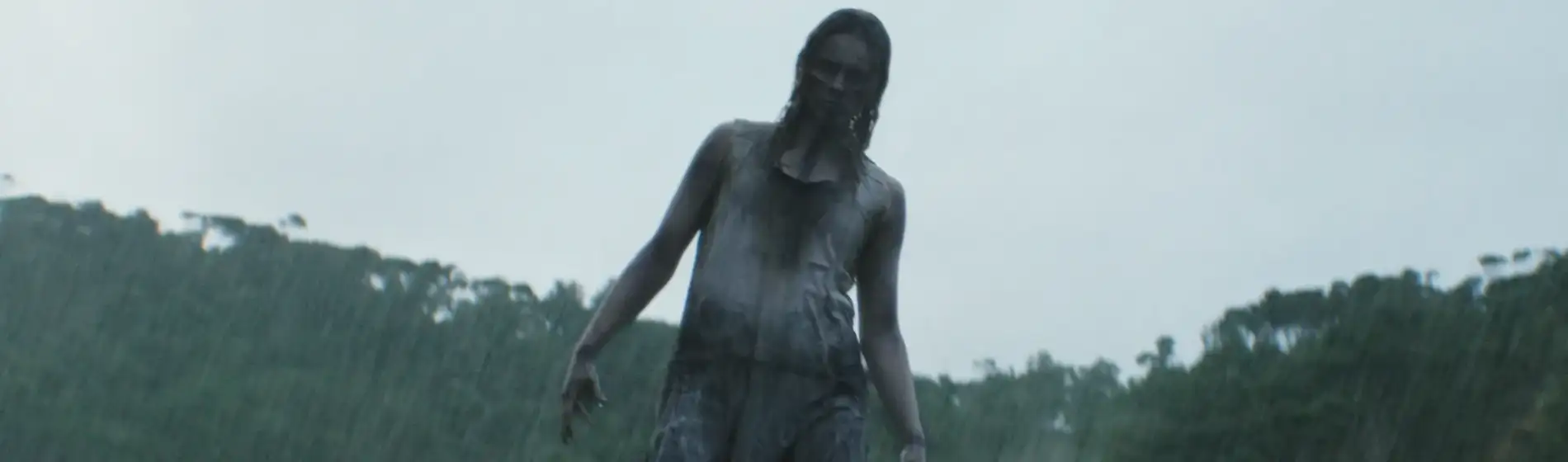
When the Deadites make their inevitable entrance, Alice’s survival will depend purely on her guile, wits, and willingness to use gas-powered farming equipment. But well before then, long-held grudges, grievances, and resentments threaten to fracture the Price family into a hundred million pieces. In short, they’re ripe for a full-blown takeover by an external demonic threat. A deeply uncomfortable dinner emphasizes not just Alice’s outsider status, but also the site for the family’s blame-shifting grief. To differing degrees, Edgar and Susan hold Alice responsible for William’s death: a borderline physical argument led to William’s abrupt departure from a nightclub. Joseph, the family’s second, lesser son, doesn’t escape blame either: The weak-willed, milquetoast Joseph could have stopped an intoxicated William from driving away in his sports car, but didn’t.
All that, of course, serves as prelude, background, and set-up for everything to come: Once the Deadites appear, gut-churning chaos follows. As one family member after another falls to demonic possession, bodies, possessed and otherwise, get skewered, smashed, and broken in increasingly gruesome, graphic, gnarly ways. It’s a testament, if nothing else, to the next-level practical/make-up effects team and their contributions to the memorably bloody, gory results. Individually and collectively, the practical/make-up team deserves every accolade that comes their way for the impressively realized, ultra-realistic violence that fills every corner of the screen for the remainder of Evil Dead Burn’s running time.
All the high-end, cringe- and wince-inducing practical effects, however, can’t hide an otherwise underwritten narrative, superficially drawn characters, including the traumatized-with-a-capital-“T” protagonist, or the thinly developed thematic material surrounding the Deadite-centred set pieces. Even the grim, black humour that punctuated the last, far superior entry, Evil Dead Rise , rarely appears here, inevitably leading to an inescapable sense that VaniÄek doesn’t just want to gleefully torture his characters; he wants to punish the audience on the other side of the screen, too. It worked for VaniÄek’s predecessors and influences in the New French Extremity movement, but it doesn’t fully work here. While Evil Dead Burn undoubtedly highlights VaniÄek’s technical proficiency as a filmmaker, it also makes for a downbeat, ultimately acrid experience.
Evil Dead Burn opens theatrically on Friday, July 10, via Warner Bros. Pictures.