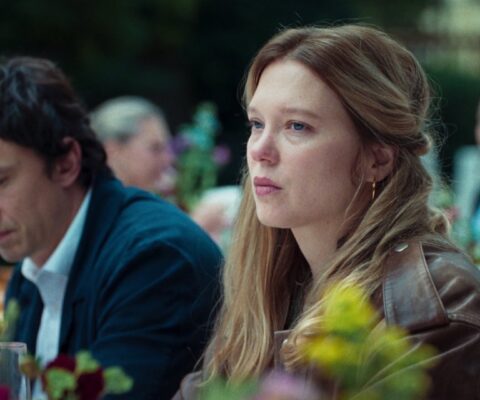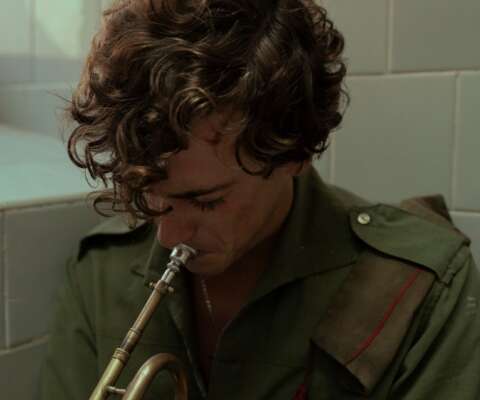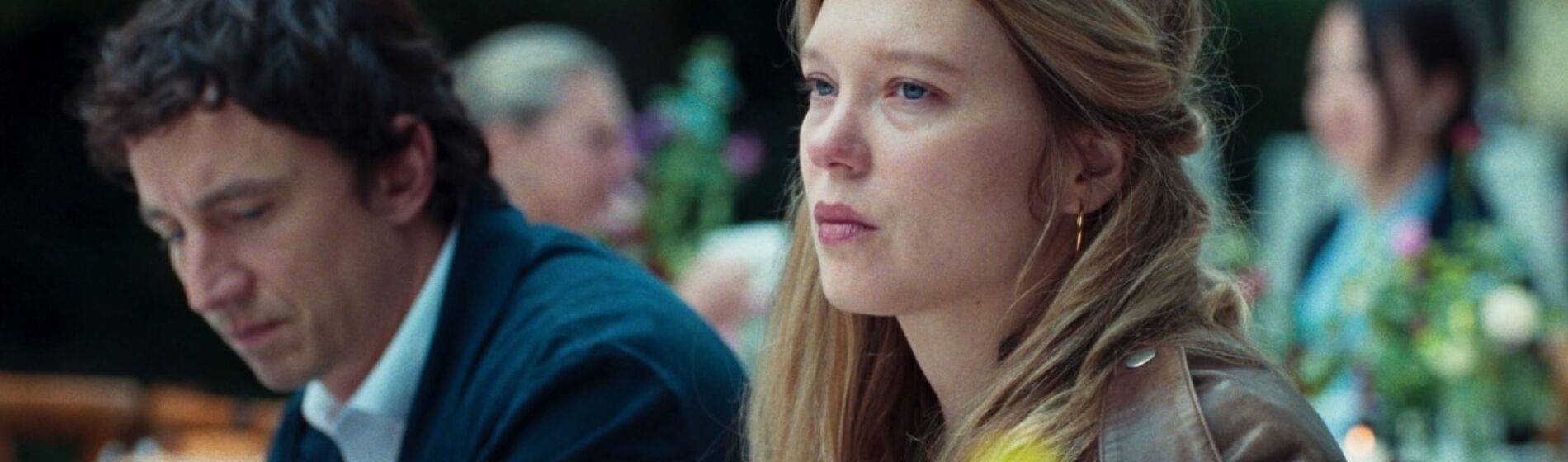



What if your partner was accused of an act so heinous that your life as you knew it changed in an instant? The kind of implosion where, even if you tried to glue the pieces back together, the fault lines would always show.
Writer-director Marie Kreutzer (Corsage) is in no hurry to reveal the monster at the centre of her difficult drama, introducing married couple Lucy (Léa Seydoux, Dune: Part Two, Inglourious Basterds) and Philip (Laurence Rupp) as they settle into an unsteady rhythm at their new house in the German countryside with young son Johnny (Malo Blanchet). We get hints that their move from the city wasn’t just for the pastoral views. It’s a chance for a fresh start after a rough patch and Philip’s struggle with burnout.
They’re both artists, or at least pursuing artistic paths. Lucy sings and plays the piano with puckish precision, performing her deconstructed takes on pop songs; Philip wields a camera without much to show for it on the other end. He arrives home one day hyperventilating, soon crashing on their bed—clearly burnout isn’t totally behind him. Lucy’s left explaining to his mother Inge (Regina Fritsch) that they won’t be visiting as planned. Your problems don’t care if you have a new address.
Can you ever really know someone?
In keeping with the purposeful pacing—the movie’s title only appears onscreen at minute 13—even when police show up with a search warrant for Philip’s computer and cell phone, the sense of dread announces itself slowly. Philip looks panicked but not entirely shocked, and Lucy, just waking up, tries to figure out what’s going on. She even darkly jokes that maybe his crime was hacking into a bank. If only.
Everyone moves with wariness and restraint. No big emotions, screaming for answers, or demanding to understand what exactly they’re hoping to find. Philip calls his lawyer friend and voluntarily goes to the station. And just like that, nothing will ever be the same.
It isn’t until Lucy visits the station herself that she fully understands the sickening nature of the accusations. Visibly distressed, she tries to get details from lead officer Elsa Kühn (Jella Haase), a young woman who presides over cases of possession and distribution of child sexual material with a detached nature, and who’s navigating sexual boundaries on a different spectrum while managing at-home care for her father with dementia.
Intuitive, fearless performance
Lucy’s sense of fear and betrayal are heartbreaking, and Seydoux turns her entire body into a raw nerve. Not as a sign of fragility, but of overexposure; there’s nowhere to hide. This film demands an intuitive, unselfconscious performer, and Seydoux is fearless as a woman whose life is unravelling in real time. She can only react with half-truths to guide her, grasping for a lifeline in unsteady waters.
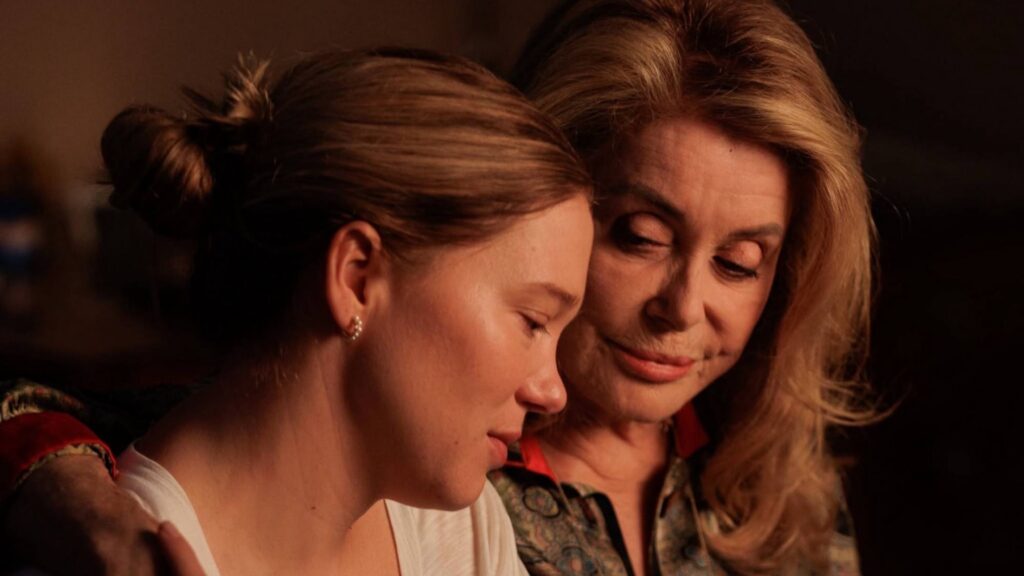
It slowly sinks in that maybe she doesn’t really know what her husband was doing on his laptop at night. Or when he was hiding out in the bedroom of his parents’ idyllic mountainside house, claiming to be working. When she spies him smoking from the police station window and remarks that he quit two years ago after hypnosis, the small lie suggests bigger secrets. She instantly jumps into protection mode, retreating to her mother’s place (played by screen legend Catherine Deneuve) with her son in tow.
No easy answers
Gentle Monster resists easy answers, and you can almost see the tension rising off Lucy’s pores like steam as she tries to discern what’s true. Then, there’s also the immense shame of what her husband may have done. This is the man she’s chosen to have a life and a child with, after all. And given her lineage as the daughter of a classical pianist mother who seems to have little respect for a conventional life, Lucy’s also dealing with the guilt of choosing the predictable path that somehow still got her here.
There’s no one way to navigate this nightmarish situation, and Lucy uses music as an outlet. She pours her anxiety and panic into a gonzo performance in Berlin. An exorcism of emotion at the piano leaves her breathless and maybe able to face another day. This is also the same sold-out concert that Philip more or less dismissed when she first told him she’d heard the news days before, now a lifetime ago. When we flash back to a couples’ therapy session, we hear his frustration that she doesn’t take his job seriously. That she convinced him to move out of the city and now he’s unhappy as a stay-at-home dad. A previous remark that this type of sexual perversion is often about powerlessness suddenly feels very on the nose without at all excusing it.
Meta narrative
The film also comes with a degree of real-world baggage and controversy. Florian Teichtmeister, an actor in Kreutzer’s 2022 movie Corsage, was at the centre of rumours before the movie premiered and was ultimately charged with possession of child pornography in 2023. While he first denied any wrongdoing and claimed it was an act of revenge by an ex, he eventually pleaded guilty and was sentenced to prison. Kreutzer released a statement in 2023, saying she was “sad and angry that a feminist film that more than 300 people from all over Europe worked on for years may be tarnished and damaged by the horrific actions of one person.” The movie remained Austria’s Oscar entry that year, though it didn’t get nominated.
It’s clear that culpability, and even guilt in a court of law, doesn’t make the truth any easier to confront. And even though Kreutzer said she was inspired to make this film after reading a German news article on the subject, it’s hard to imagine that the previous scandal didn’t seep in. How to reconcile experiences, both personal and professional, with a person who could do something like this? Were there signs you ignored, people you didn’t listen to, or is this an inexplicable crime like so many others?
When the truth is too painful
We’re rarely in Philip’s POV for long, which makes it easier to keep us guessing whether this is a misunderstanding or the worst is true. And what forgiveness would look like if it were. Lucy eventually tells Philip’s mom about the accusations when they’re both smoking side-by-side, wading in ankle-deep water by the lake. Inge is befuddled, though not horrified. She assumes that Lucy would have noticed something if it were true and ultimately sees her role as protecting her son.
This is a feeling that Lucy knows in her bones. Johnny’s safety is paramount. She submits him to gentle questioning by Kühn and a psychologist to explore if he’s one of Philip’s victims, an unthinkable transgression for any parent to consider. He shows no signs of trauma, but what’s the truth anymore?
There is no tidy ending when it comes to a crime drama involving children, and it’s a difficult film to watch, doubly so as a parent. It explores what we can accept, tolerate, or deny for family, for love, and how that line is not only different for every person; it’s a movable object even for those in the eye of the storm. But pretending that these sorts of things only happen at the hands of obvious predators, instead of “nice people” too, is simply not the way the world works.
Gentle Monster is now streaming on Netflix.